

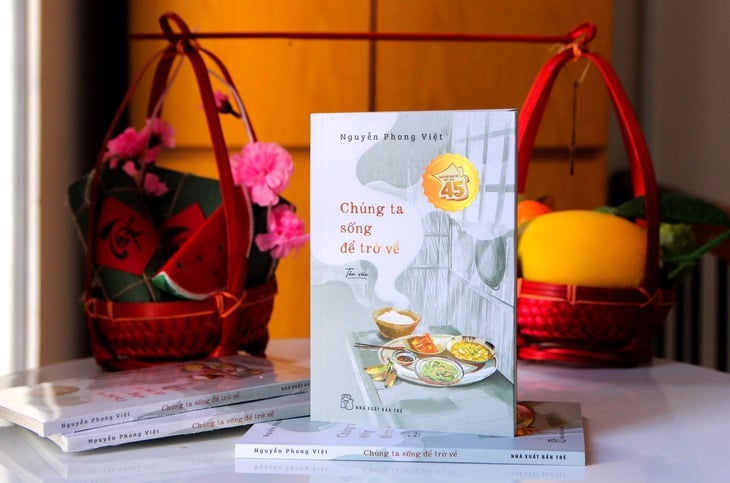
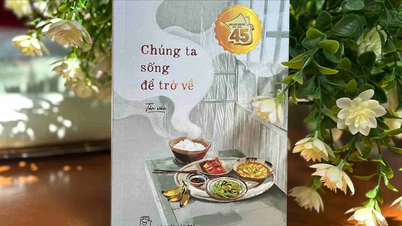
Book cover of "We Live to Return" by author Nguyen Phong Viet, published by Tre Publishing House - Photo: FBNV
Following his two books, "We Live to Listen" and " We Live to Move Forward ," author Nguyen Phong Viet continues to introduce readers to "We Live to Return ," a book where people reflect on themselves after years of ups and downs.
The journey of going and returning
In the midst of modern life's constant changes, the story of leaving seems to have become commonplace. Young people leave their hometowns to study and work, while adults embark on new journeys filled with ambition and pressure. "We Live to Return" raises a simple thought: no matter how far we travel, we always need a place to return to.
Images like trays of traditional New Year's sweets, mothers meticulously preparing the offering tray for New Year's Eve, their hands trembling with age… are not only family memories, but also symbols of time and change.
From homemade jams to store-bought candies, the author evokes the transformation of modern life – where convenience may replace effort, but not easily replace emotion.
Alongside this is the feeling of waiting and promises. The author writes: "In each of us, there is someone waiting at the end of the wind and clouds. It could be a wife waiting for her husband, a mother waiting for her child, a child waiting for their father's footsteps. There are promises of return by the end of the year, promises that will take two or three years, and promises that last for more than a decade."
These lines of text remind us that behind every journey, a light still shines, a person still holds onto hope. Therefore, returning home is not only a need for those who leave, but also a longing for those who remain.
In another passage, the book touches upon a very ordinary desire: "One day I realized I wanted to live a normal life / I wanted to be held by my mother's hand again, walking down the road from our house to the market / I wanted to wear the sweater my mother knitted, regardless of what people thought it was old-fashioned / I wanted the stone bench in front of our house to still have its usual empty seat / with no one missing...".
In terms of form, the 192-page work retains the structure of short passages interwoven with poetry and reflection, creating the unique style of author Nguyen Phong Viet. The slow pace and rich narrative make it accessible to the reader, while also providing moments of quiet reflection.
Source: https://tuoitre.vn/chung-ta-song-de-tro-ve-20260214122752395.htm











































































Comment (0)