

As the textbook revision cycle for the 2018 general education program concludes, shortcomings are gradually becoming apparent… In reality, the curriculum and textbooks not only force students to make changes midway through their studies but also cause imbalances in career choices when they enter university.
Lesson 1: Carving a plow in the middle of the road
According to the 2018 General Education Program, students can register for subject combinations that match their abilities, aptitudes, and career aspirations, but in reality, the right to rearrange these depends on the specific teaching staff and facilities of each school.
Parents are flustered.
Starting from the 2022-2023 school year, high school students will follow the 2018 General Education Program. Students are required to study four compulsory subjects: Mathematics, Literature, Foreign Language, and History. The remaining subjects are chosen according to subject combinations that align with future career aspirations. Students select four out of nine subjects. However, the subject groups are determined by individual schools based on two factors: the available teaching staff and the university admission combinations.
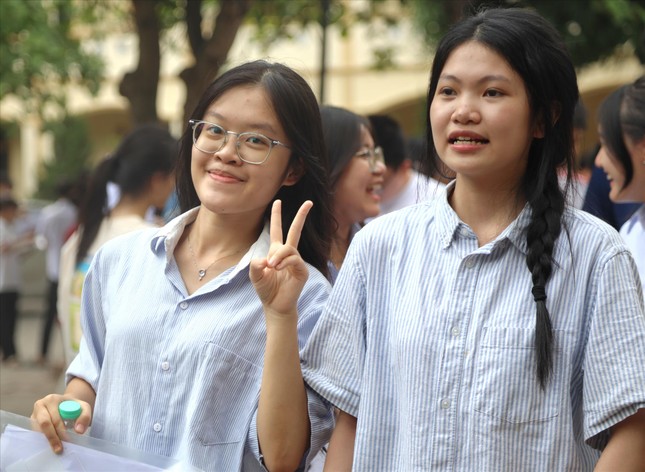
The last high school graduation exam candidates of the 2006 education program. Photo: NGOC TU
After students are admitted, the school will provide a pre-designed "menu" for registration. But this is only a necessary condition. Ms. Tran Thi Thanh from Hai Ba Trung district said that her child was admitted to a high school in Hoang Mai district for the 2024-2025 school year. When choosing classes, although the school provided a "menu" of subject combinations for parents and students to choose from, it also included a message that the selection and career orientation would be based on the student's exam scores. For example, students with top exam scores would be placed in science classes. The remaining students would be in social science classes or science classes 3, 4, etc.
Observations from high schools nationwide show that, when implementing the 2018 General Education Program, the general approach was to base teaching plans and subject combinations on the existing teaching staff and facilities of each school. Some subjects, although included in the curriculum and in demand by students, were not offered in all schools, such as specialized subjects like Fine Arts and Music.
According to the 2018 General Education Program, transferring high school students also presents many difficulties: There are three sets of textbooks in one program, and schools have different choices. Each class has different elective subjects, optional subjects, and specialized subject clusters. If many students transfer and choose different optional subjects, it becomes difficult to assign teachers to support them with tutoring and organize assessments. Finally, class placement for students becomes more difficult and time-consuming.
In the first academic year of implementing the new textbooks for high school students under the 2018 General Education Program (2022-2023), parents and schools were confused and bewildered when it came to transferring and admitting students. One parent in Hanoi found themselves in an ironic situation. They wanted to transfer their child to another school after the first semester, but the school their child was attending was one of the few in Hanoi that offered both Art and Music as elective subjects.
The design of the elective subjects in the school's subject combinations is already "fixed," so students cannot choose individual subjects. Ironically, every combination designed by the school includes two subjects: Art and Music. Whether they like it or not, students must take all four elective subjects as designed by the school. Therefore, when transferring to a school that doesn't offer Art and Music, students will have to replace them with two other subjects.
At that time, the Ministry of Education and Training had not yet issued guidelines, causing confusion among parents. It could be argued that the high school's design was designed to make things difficult for parents in order to retain students. Subsequently, the Ministry of Education and Training had to issue guidelines stating that if the transferring school matched the student's chosen subject combination, the transfer could be made after the end of the first semester. However, if the subject combination did not match, the transfer could only be made after the end of the school year. To date, the aforementioned high school no longer forces parents into a dilemma by including two subjects "exclusive to the school" in all chosen subject combinations.
According to feedback from high school leaders, the most difficult aspect of transferring schools is when students are taking elective subjects and specialized courses at their transferring school that do not coincide with those at their receiving school. The receiving school needs to have a plan and appropriate solutions to support students in supplementing their knowledge and skills in the new subjects so that they are competent enough to continue learning the new subjects in the next grade.
Students couldn't turn around in time.
Experts believe that, fundamentally, 10th-grade students lack career guidance information. Some parents and students are also unaware of the importance of subject selection, often choosing subjects that are easy to learn and easy to score high marks on the graduation exam. Changes in university admissions, and the emergence of multiple entrance exams such as aptitude tests and cognitive assessment tests, have confused schools and students alike.
According to Mr. Nguyen Quang Tung, Principal of Lomonosov High School (Hanoi), in 2025, the school will have 350 students taking the high school graduation exam. According to regulations, students are required to take two subjects: Literature and Mathematics. The remaining elective subjects chosen by the 12th-grade students are as follows: Physics (145 students), Chemistry (39 students), Biology (only 9 students), History (97 students), Geography (90 students), Economics and Law Education (73 students), and English (a strong subject for the school, chosen by 337 students). To increase their chances of university admission, approximately 120 students from Lomonosov High School are expected to register for the 2025 aptitude test of Hanoi National University. Over 60 students are also expected to participate in the Hanoi University of Science and Technology's thinking skills assessment exam.
However, Mr. Tung stated that out of the school's 350 students, 62 did not choose any subjects that overlapped with those related to the National University of Hanoi's aptitude test, because these students registered for elective subjects three years ago (when they entered 10th grade). Recently, the National University of Hanoi announced adjustments to the aptitude test according to the 2018 general education program.
Every year, Mr. Tung has to review the choices of about 15 students who have chosen the wrong subjects. The Ministry of Education and Training has issued guidelines, but students face real difficulties when they are a semester or a year behind their peers. Therefore, Mr. Tung hopes that the Ministry of Education and Training will stabilize the admissions plan and announce it early. University admissions plans need to be stable and available early so that students can orient themselves towards their careers. "High schools have career guidance for students, but there is too little time. I hope that teachers at the junior high school level will provide in-depth guidance from grade 9 so that students can choose the right subjects in high school, without making mistakes or being caught off guard," Mr. Tung said.
Ms. Nguyen Thi Nhiep, Principal of Chu Van An High School (Hanoi), shared that the school offers six elective subjects for 10th-grade students. After three years of implementing the 2018 General Education Program, she noticed that some students planning to study abroad after graduating from high school had their applications rejected by foreign universities because they did not study Physics and Chemistry. According to Ms. Nhiep, for 11th-grade students who did not choose these two subjects but now wish to adjust their choices, the school provides remedial instruction covering the 10th-grade curriculum and organizes supplementary tests to help them meet the requirements.
Teacher Nguyen Quang Tung believes that choosing subjects from grade 10, while the university admission process changes every year, will make things difficult for students. Furthermore, some students only discover they chose the "wrong subjects" after a year of schooling and request to switch to a different subject combination.
Source: https://danviet.vn/chuong-trinh-giao-duc-pho-thong-2018-vua-hoc-vua-xoay-20241212065714931.htm

![[Photo] General Secretary and President To Lam meets with National Assembly delegates from ethnic minorities.](https://vphoto.vietnam.vn/thumb/1200x675/vietnam/resource/IMAGE/2026/04/20/1776696701056_a1-bnd-8331-3342-jpg.webp)



![[Image] National Assembly discusses the implementation of the socio-economic development plan.](https://vphoto.vietnam.vn/thumb/1200x675/vietnam/resource/IMAGE/2026/04/20/1776696707422_ndo_br_img-20260420-185419-jpg.webp)





























































Comment (0)