

At the end of a 90-minute phone call on May 27, President Joe Biden and House Speaker Kevin McCarthy reached a preliminary agreement on raising the debt ceiling.
Now, both Democratic and Republican representatives will have to convince their allies in both the Senate and the House of Representatives to pass the agreement before June 5th, the date on which Treasury Secretary Janet Yellen warned that the U.S. would default on its bills.
Ending the deadlock
If the final agreement is passed by Congress and signed into law by Mr. Biden before date X (the date the US is expected to default on its debt, i.e., June 5th), then the US will avoid an unprecedented economic crisis.
The prolonged deadlock has spooked financial markets, weighed on stocks, and forced the U.S. to pay record-high interest rates in several bond sell-offs. Economists argue that a U.S. default would plunge the nation into recession, shake the global economy, and lead to a surge in unemployment.
President Biden had refused to negotiate with McCarthy on spending cuts for months, and demanded that lawmakers pass an increase in the debt ceiling without conditions. Bilateral negotiations between Biden and McCarthy began on May 9th, but truly became serious on May 16th.
Although an agreement in principle has been reached, raising the debt ceiling will still take time. McCarthy has stated that he will give House members 72 hours to read the bill before it is put to a vote. The bill needs at least nine Republican votes to pass in the Senate.

The US Treasury Secretary warned on May 26 that the US would default on its debt by June 5 if it did not act quickly. (Image: theitem.com)
“We still have a lot of work to do, but I believe this is an agreement in principle that the American people deserve,” McCarthy told reporters at the Capitol on May 27. The Republican leader said he expected to finish writing the bill by May 28, then speak with Biden again that same day and arrange a vote on May 31.
A Democratic aide said the White House plans to hold a press conference with Democrats on May 28, CNN reported.
Although an agreement in principle has been reached, new issues may still arise during implementation, and each step takes considerable time. Furthermore, observers anticipate strong opposition from both the left and the right. Therefore, active support from both sides is needed to truly find common ground.
The final hurdle
The agreement in principle would raise the current debt ceiling of $31.4 trillion over two years, while limiting non-defense spending to its current level in fiscal year 2024, and then increasing it by 1% in fiscal year 2025.
The White House also appears to have conceded to Republican negotiators in the House of Representatives on job requirements for food stamp recipients.
Additionally, the agreement also sets new requirements for some recipients of government aid, including food stamps and temporary assistance programs for impoverished families. The food assistance program for those 54 and under without children will end in 2030, expanding access for veterans and the homeless.
Current requirements for the Supplemental Nutrition Assistance Program (SNAP) will only apply to certain individuals aged 18-49.
The agreement is also expected to recover unused funds from the previous pandemic relief bill and reduce $10 billion (from $80 billion to $70 billion) in new implementation funding for the Inflation Reduction Act aimed at controlling tax fraud.
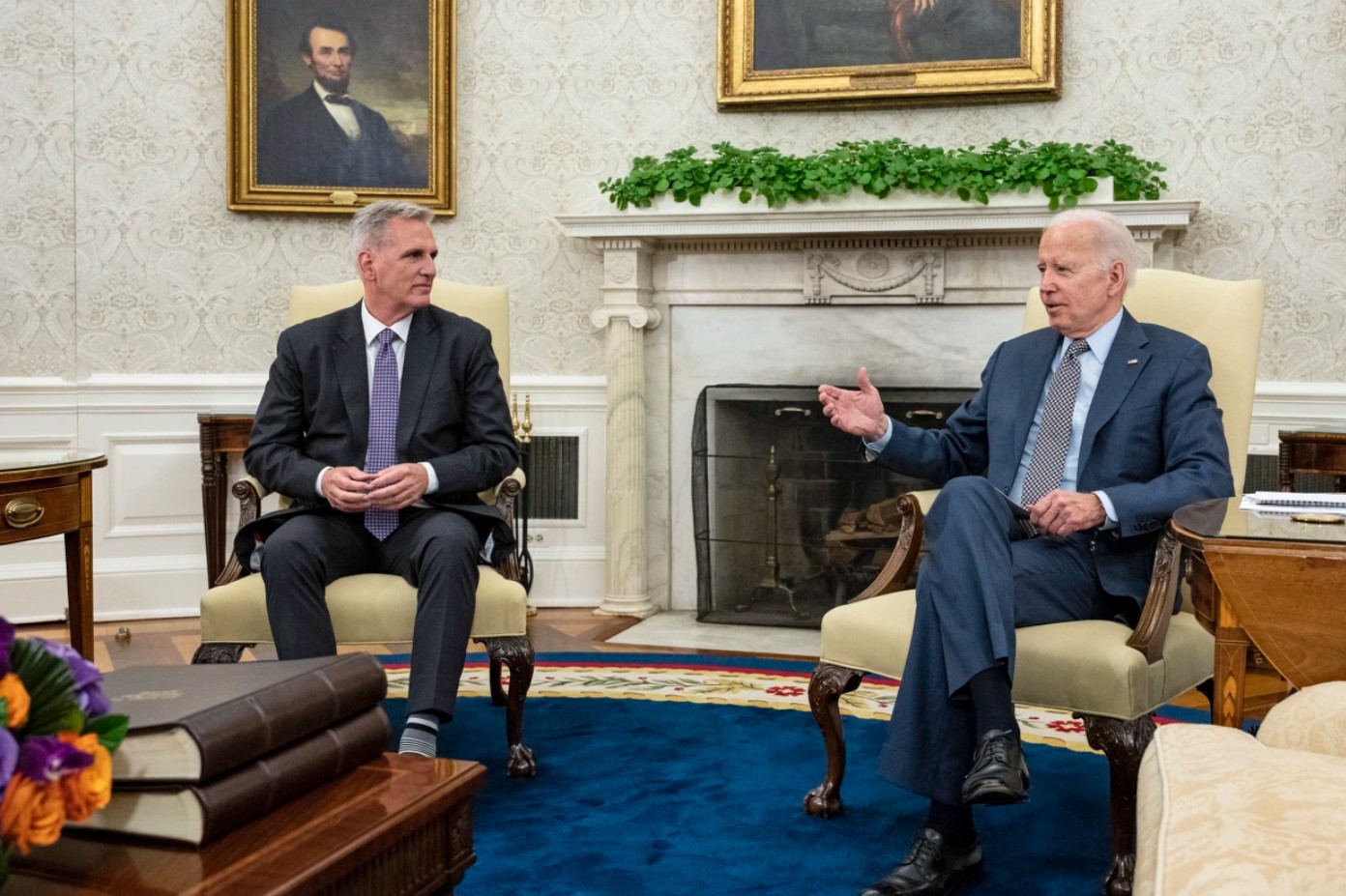
It wasn't until May 16th that President Joe Biden and House Speaker Kevin McCarthy officially began serious negotiations on the debt ceiling, after the Treasury Department repeatedly warned of the risk of a federal government default in June. (Photo: NBC News)
According to CNN, new requirements for some social safety net programs remain the final sticking point.
Republicans argue that those who receive programs like food assistance and those without dependents should be forced to abide by the new rules. However, Democrats have viewed this idea as an attack on the poor.
For months, Republicans had been adamantly opposed to raising the debt ceiling unless Biden agreed to spending cuts. The final agreement accomplished their goal, but only modestly.
An analysis by the New York Times of the spending limits in this agreement shows that the U.S. Congress would only cut federal spending by about $650 billion. These cuts are certainly too little to win the votes of conservatives in the House of Representatives.
McCarthy has repeatedly expressed confidence that a majority of Republicans will vote for the deal, but it remains unclear how many Republicans actually support it, and how many Democratic votes are needed to offset the Republican opposition .
Nguyen Tuyet (Based on NY Times, CNN, Reuters, Bloomberg)
Source
![[Image] Hanoi's urban life under the challenge of a "scorching hot" environment](https://vphoto.vietnam.vn/thumb/1200x675/vietnam/resource/IMAGE/2026/05/25/1779706979265_nang-nong-t5-2026-minh-duy-7-4636-jpg.webp)



![[Image] Close-up view of the interchange connecting the two expressways and Long Thanh Airport.](https://vphoto.vietnam.vn/thumb/1200x675/vietnam/resource/IMAGE/2026/05/25/1779703378210_ndo_br_z7863716673926-224453a31600126cce10622af6290afd-4549-jpg.webp)





























































































Comment (0)