

Factories are cutting jobs, limiting hiring, and the cost of living in the city is rising, so many workers are returning home to seek opportunities.
Since the beginning of this year, LR Vietnam Co., Ltd. in Linh Trung 1 Export Processing Zone (Thu Duc City), a shoe manufacturing company, has only been operating three days a week due to a lack of orders. Workers are left with less work, resulting in reduced income. After much deliberation, Ms. Tran Thi Cam Linh decided to quit her job and return to her hometown to work on the farm with her family.
Nearly 10 years ago, Ms. Linh left Dinh Quan ( Dong Nai province ) to work in the city with an acquaintance. There she met her husband, also a factory worker in the export processing zone. After many years working at the factory, their basic salaries gradually increased. If the company had stable production and overtime, their combined monthly income would exceed 20 million VND. However, after deducting rent, food, and the cost of raising one child in the city and two children in their hometown, they still had little left over.
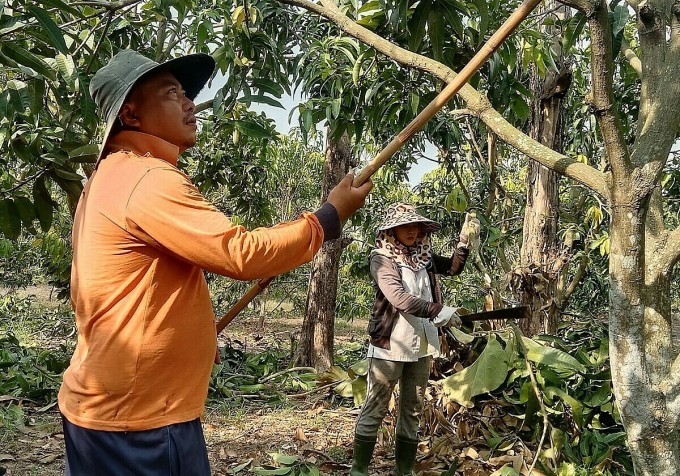
Linh and her husband tend to their mango orchard in Định Quán. Photo: An Phương
The 29-year-old mother said that after going through many difficult times, such as the city's COVID-19 outbreak, she and her husband began to think about returning home. Especially now that their two children are entering adolescence and need their mother's presence. They own three acres of farmland, equivalent to 30,000 square meters, so they are planning to return to their hometown to engage in agriculture .
Early last year, her husband quit his job to return home and take care of the mango orchard and plant more durian trees. She continued working at the factory to maintain a stable income, in case her work back home became difficult. On days when the factory had reduced work, she took the opportunity to return home to work in the fields to get used to farming.
"I wasn't planning to go home right away, but the company's production situation isn't stable, so I decided to leave sooner," Linh said. Nearly four months after leaving the factory, Linh is still learning to manage her finances based on seasonal income instead of her fixed monthly salary. The mother of three says that sometimes she spends tens of millions of dong hiring workers or buying fertilizer, which "heartaches," but she has to get used to it. Before, working at the factory meant enduring the sun and rain, and working in the fields meant spending the whole day outdoors. However, in return, her family gets to be together.
Unable to afford the cost of living in the city, 40-year-old Phan Thi Kieu Trang decided to return to her hometown. Since her family doesn't own any land for farming, she continued to look for opportunities in factories.
Ms. Trang has worked for Nikkiso Vietnam Co., Ltd. in Tan Thuan Export Processing Zone (District 7) for nearly 15 years, earning almost 16 million VND per month. However, as a single mother, her salary is insufficient to cover the increasingly expensive living costs in the city. Her two daughters have no one to take them to and from school.
When the company opened a new factory in Quang Ngai , about a 30-minute motorbike ride from her hometown, Trang asked to change jobs. Her mother took over the task of taking the children to school and preparing meals daily. As for Trang, although her income decreased compared to when she lived in the city due to the difference in the regional minimum wage, the mother of two still felt satisfied because it reduced a lot of pressure.
Not only Ms. Trang, but since the beginning of the year, more than 10 Nikkiso workers have applied to transfer to the factory in Quang Ngai. Ms. Nguyen Thi Phat, Chairwoman of the company's Trade Union, said the new factory is currently in the trial operation phase and will officially start operating in June. The company is preparing its workforce and has many policies to attract workers. Experienced workers returning from the city will certainly have opportunities for advancement.
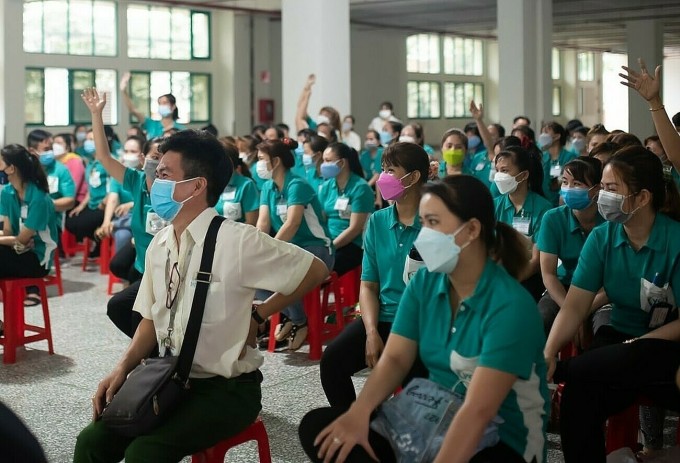
After laying off more than 3,000 workers in Ho Chi Minh City at the end of last year, Ty Hung Co., Ltd. announced that it will rehire workers at its two factories located in Ben Tre and Dong Thap provinces. Photo: An Phuong
Leaving the city to return to their hometowns in search of opportunities is not just the story of Ms. Trang and Ms. Linh. A survey of over 1,000 workers in Ho Chi Minh City, Binh Duong, and Dong Nai conducted by the Ho Chi Minh City branch of the Vietnam Chamber of Commerce and Industry (VCCI) and the International Organization for Migration (IOM) showed that 15.5% chose to return to their hometowns in the near future, 44.6% were undecided, and 39.9% had no plans yet.
According to the survey, the biggest reason for workers returning to their hometowns is to be closer to family, as income from working in the city is insufficient to cover living expenses. Considering their circumstances, older workers and those with children to care for by their grandparents are even more eager to return home.
Another reason is that job opportunities in rural areas have improved due to policies expanding industrial zones across provinces, rather than concentrating them in a few major cities as before. Rising land and labor costs in Ho Chi Minh City and some areas of Dong Nai and Binh Duong have led businesses to relocate factories to these localities for lower costs, resulting in a large influx of returning workers.
Associate Professor Dr. Nguyen Duc Loc, from the Institute for Social Life Research, said that those returning to their hometowns fall into two groups: young people who return home will continue working in factories near their homes, while older workers return to agriculture.
In the short term, this trend may intensify due to the increasingly limited job opportunities in industrial hubs and major cities. A survey by the Ho Chi Minh City Department of Labor, War Invalids and Social Affairs on labor demand from nearly 4,000 businesses in the first quarter showed that, compared to the end of last year, nearly 31% reduced their workforce, over 50% remained unchanged with no new hires, and about 19% increased their workforce. The group that reduced its workforce mainly operates in the footwear, textile, construction, and food processing sectors.

The job recruitment event, organized by the Dong Thap Employment Service Center for returning migrant workers, took place earlier this year. Photo: An Phuong
Mr. Ngo Xuan Lieu, Director of the National Employment Service Center, said that the current unemployment benefit payment policy is quite flexible, giving workers more opportunities when they return home. For example, workers who lost their jobs in Ho Chi Minh City, Binh Duong, and Dong Nai can transfer their benefits to their home province and be referred to suitable jobs in their place of residence by the centers.
Le Tuyet
Source link





![[Image] Close-up view of the 10-lane road connecting to Long Thanh Airport](https://vphoto.vietnam.vn/thumb/1200x675/vietnam/resource/IMAGE/2026/04/04/1775291871988_ndo_br_1-resize-5690-jpg.webp)




























































































Comment (0)