

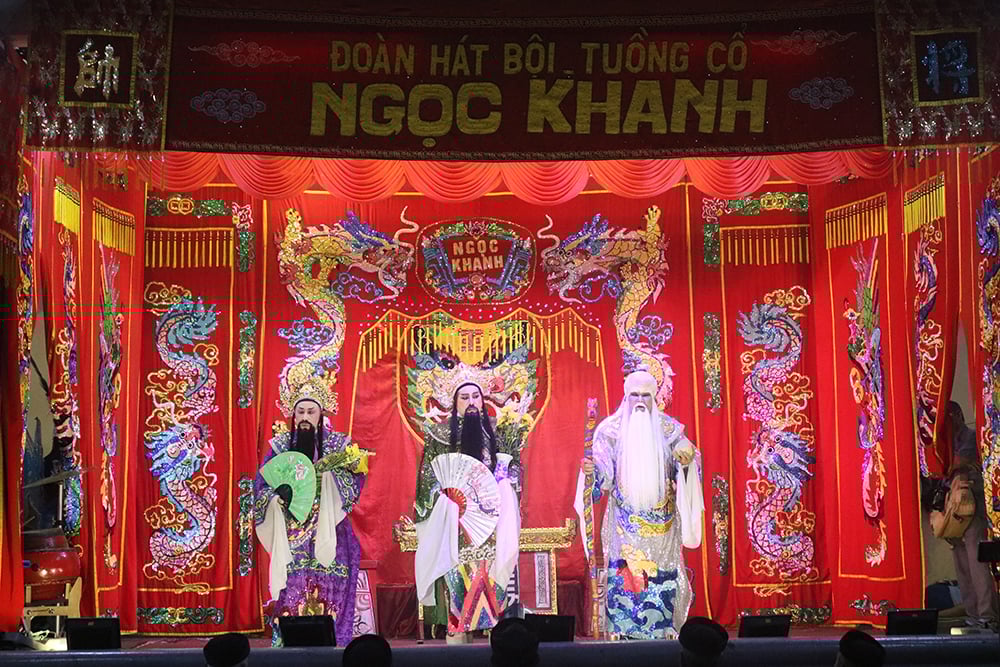
I entered the performance hall of the Lady of Sam Mountain temple as night began to fall. This was the time when the artists of the Ngoc Khanh Traditional Opera Troupe ( Dong Nai province) were putting on their makeup and preparing for their 3 AM performance. Before completing their costumes and makeup for the characters of generals, beauties, sycophants, servants, etc., they were just ordinary people in society, earning a living through various occupations. "Food and clothing are no joke for poets," so they patched up their daily lives, accumulating little by little for their passion for this special art form they loved.
At 52 years old, with 34 years of experience, leading actress Kim Hien (from Ba Ria - Vung Tau province) is still engrossed in the elaborate makeup and costumes of traditional Vietnamese opera. “When I was little, I loved watching opera so much that I would sneak away from my parents to see it. If I didn't have money for tickets, I would crawl through a hole in the ground, listening intently to every word the characters said on stage, memorizing the lines without even realizing it. I received systematic training from teachers, including Ms. Nguyen Thi Ngoc Khanh (the owner of the Ngoc Khanh opera troupe). At that time, I was 28 years old, but my singing voice and movements weren't yet fully refined. Ms. Ngoc Khanh guided me in paying respects to the patron saint of the profession, giving me a few symbolic lashes, and instructed me to respect elders, uphold tradition, and be willing to teach colleagues and younger generations; she wholeheartedly honed my skills and dedication to traditional opera…” – Ms. Hien recalled.
Artist Kim Hien loved her profession so much that she dedicated her whole heart and soul to it. In the days before technology and information were developed, obtaining lines for a play was very difficult. She would watch senior artists perform, ask to play the role of a soldier, listen and memorize, writing down the lines in her notebook, piecing them together into complete lines. After writing them down, she would hum and sing them until she knew them by heart. If the theater troupe was short of performers that day, she would volunteer to perform… Gradually, the profession loved her, bestowing upon her its glory. Her greatest happiness was receiving praise and encouragement from the late Professor Tran Van Khe – a towering figure in Vietnamese traditional music – with the words: “Artist Ngoc Khanh has an outstanding disciple in artist Kim Hien.”
Away from the stage, she is a devoted homemaker, caring for her children and managing the household. But in her free time, she intensely misses her profession. “Before, in the second lunar month, we performed 30 shows in a row. We'd finish one performance and then immediately move on to another, still wearing our makeup. Performing in places with martial arts troupes was certainly easier, but performing at temples and pagodas, we only had tarpaulins, and when it started to rain, the whole troupe would rush to grab their belongings and run. Sometimes, we'd sleep by the river, and the water would rise, soaking everything. It was tough, but nothing was more fulfilling than being on stage. On stage, I fully embodied the character. When I was bored at home, I'd call to ask when there would be another performance,” Ms. Hien shared.
Without a deep love for their profession, traditional opera artists would likely be unable to overcome the harsh realities of the craft and the times. Nowadays, traditional art forms are giving way to modern music, and the audience is shrinking. Many people are becoming disillusioned and expressing their disapproval. Performances are becoming less frequent. Even when there are stages to perform, audiences are dwindling. Fellow performers are disappearing one by one, their numbers dwindling to fewer than ten.
“I come from a family of performers, so I’ve been involved with traditional Vietnamese opera since I was a child. This troupe was established 35 years ago and has performed at the temple for 33 years. We live according to the Ky Yen festival, which lasts from Tet (Lunar New Year) until the end of April in the lunar calendar, and returns in October or November. Most artists have to have side jobs to make ends meet when they’re not performing. Sometimes they repair bicycles, work as nail technicians… But to step onto the stage, everything from head to toe costs at least 20 million dong, including: headwear, clothes, and cosmetics. The lead actress only gets a fee of 800,000 dong per performance. For each performance, I have to cover 25 million dong in expenses, not including transportation costs for the entire troupe of 30 people,” Ms. Ngoc Khanh calculated.
In the past, elders advised against pursuing this profession, saying that "talent runs out with age," and that the professional life only lasted until 40. But she accepted the challenge, driven solely by passion. Today, as the golden age of traditional Vietnamese opera (hat boi) is gradually fading, her descendants are still stepping into the field. Her granddaughter, Van Anh (20 years old), and grandson, Huu Khang (22 years old), are confidently asserting themselves on the stage of traditional opera. Seeing this, she feels somewhat comforted: "Hat boi is an art form rich in national identity; we could propose introducing it into schools and teaching it to the younger generation. I also hope the central government will pay attention to promoting it and preparing documentation to recognize hat boi as an intangible cultural heritage, so that it doesn't fade away."
The sky gradually brightened. The play lasted 3-5 hours, and the performers sang better and better, while the audience felt the emotions more and more deeply. Many middle-aged and elderly women, full of "experience," came to watch the play, bringing nylon tarpaulins to spread on the ground as seating for 2-3 people, with a basket next to them containing drinks and food. Mrs. Ba Sat (65 years old, residing in Bac Lieu province) arrived at the temple at 2 a.m., her eyes still alert to every movement of the characters. "Knowing I love watching plays, the young people brought me to the temple to pay respects to the Goddess, so I could indulge myself. I've seen every play before, sometimes a dozen times, almost to the point of knowing them by heart, but I still want to see more..." she answered me hastily as the play was about to begin.
That day, actress Kim Hien played the wife of Bang Duc in the play "Quan Cong Builds a Dam to Capture Bang Duc". She portrayed a woman torn by inner conflict, desperately trying to prevent her husband from going to war, but he insisted on leaving to repay his "national debt". Therefore, the wife decided to commit suicide so that her husband could leave without any burdens. Her singing and tears blended with the colorful lights of the stage, sometimes tender, sometimes courageous and brave…
GIA KHANH
Source: https://baoangiang.com.vn/dang-sau-san-khau-hat-boi-a422352.html























































Comment (0)