

Water transport is five times cheaper than road transport.
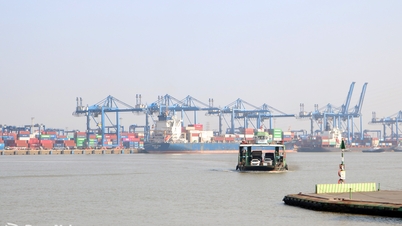
At the workshop to gather business opinions on the draft Law on Special Cities organized by the Ho Chi Minh City People's Committee on May 27th, Mr. Pham Quoc Long - Chairman of the Vietnam Association of Maritime Agents, Brokers and Services (Visaba), pointed out that one of the major bottlenecks in Ho Chi Minh City's logistics system today is the lack of waterway transportation.

Ho Chi Minh City still has great potential for developing waterway transportation.
Photo: Independent
According to Mr. Pham Quoc Long, the volume of goods handled through Ho Chi Minh City's seaport system (including the Cai Mep port cluster, formerly in Ba Ria-Vung Tau) will reach approximately 24 million TEU in 2025, ranking 8th in the world . With a cargo growth rate of 12-15% per year, it is expected that by 2030, the volume will reach approximately 34-45 million TEU. At that time, Ho Chi Minh City will rise to 4th or 5th place globally in terms of cargo volume handled through its ports. However, this figure will also create significant pressure on transportation infrastructure, requiring long-term solutions. The "key" identified is the waterway transportation system.
The Chairman of Visaba pointed out that the cost of water transport is 50-60% lower than other modes of transport. For example, the cost of transporting a 20-foot container by road from the core of Ho Chi Minh City to Cai Mep port is 4 million VND, while water transport only costs 700,000 VND - less than one-fifth of the cost by road. Furthermore, the volume of transport is also higher: one barge can carry up to 300 containers, reducing congestion, environmental pollution, and significantly lowering the cost per unit of goods compared to transporting those 300 containers by road.
Amidst sharply rising international shipping costs, the continued high cost of domestic logistics further increases pressure on businesses.
Beyond simply addressing the cost problem of logistics, Mr. Bui Van Quy, Vice Chairman of the Vietnam Port Association, assessed that the requirements for green transformation and adaptation to climate change are also creating a strong impetus for water transport. The logistics and port industry is the backbone of the economy . Logistics activities contribute significantly to a country's development, but at the same time, they have a huge impact on the environment due to their large emissions. Therefore, in the green transformation effort to help Vietnam achieve net-zero emissions by 2050, logistics and transportation must be pioneering sectors in this transformation.
"According to calculations, a truck carrying one container consumes 50 liters of fuel per 100 km. Using barges, however, allows for the transport of 30-40 containers, significantly reducing fuel consumption and emissions by approximately 70%. Furthermore, a single ship transporting large volumes of goods along the coast, replacing thousands of cars, will reduce traffic congestion and road emissions. Overall, water transport is the future, both economically and environmentally," Mr. Bui Van Quy explained.
Focusing efforts on "reviving" 1,000 km of waterways.
With its unique network of rivers, canals, and waterways, Ho Chi Minh City recognized from the early 2000s that water transport was the "key" to revitalizing its riverside urban landscape. Projects to renovate the Nhieu Loc - Thi Nghe and Tau Hu - Ben Nghe canals not only aimed at environmental improvement but also paved the way for recreating the characteristic "boats on the docks" scene of old Saigon. However, the demolition of thousands of dilapidated houses along the canals has dragged on for decades and remains incomplete. Even the cleaned sections are still not connected to the public transport network or large-scale freight transport.

Water transport will significantly help alleviate road congestion in Ho Chi Minh City.
Photo: Independent
In 2014, Ho Chi Minh City approved the Inland Waterway Network Development Plan until 2020, with a vision beyond 2020, aiming to establish container shipping routes from inland container depots (ICDs) in Truong Tho (formerly Thu Duc) to major seaports in Cat Lai and Hiep Phuoc. Simultaneously, it aimed to open up inland waterways directly connecting to the former Long An province, Tay Ninh , and the Mekong Delta region to consolidate cargo. However, this plan also failed, largely due to obstacles in dredging Ho Chi Minh City's inland waterways, preventing large cargo ships from accessing the inner city.
The Ho Chi Minh City Department of Construction acknowledges that the biggest bottleneck for waterway transport is the underdeveloped port and dock infrastructure in the city, which has not kept pace with its potential. Following the merger, Ho Chi Minh City currently has approximately 1,000 km of canals and waterways, of which 92 waterway routes (574 km) are in operation. However, only 8 routes meet planning standards (such as Thanh Da Canal, Rach Tom Canal, and Rach Giong Canal). The waterways connect inter-provincial and inner-city areas extensively, particularly with major seaports like Saigon Port, Cat Lai Port, and Hiep Phuoc Port. Although waterway transport currently accounts for over 34% of cargo volume compared to road transport, infrastructure investment in this sector has only accounted for 5.4% of total transportation capital over the past five years.
Not only Ho Chi Minh City, but other localities before the merger also heavily relied on waterways. Binh Duong relied on the Saigon River and the Dong Nai River to connect goods from industrial zones to the Cai Mep - Thi Vai seaport, but its port infrastructure was limited and loading and unloading operations were outdated. Currently, the former Ba Ria-Vung Tau area still plays a leading role with the Cai Mep - Thi Vai port cluster. More than 80% of goods passing through this port cluster are collected or unloaded via inland waterways, but connections to the core of Ho Chi Minh City or the former Binh Duong area are still primarily by road.
Overall, the city currently has very few large-scale seaports, insufficient to accommodate many mother ships simultaneously. Furthermore, multimodal connectivity, including road, rail, and waterway transport, is not yet truly seamless. Many freight transport routes are not operating efficiently due to limitations in waterways and clearance.
According to the Department of Construction, in order for Ho Chi Minh City to unlock its potential in waterway transportation, become the leading waterway transport center in the country, with a scale comparable to that of Southeast Asia and Asia, and contribute to socio-economic development and national defense and security, it must invest appropriately according to the approved plan.
In the list of key projects prioritized for investment during the period 2021-2030, with a vision to 2050, Ho Chi Minh City has added a series of projects to develop the waterway transport network, waterway infrastructure, and ports and wharves.
Initially, the city will establish two main waterway transport corridors: a North-Southeast corridor encompassing northern Tay Ninh, Binh Duong, and Dong Nai – the city center – Hiep Phuoc, Can Gio, Vung Tau, and Cai Mep-Thi Vai; and an East-West corridor encompassing southwestern Tay Ninh, southern Tay Ninh – the city center – Hiep Phuoc, Can Gio, Vung Tau, and Cai Mep-Thi Vai. Along these two corridors, four key development axes connecting to the city center will be prioritized.
From now until 2030, the city will develop infrastructure for the central area, prioritizing investment in the Nha Rong - Khanh Hoi international passenger port system and the Ben Bach Dang park passenger port. Simultaneously, it will encourage investment in and the formation of inland waterways to serve public passengers, and upgrade many important canal routes.
In the northern part of Ho Chi Minh City, at least one cargo port, one passenger port, and one inland port will be built, along with the formation of numerous inland waterway terminals. In the south, the Vung Tau international passenger port will be completed, and several international container terminals will be developed in the Can Gio - Cai Mep - Thi Vai area... Overall, in the period 2021-2030, with a vision to 2050, Ho Chi Minh City has nearly 30 key projects included in the priority investment list, including waterway transport networks, ports, wharves, and channel dredging...
Representative of the Department of Construction
Source: https://thanhnien.vn/danh-thuc-giao-thong-thuy-bao-gio-185260528211018366.htm

![[Image] Pleasant weather helps students enter the 10th grade entrance exam with confidence.](https://vphoto.vietnam.vn/thumb/1200x675/vietnam/resource/IMAGE/2026/05/29/1780034401612_ngay-1-thi-lop-10-minh-duy-8-5009-jpg.webp)

![[Photo] Ba Lang An Lighthouse - the "eye of the sea" amidst the "rock museum" of Quang Ngai province.](https://vphoto.vietnam.vn/thumb/1200x675/vietnam/resource/IMAGE/2026/05/29/1780038698840_anh-man-hinh-2026-05-29-luc-14-10-42.png)























































































Comment (0)