

Even though time pushes those memories further and further away from us today. Even though the aging of the biological body may cause the human brain to gradually become numb and forgetful. Even though the world changes, and life has its ups and downs…
Strangely enough, the more turbulent and eventful the future becomes, the more radiant the beauty of distant memories shines. Perhaps it's because these are always beautiful recollections brought back to life in the mind of the keeper. And each time they are resurrected, they are further enhanced by affection and love.
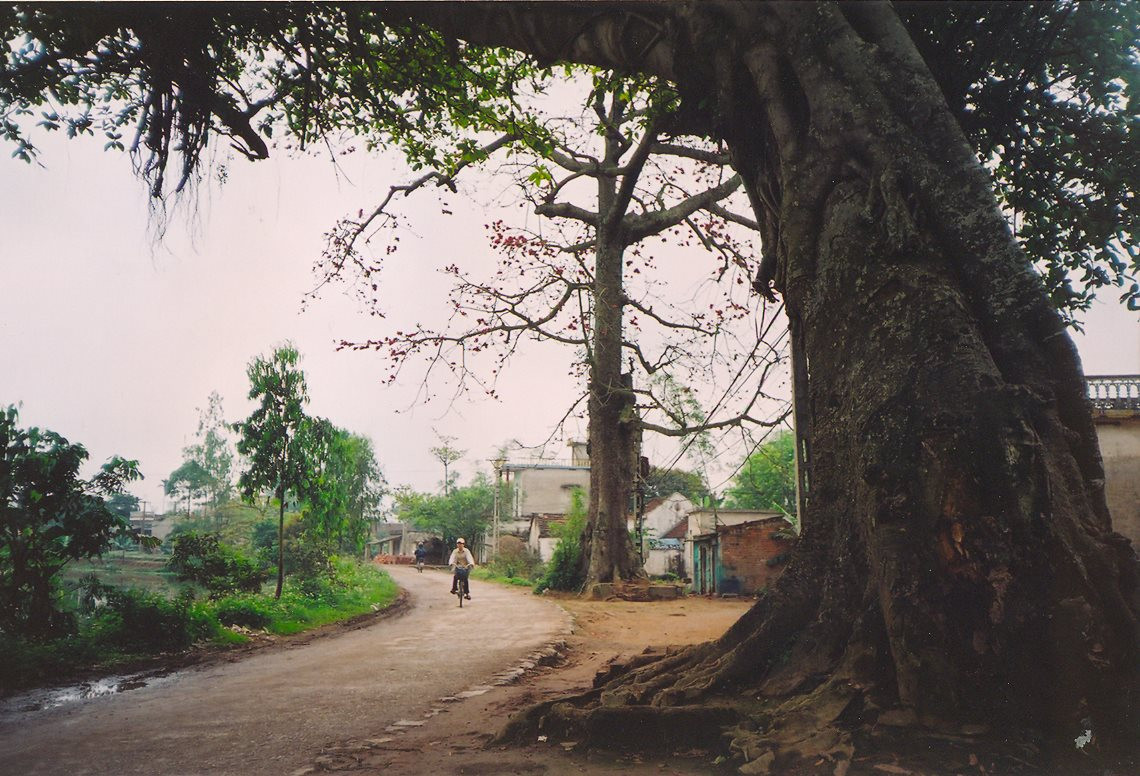
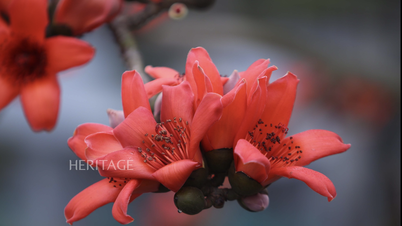
One time last autumn, not in the middle of the flowering season, I suddenly felt an intense longing for the old kapok trees in my village. The longing was tinged with sadness and regret for the two old kapok trees in the middle of the village that had become too old, diseased, and the villagers had reluctantly cut them down to alleviate the anxiety of passersby.
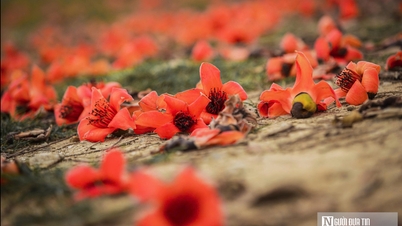
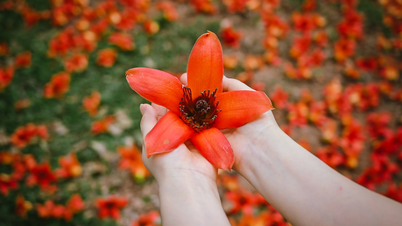
My son's name is Gạo (Rice). It's a name that holds sweet memories for me of the two rice trees in the village. Memories of childhood, playing hopscotch and jump rope by their base. Memories of picking fallen rice blossoms with my hat every March. Memories of sitting by the rice trees during harvest season, waiting for my sister's rice cart to arrive, helping her push it across the arched brick bridge. And memories of love, telling my loved one about the village, the river, the stone wharf, the bridges, and the two rice trees…
Folklore often says, "The banyan tree is guarded by a spirit, the kapok tree by a ghost." Ancient people believed that each village/region was protected by a deity, so places considered sacred had temples dedicated to the guardian spirits.
In most families, there is an altar dedicated to the local deities. Even if there isn't one, during ancestral worship ceremonies and holidays, the opening phrase in prayers to ancestors is always: "I bow before the divine spirits...". When performing groundbreaking ceremonies or moving into a new house, the first prayer is always "I respectfully bow before the local deities...", even if the specific deity is unknown. This means that deities always reside in the human consciousness. "Every land has its guardian spirit, every river has its water deity," "all things have spirits." In villages without separate temples dedicated to deities, but with communal halls dedicated to the village guardian spirits—those who contributed to the founding of the village, established settlements, or passed down traditional crafts; or temples dedicated to saints or historical figures revered as saints—the people still consider those communal halls/shrines to encompass the worship of these deities as well.
The spirit of people when visiting temples and shrines to offer prayers and sacrifices always encompasses various meanings: offering to gods, saints, and the guardian deity of the village... And in the prayers, they always invoke all the gods and saints, both named and unnamed, those in history and those not, even if the temple or shrine worships a specific historical figure, people will usually just generally say, "I bow to the saints and gods"...
But almost every village, next to the communal house dedicated to the village's guardian deity or patron saint, will have at least one banyan tree. The traditional village structure typically included a river, a communal house, a banyan tree, and a well. Besides its significance for scenery and shade, when the banyan tree grows into an ancient tree, everyone surely thinks that it is where the saints and deities reside…
And what about the kapok tree? Why the saying "the banyan tree is sacred, the kapok tree is haunted"? People are usually afraid of ghosts, so why do people plant kapok trees in villages, along riverbanks, and at boat docks? I often ponder this, perhaps it's still because of memories. Memories contain so many beautiful images, evoking many poignant recollections, and simultaneously recalling vague yet sacred things. In my family, the people I retain the fewest images of are my paternal grandparents. My grandfather passed away when I was very young, only five or six years old; my grandmother lived with my uncle and was rarely home.
But I remember my grandmother once telling me that whenever I passed a temple or pagoda, I should slow down and bow my head slightly. Since I was little, I've remembered temples and pagodas as sacred places, and I've always been cautious and apprehensive when going to them. So, without needing an explanation, I knew why I should slow down and bow my head slightly.
But my grandmother also advised that when passing a banyan tree or a kapok tree, one should gently bow their head before looking up to admire it. She said that banyan trees are the dwelling places of gods, and kapok trees are the dwelling places of wronged, wandering, and restless souls. Now I think, perhaps people plant kapok trees so that these wronged, wandering, and restless souls have a place to take refuge? People are generally afraid of ghosts, but perhaps fear should be accompanied by reverence—reverence to lessen the fear and to believe that, with respect, ghosts will not cause trouble…
When I was very young, only about two or three years old, my grandmother had a small stall selling drinks and snacks under a large kapok tree at the edge of the village. Beside that kapok tree flowed the Vinh Giang River, passing through the Second Palace and down to the Thien Truong Royal Palace, in what is now Tuc Mac, the location of the Tran Temple, dedicated to the kings and generals of the Tran dynasty. Opposite that kapok tree was the site of a vocational school from Nam Dinh during its evacuation; later, when the school moved to Loc Ha, that place became a primary school, for the kindergarten and first grade classes of our generation.
My memory only retains one instance: my grandmother took me to her tea stall. The thatched-roof hut was built on four stakes, two on the bank and two in the river. Her tea stall consisted of a small bench, on which lay a teapot and basket of green tea, jars of peanut candy, sesame candy, and some bananas; there were also a few chairs.
She sat me in the tent and gave me a peanut candy. But I remember that kapok tree very well. It's been with me ever since, throughout my childhood and into adulthood. Whenever my friends teased me, I would run to the kapok tree, bury my face in its trunk, and cry uncontrollably. At that time, I wasn't afraid of any gods or ghosts; I only saw that large tree as a support, a place to shield me from the gaze of others watching me cry. Right next to the kapok tree was a cool, shady stone landing. The kapok flowering season coincided with the late spring rains, and the roads were muddy. We used that stone landing to wash our feet, rinsing the mud off our trousers before going to class.
That day, I don't know what possessed my memory, or perhaps my mind wanted to play a slow-motion film beyond my control, but while reminiscing about the two kapok trees in the middle of the village, I was convinced that on the riverbank at the edge of the village, where my elementary school used to be, there was still a kapok tree...
In the morning, I eagerly went out to the village road and met Tha, who asked where I was going. I said, "To take pictures of the kapok tree at the beginning of the village." Tha said, "There's no kapok tree anymore. It's been a long time since they built a concrete road along the river." I was stunned and couldn't believe it. I clearly still saw the kapok tree, standing tall on a large grassy area, and the blue stone dock; that section of the river was widest but very peaceful.
I insisted I had seen the kapok tree recently. My conviction was so strong that Thà began to doubt herself. Her house was near the kapok tree. Thà claimed she passed by the edge of the village every day, that the villagers had performed a ritual to appease the tree spirit and cut it down long ago because several branches were infested with insects, signaling they might break and pose a danger to children. Yet, I remained skeptical. Thà said, "I remember that kapok tree very clearly; your grandmother used to run a tea stall under it."
Her grandfather was tall and thin, a handsome old man. That's true. Even though he's my cousin, he's three years older than me; he probably remembers that little shack better than I do. Standing at the end of his lane, he could see the whole kapok tree every day. But I still can't accept the disappearance of the kapok tree. My two kapok trees in the middle of the village are gone, and now it's the one at the edge of the village.
Instead of saying, "Sit here, I'll take you to find the kapok tree," I just stood there, gazing in amazement. The Vinh Giang river was still there, the school had been rebuilt and was much grander, no longer just a row of buildings for a few kindergarten classes like before. Now it was a large school complex including primary and secondary schools. Only my kapok tree was gone…
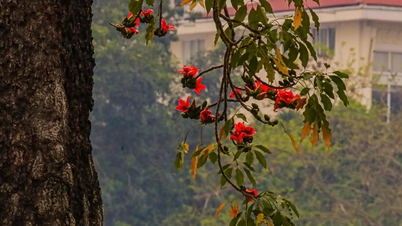
Seeing me standing there lost in thought, she said, "Let me take you to find another kapok tree, also by this river." The late autumn sun was still scorching, burning our cheeks. We walked against the sun west of the village, searching for the kapok tree at the edge of Nhat De village. It wasn't flowering season, but the tree was lush green, casting its shadow onto the river, which was almost completely dry during the dry season. That was still an extension of the Vinh Giang River.
Once a river teeming with boats, its banks lined with meticulously constructed stone jetties for mooring, it has now shrunk to the size of a mere ditch. "The world changes, valleys become hills" (poem by Nguyen Binh Khiem), "In an instant, the sea becomes a mulberry field" (Le Ngoc Han - Ai Tu Van), no wonder the rice trees in my village have aged and are no more...
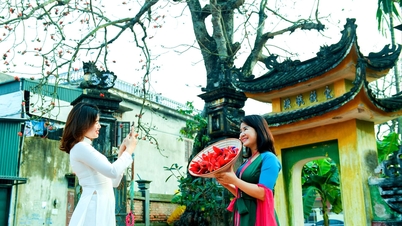
"I'd rather you take a picture of me with the kapok tree," she said. "When the kapok flowers bloom, come back, and I'll take you to find them again..."
Now that the kapok trees are in bloom, I owe you a promise. I know I still have many memories and longings for the village, the kapok trees, and the rivers…
Source
![[Photo] Prime Minister Pham Minh Chinh presides over a dialogue with Japanese businesses.](https://vphoto.vietnam.vn/thumb/1200x675/vietnam/resource/IMAGE/2026/03/21/1774097547316_ndo_br_dsc-0448-jpg.webp)









































































Comment (0)