

2026 is identified as the beginning of a new phase of development for the city. Based on a comprehensive assessment of the domestic and international context, Ho Chi Minh City has developed three growth scenarios, ranging from a baseline (8.5%-9%), a target scenario (9.5%), to a high-growth target scenario (10%).
These scenarios are closely linked to the need for breakthroughs in infrastructure, the ability to effectively absorb and implement specific mechanisms and policies, as well as the level of proactiveness and flexibility in the face of global trade fluctuations. A common point among all three scenarios is that they all identify the service sector, especially industries with high knowledge, technology, and added value content, as playing a leading role and acting as the driving force for restructuring the city's economy .
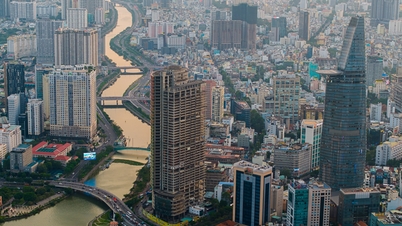
Currently, Ho Chi Minh City's Gross Regional Domestic Product (GRDP) is approximately US$120 billion, accounting for 23.5% of the national GDP; the service sector continues to play a pivotal role, contributing about 51% of the GRDP. Notably, nine key service sectors, with increasingly clear potential and competitive advantages, are asserting their leading role and becoming an important foundation for building Ho Chi Minh City into a major service center for the country and the region.
The choice of high-end services as a pillar of development is therefore well-founded, based on the city's outstanding advantages in market size, finance, logistics, international trade, specialized healthcare, high-quality education , etc., along with a high-quality workforce, a diverse business ecosystem, and increasingly deep international connectivity.
A decisive favorable condition during this period was the National Assembly's adoption of Resolution 260, amending and supplementing several articles of Resolution 98. The new policies not only expanded the scope for experimentation but also strengthened decentralization and delegation of power, while designing mechanisms attractive enough to attract strategic investors.
The establishment of the Ho Chi Minh City Free Trade Zone (FTZ) is expected to become a nucleus connecting the city with global trade, finance, and logistics flows. The FTZ is positioned as a unique institutional space, bringing together high-level trade, finance, maritime transport, and logistics services operating according to international standards.
Within that overall picture, the contents approved by the City Party Committee Conference related to investment in transportation infrastructure - such as the Thu Thiem - Long Thanh railway line and especially the sea-crossing route connecting Ho Chi Minh City (old) and Ba Ria - Vung Tau (old) - show that the city's development orientation is expanding towards strengthening regional linkages and being associated with the maritime economic space.
Once these strategic connecting axes are established, Ho Chi Minh City will have more favorable conditions to build a multimodal logistics ecosystem, directly supporting the operations of the FTZ and thereby enhancing the competitiveness of the entire service sector.
With strong determination from the beginning of the term, along with the synchronized implementation of specific mechanisms and policies according to Resolution 260, Ho Chi Minh City is facing a great opportunity to attract large economic groups, financial institutions, and strategic investors.
Large-scale capital inflows, advanced technology, and modern management practices will create a crucial impetus, helping the city's high-end, modern service industries approach regional standards. Therefore, positioning Ho Chi Minh City as a high-end service center in the region is not only a long-term goal but also opens up a concrete action plan for the city to continue its breakthroughs in this new phase of development.
Source: https://www.sggp.org.vn/dinh-vi-trung-tam-dich-vu-cao-cap-post832458.html
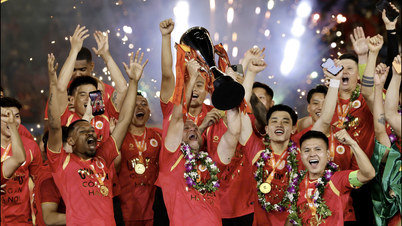
![[Image] Hanoi Police officially crowned champions of V-League 2025/2026](https://vphoto.vietnam.vn/thumb/1200x675/vietnam/resource/IMAGE/2026/05/31/1780244769054_ndo_br_039d561b692be875b13a-jpg.webp)




![[Photo] The General Secretary, President and his wife begin their state visit to the Philippines.](https://vphoto.vietnam.vn/thumb/1200x675/vietnam/resource/IMAGE/2026/05/31/1780230559452_anh-man-hinh-2026-05-31-luc-19-28-11.png)













![[Video] Sunset at Lap An Lagoon – Where the sun sets over the fishing nets](https://vphoto.vietnam.vn/thumb/340x192/vietnam/resource/IMAGE/2026/05/31/1780192137701_beach-landscape-sea-water-nature-grass-745871-pxhere-com.jpeg)
![[Photo] Admire the coral "masterpiece" amidst the million-year-old heritage of Dak Lak province.](https://vphoto.vietnam.vn/thumb/1200x675/vietnam/resource/IMAGE/2026/05/31/1780221235105_anh-man-hinh-2026-05-31-luc-16-53-27.png)
![[Photo] Solemn bathing ceremony and Buddha procession in Hue](https://vphoto.vietnam.vn/thumb/1200x675/vietnam/resource/IMAGE/2026/05/31/1780228263543_1-jpg.webp)





























































Comment (0)