

The free market US dollar surged dramatically.
At the beginning of the week, the US dollar on the free market unexpectedly surged, heading towards 25,000 VND. Subsequently, the greenback cooled down to 24,750 VND/USD – 24,830 VND/USD on December 18th. However, in this morning's trading session, the free market USD exchange rate has surged again.
In Hang Bac and Ha Trung – Hanoi 's famous "foreign exchange streets" – the USD/VND exchange rate is commonly traded at 24,850 VND/USD - 24,930 VND/USD, an increase of 100 VND/USD compared to yesterday. The difference between different shops is approximately 10 VND/USD.
It can be seen that the free market exchange rate for the US dollar is approaching the 25,000 VND/USD mark. Meanwhile, in the banking market, the USD exchange rate is erratic, rising in some places, falling in others, and remaining unchanged in some.
At Vietnam Foreign Trade Commercial Bank ( Vietcombank ), the USD/VND exchange rate is currently trading at 24,390 VND/USD – 24,730 VND/USD, an increase of 5 VND/USD in both buying and selling rates compared to the end of yesterday.
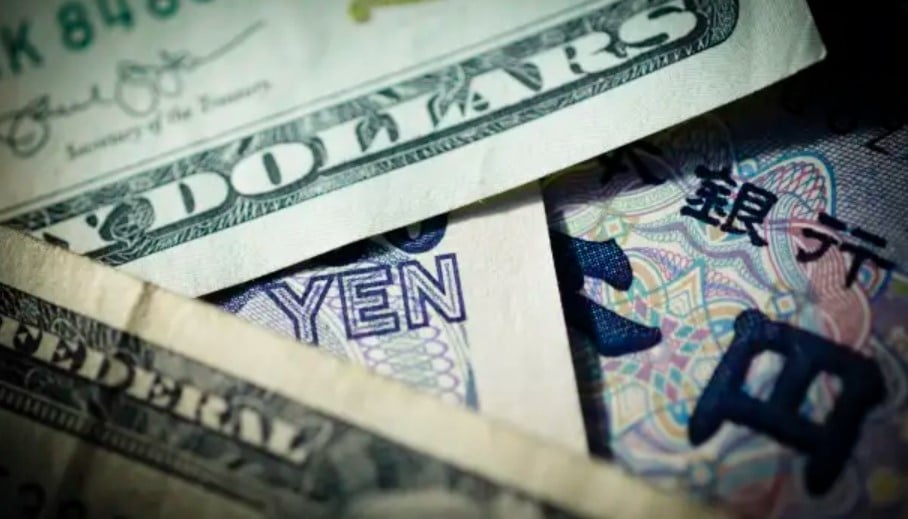
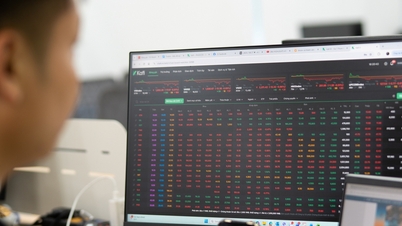
The US dollar is surging dramatically in the free market, heading towards 25,000 VND, but is losing direction in banks. (Illustrative image)
Conversely, Vietnam Prosperity Commercial Bank ( VPBank ) adjusted the USD exchange rate down by 5 VND/USD in both buying and selling directions to 24,403 VND/USD – 24,713 VND/USD.
Meanwhile, many institutions have not yet changed their exchange rate listings. At the Vietnam Investment and Development Bank (BIDV), the USD is traded at: 24,410 VND/USD – 24,710 VND/USD. The USD exchange rate at the Vietnam Agricultural and Rural Development Bank (Agribank) is listed at: 24,400 VND/USD – 24,720 VND/USD. Techcombank is trading the USD at: 24,400 VND/USD – 24,710 VND/USD, unchanged from yesterday's closing price.
Vietnam Joint Stock Commercial Bank for Industry and Trade (VietinBank) is a rather special case. The USD/VND exchange rate is currently trading at: 24,393 VND/USD – 24,733 VND/USD, an increase of 43 VND/USD in the buying rate but a decrease of 37 VND/USD in the selling rate.
Therefore, at the present time, the price of USD in the market continues to be higher than in the free market.
The US dollar is heading for a second consecutive week of gains globally.
On the global market, the dollar headed for a second consecutive weekly gain on Friday, fueled by signs of a recovering US economy and warnings of interest rate cuts from central banks.
Weekly gains of 1.7% and 2.1% for the risk-sensitive Australian and New Zealand dollars were considered the largest increases since November and June, respectively. The market priced in a 57% chance of a US interest rate cut in March, down from 75% a week earlier.
The dollar index rose 0.9% to 103.4 this week and is currently at 148.12 yen. The dollar has gained nearly 5% against the Japanese currency this year as confidence that the Bank of Japan (BOJ) is about to raise interest rates has also been shaken.
Data released on Friday showed that Japan's core inflation fell to 2.3% in the year to December, its lowest annual rate since June 2022 – seemingly demonstrating policymakers' wait-and-see approach.
Rabobank strategist Jane Foley said: “The market recognizes that raising interest rates will not be easy for the BOJ in the coming months, and the revaluation of the risk of a Fed rate cut has coincidentally been reflected in the upward trend of the dollar/yen.”
Rabobank has revised its one-month forecast for the dollar/yen to 148 from 144, expecting further reductions in bets on the pace of US interest rate cuts to support the dollar.
Currency movements in early Asian trading on Friday were modest, leaving the euro down 0.7% for the week at $1.0878 and the British pound down 0.3% to $1.2708.
Earlier data showed retail sales rose more than expected in December. Federal Reserve Governor Christopher Waller said on Tuesday that the strength of the U.S. economy gives policymakers the flexibility to move “cautiously and slowly,” which traders interpreted as pushing back against pricing in a rapid interest rate cut.
Source







































































































Comment (0)