


Develop a production model that suits practical needs.
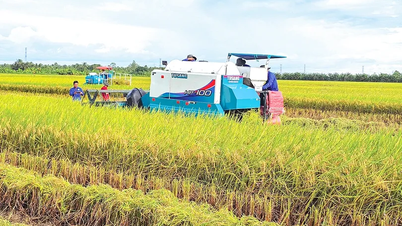
Following the merger, Can Tho City has a wider development space along with many resources and advantages, in which agriculture continues to play an important role. Lieu Tu commune has more than 5,300 hectares of agricultural land, and is being oriented to become a model for sustainable agricultural development. The locality aims to have 40% of its rice production area meet organic standards by 2030.
Mr. Nguyen Thanh Duy, Secretary of the Party Committee and Chairman of the People's Council of Lieu Tu commune, said that the commune has conducted surveys and developed a resolution on the development of organic agriculture, focusing on mobilizing farmers to change their production mindset. Simultaneously, the local government is proactively connecting with reputable businesses in the clean agriculture sector, creating conditions for the formation of sustainable supply chains.
In a short period, Lieu Tu has signed numerous memoranda of cooperation with businesses, most notably an agreement with Global Organic Clean Agriculture Co., Ltd. to implement a smart organic farming model. The model focuses on developing organic rice and shrimp farming, building an agricultural value chain incorporating Glorin technology for origin verification and carbon credit measurement, targeting both domestic and export markets. The company provides support with organic seeds and supplies, technology transfer, training, and guarantees product purchase at pre-agreed prices, while also implementing weather parameter insurance to mitigate risks from climate change. The model aims for a profit of 70-80 million VND/hectare, enabling Lieu Tu organic rice to reach international markets.

Using drones in rice fields in Can Tho City. Photo: CTV
Based on a field survey of production models and discussions on development opportunities and value chain linkages for key agricultural products, the Mekong Institute - Can Tho University, My Tu commune, and businesses identified the potential, technical support needs, and challenges in local agricultural production. Following this, the People's Committee of My Tu commune and the Mekong Institute signed a memorandum of understanding on cooperation in science, technology, innovation, and digital transformation to serve local socio -economic development. The cooperation focuses on developing ecological, organic, and smart agriculture; building multi-value farming models and ecological crop rotation; promoting the circular economy; researching solutions for climate change adaptation and disaster risk management; and strengthening production organization and improving local governance capacity.
Associate Professor Dr. Van Pham Dang Tri, Director of the Mekong Institute, said that the Institute has signed many cooperation agreements with several localities in Can Tho City and the Mekong Delta region. This is a concrete step demonstrating the Institute's commitment to accompanying local authorities, bringing science and technology and innovation into solving practical problems. As a research, training, and policy consulting unit on sustainable development in the Mekong Delta, the Mekong Institute aims to become a reliable partner of local authorities, working with them from practical experience to build effective, scalable models, contributing to improving people's livelihoods and promoting sustainable development in the Mekong Delta region.
Technology – the “key” to a new phase of growth.
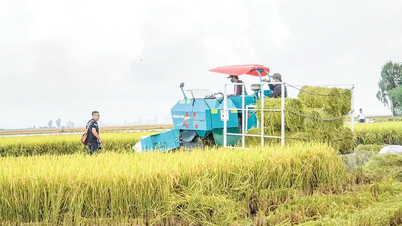
Using drones for spraying pesticides, tracing product origins with QR codes… many farmers in Can Tho are also managing production using digital technology. Applications such as VNPT Green's agricultural area management software, the Mobi Agri pest identification and technical consulting application, and the Ricemore rice production management software… along with the application of IoT, AI, and Big Data are helping farmers optimize costs, increase productivity, and significantly reduce manual labor.
In this context, CT Group developed the National Digital Twin platform - Digital Twin DT15, integrating 15 data layers and over 300 real-time data sources, with hundreds of application features for various fields. According to Mr. Tran Kim Chung, Chairman of CT Group, DT15 ushers in a new era for smart agriculture with 36 applications directly serving production, helping to build a digital twin agricultural model, renewable, sustainable, and smart agriculture based on AI, IoT, UAV, biotechnology, big data, and renewable energy. In particular, this platform contributes to bridging the gap between producers and consumers globally, opening up opportunities for trade and sustainable development.
To concretize this direction, in September 2025, CT Group and Can Tho University signed several strategic cooperation agreements. By November 2025, the UAV & Robot Agritech Innovation Lab located at Can Tho University officially commenced operations. This is a professional, modern, and practical laboratory with advanced equipment. CT Group continues to invest in agricultural robots, integrated with UAVs on the national digital clone platform DT15, gradually perfecting technological solutions to serve smart agriculture.

Representatives from CT Group and Can Tho University signed an agreement for a UAV center combining agricultural robots and a UAV pilot training school. This center will train personnel and develop UAV products to serve smart agricultural production. Photo: TUYET TRINH
In the current context, developing smart agriculture is not only an inevitable trend but also a strategic solution to ensure food security, effectively adapt to climate change, and enhance international competitiveness. However, for technology to truly be integrated into production, the key factor remains human resources.
Associate Professor Tran Trung Tinh, Rector of Can Tho University, stated that the university is committed to pursuing the "State - University - Enterprise" cooperation model, considering it a pillar in sustainable development and community service. Can Tho University has developed a roadmap for training high-quality human resources for smart agriculture and high-tech agriculture, with undergraduate and master's degree programs, and plans to launch doctoral programs in smart agriculture in the near future.
*
* *
This spring, Can Tho's agriculture is not only celebrating bountiful harvests but also a profound shift in production thinking: moving from "quantity" to "quality," from emissions to "greening." With a "green passport" and the resilience of its hardworking and perceptive people, Can Tho's agriculture is expected to firmly establish itself on its path to prosperity, allowing Can Tho's agricultural products to assert their position and brand in the global market.
TUYET TRINH
Source: https://baocantho.com.vn/dot-pha-tu-cai-bat-tay-cong-nghe-a198842.html






















































Comment (0)