


According to the Government 's requirements, by 2025, 100% of eligible administrative procedures will be provided as full-process online public services, and at least 80% of administrative procedure dossiers will be processed online. Also by 2025, Vietnam will complete the provision of all 76/76 essential online public services.
Bringing digital technology to every home.
Following an initiative by the Ministry of Information and Communications in March 2022, all 63 provinces and cities nationwide have established community digital technology groups (CTSGs). Currently, there are more than 74,000 CTSGs across the country with over 340,000 members.
According to Mr. Sinh Di Gai, a Lo Lo ethnic minority member, village head, and member of the Community-Based Tourism Team in Lo Lo Chai village (Lung Cu commune, Dong Van district, Ha Giang province), the team has helped villagers apply digital technology to promote smart tourism. Businesses in the village have installed and used the VNeID service for reporting guest stays, promoting and selling rooms through websites and social media. The team also disseminated information and guided youth union members, officials, and households in the village to install and use the VNeID application to support electronic identification for citizens.
Ms. Tran Thi Thu Giau, Head of the Community Service Team in Ward 1 (Sa Dec City, Dong Thap Province), shared: "The team members have directly gone to each house to disseminate information and guide people on using beneficial applications of Dong Thap province such as: the e-Dong Thap application related to e-government, Dong Thap Health to help people access medical services in the province; and the VNeID application to replace traditional documents."
From the beginning of 2025, many localities officially launched the "Digital Literacy Movement" (DMM), which General Secretary To Lam initiated on Vietnamese Teachers' Day 2024. The goal is to "eradicate technological illiteracy" in the community. Implementing organizations are also promoting knowledge dissemination activities via the internet, utilizing online learning platforms to provide knowledge and skills to everyone. On March 21, Ha Long City, Quang Ninh province, held a conference to launch the "DMM" movement throughout the city. The movement will promote and raise awareness among all segments of the population about "DMM". Utilizing digital services, platforms, and technologies, especially artificial intelligence (AI), in work and life... The goal of Ha Long City is that by the end of 2026, 100% of students from primary school upwards, adult citizens, and workers will be equipped with digital knowledge and skills, proficiently using smart devices to access information, use essential digital services, other digital services, and know how to protect themselves in the digital environment, integrated into the VNeID platform. In Thanh Hoa province, currently 100% of villages, hamlets, and residential areas have established community-based digital literacy teams.
Ho Chi Minh City has now established over 300 "Digital Citizen Service Teams" down to the grassroots level to help bring digital technology to the community. Binh Chanh District has established 16 "Digital Citizen Service Teams" in 16 communes and towns. Team members have gone to each residential area and lodging house to disseminate information and guide people on installing and using online public services and the Ho Chi Minh City Digital Citizen application. This approach clearly brings many benefits to local people, especially in remote and rural areas, contributing to bringing digital transformation to every home and every citizen.
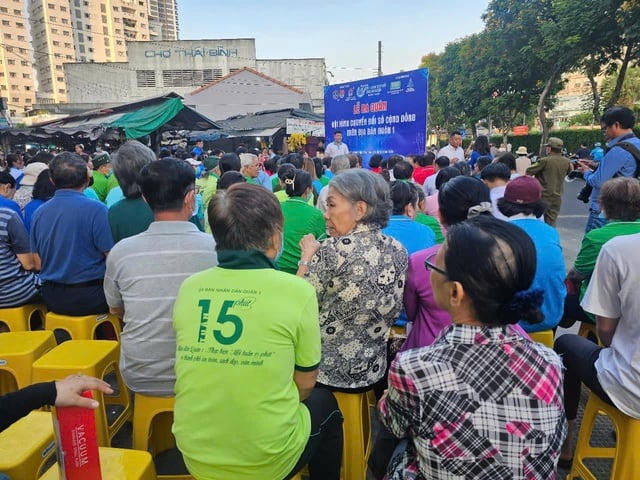
Launching the community digital transformation team in District 1, Ho Chi Minh City. Photo: Le Tinh
Enhance support
Based on their practical experience, these community groups recommend that they need support from relevant authorities to maintain effective and long-term operations. For example, local governments could work with telecommunications service providers to subsidize telecommunications costs, update skills in using digital platforms, and access digital public administrative services.
For the broad community, especially those with limited technological literacy, popularization requires two key elements: enthusiastic participants with knowledge and skills in technology, and accessible, easy-to-understand, and practical instructional materials that teams and groups can use to guide people step-by-step. Efforts to popularize technology in the community can only be effective if they are socialized, mobilizing the public to support the community. A feasible and effective solution is to mobilize local socio-political organizations. The Central Committee of the Vietnam Youth Union has proactively participated in and implemented the "Digital Literacy and Digital Skills" movement. Youth Union branches at all levels organize youth teams and open classes to improve essential digital awareness and skills for people, especially the elderly, those in rural areas, remote areas, or those with limited access to technology. Each local branch establishes at least one team with young people possessing strong technological knowledge as the core. In addition, when implementing digital government applications, many localities assign officials to be on duty at their offices to guide citizens in completing administrative procedures online.
Meanwhile, the comprehensive national digital transformation is becoming even more urgent as Vietnam streamlines and reorganizes its administrative apparatus. The role of digital government, with online public administrative procedures, is even more pressing in this new context.
Complete tasks efficiently and quickly.
On March 22nd, the Ho Chi Minh City Department of Science and Technology, in collaboration with the Ho Chi Minh City Department of Home Affairs, organized a training course on AI application for civil servants in Ho Chi Minh City in 2025. Mr. Lam Dinh Thang, Director of the Ho Chi Minh City Department of Science and Technology, stated that the training will focus on using AI to synthesize data, process documents, and automate manual processes. The Department plans to hold the course every two weeks until all officials, civil servants, and public employees in the city have been trained and guided, and then expand it to the general public.
Mr. Nguyen Bac Nam, Deputy Director of the Ho Chi Minh City Department of Internal Affairs, said that with the reorganization of administrative units at the ward, commune, and town levels, the workload of officials and civil servants at the grassroots level will increase significantly, estimated to be 3-4 times higher than before, while the number of personnel will not increase. Organizing training on AI applications will support the efficient and rapid resolution of tasks.
Province
Source: https://nld.com.vn/dua-cong-nghe-so-den-cong-dong-196250322184157715.htm





![[Photo] Radiant smiles at the "Building Tet" festival in Da Nang](https://vphoto.vietnam.vn/thumb/1200x675/vietnam/resource/IMAGE/2026/02/12/1770872911216_ndo_br_nhan-qua-jpg.webp)























































































Comment (0)