


The word "Nobel" outside the Nobel Forum in Stockholm, Sweden in this photo taken on October 7, 2024 - Photo: REUTERS
According to the journal Nature, since 2000, the United States has been the most popular destination for Nobel Prize winners. Of the 202 science laureates this century, less than 70% were from the country where they received the prize, and the remaining 63 left their country of birth before being awarded the prize.
America - top destination
Among those who have emigrated are two of the three chemists who won the prize on October 8: Richard Robson, born in Britain but now living in Australia, and Omar Yaghi, a US citizen who became the first Palestinian born in Jordan to receive a Nobel Prize.
Two of the three 2025 laureates are also immigrants: French-born Michel Devoret and British-born John Clarke, both now residing in the United States.
Immigrants have long played a prominent role on the Nobel stage, from Albert Einstein to Marie Curie. “Talent can be born anywhere, but opportunity cannot,” University of Massachusetts Amherst economist Ina Ganguli wrote in Nature.
Of the 63 laureates who left their home countries, 41 were living in the United States when they were honored. After World War II, the United States became the world's scientific center thanks to generous funding and a leading university system.
“What we have in the US is unique. It is a destination for the best students and scientists,” said Ms. Ganguli. And Mr. Andre Geim, a physicist who won the Nobel Prize in 2010 and has worked in Russia, Denmark, the UK, and the Netherlands, said: “If you stay in one place all your life, you miss half the game.”
Britain has also seen a lot of talent leave. According to researcher Caroline Wagner of Ohio State University, as many as 13 laureates were born in Britain but received the prize while living abroad, lured by higher salaries and more prestigious positions. Significant numbers also left Germany (6), Japan, France and Russia (4 each).
Physics has the highest proportion of foreign-born Nobel laureates at 37%, followed by chemistry at 33% and medicine at 23%. According to Ms. Wagner, physics leads because the field relies heavily on expensive equipment concentrated in a few advanced countries.
"The medical field doesn't require a lot of equipment, so it's easier for scientists to stay in their home country," she explained.
Challenges and the future
The Nature analysis comes as the global movement of talent faces growing obstacles. In the US, cuts to research funding and stricter immigration policies under the Trump administration threaten a “brain drain.” Such restrictions “will slow the pace of groundbreaking research,” Wagner said.
Australia has also restricted international students, Japan has cut support for foreign researchers, Canada and the UK have also imposed restrictions. The US has cut billions of dollars in research funding and is charging $100,000 for each H-1B visa application, a visa many foreign researchers are required to have.
Many international researchers have left the US, while other countries are ready to welcome them. France, South Korea and Canada have set up programs to attract scientists from the US. The European Research Council (ERC) offers grants of up to 2 million euros to those moving their labs to the EU.
The next consequence, Ganguli said, could be a massive migration wave, similar to the exodus from Germany after World War II and Russia after the collapse of the Soviet Union in 1991. “We are seeing a huge loss of human capital, and those people will go to other countries,” Ganguli said, though she was not sure where they would go next. Wages in Europe are still not attractive enough.
Ms. Wagner said it was impossible to predict where the next Nobel Prize center would be, because it depended on complex political, economic and social factors.
“Smart people will eventually disperse. But can they replicate the magic? That’s an open question,” she said. It’s also hard to predict when policy changes will have a tangible impact on the Nobel Prize list. “The full impact will probably be felt only in the very long term,” Wagner said.
Mr Geim urged countries not to close their borders. "Movement benefits everyone. Each newcomer brings new ideas, new techniques and different perspectives," he said. "Countries that welcome this movement will maintain the upper hand."
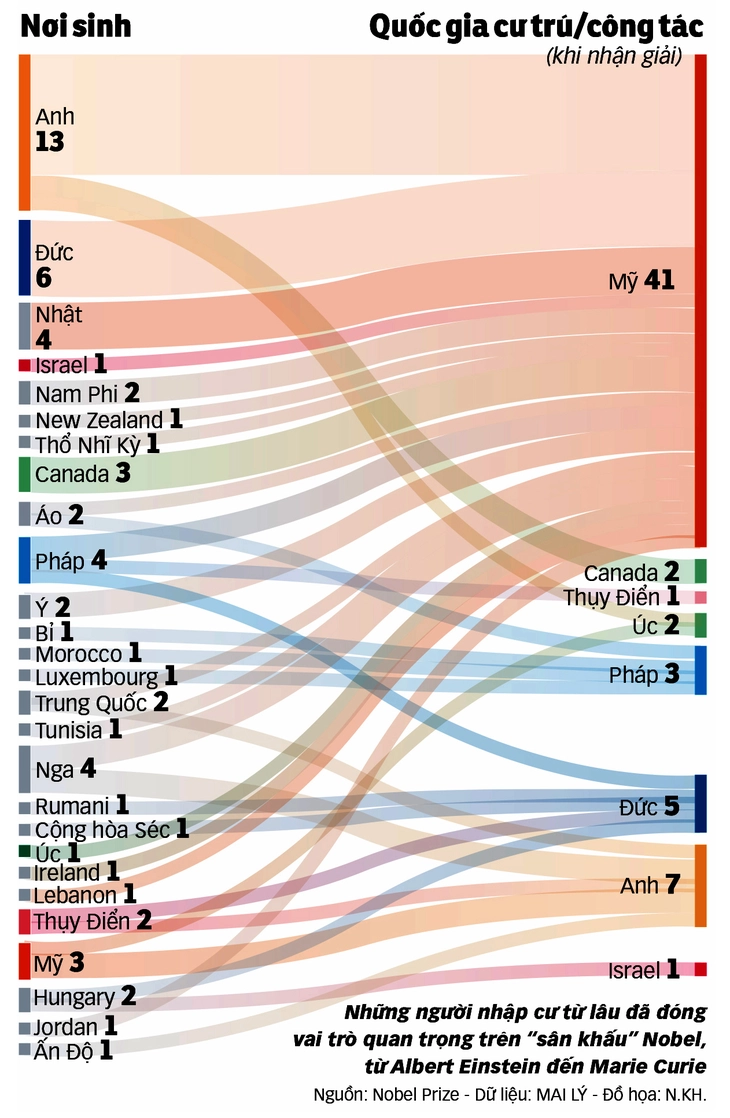
Source: https://tuoitre.vn/giai-nobel-nhin-tu-dong-chay-nhap-cu-20251013083329041.htm


![[Photo] Prime Minister Pham Minh Chinh receives President of Cuba's Latin American News Agency](/_next/image?url=https%3A%2F%2Fvphoto.vietnam.vn%2Fthumb%2F1200x675%2Fvietnam%2Fresource%2FIMAGE%2F2025%2F12%2F01%2F1764569497815_dsc-2890-jpg.webp&w=3840&q=75)


















































































Comment (0)