

On May 28th, the Da Nang City Cooperative Union organized a seminar titled "The Role of Cooperatives in Linking the Rice Seed Production Chain in the Area" to assess the current situation, share experiences, and propose solutions to improve the effectiveness of linking rice seed production and consumption along the value chain.
According to Mr. Doan Ngoc Trung, Vice Chairman of the Da Nang City Cooperative Alliance, after the merger, the city has approximately 960,950 hectares of agricultural land, creating favorable conditions for developing agriculture in a modern and sustainable direction. In particular, rice production and rice seed production are important sectors, contributing to ensuring food security, creating jobs, and increasing income for rural people.

The seminar aimed to discuss solutions to improve the effectiveness of linking rice seed production and consumption along the value chain. Photo: LA
However, rice seed production is a specialized industry, requiring strict technical procedures and close coordination from research and breeding to production organization. In recent years, the business-cooperative-farmer linkage model has proven effective, contributing to stable output, forming a closed production chain, and encouraging farmers to shift from small-scale to large-scale commodity production. This allows farmers to access advanced technology, improve the quality of rice seeds, build product brands, and minimize market risks.
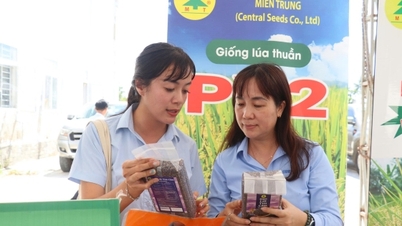
Many collaborative models have shown clear effectiveness, such as Hoa Tien 1 Cooperative's collaboration with Dong Tam Agricultural Company Limited and Quang Nam Central Seed Company; and cooperatives in Hoa Phong, Que Xuan, Dai Minh, Dien Hong, Que Phu, etc., participating in production chains with large seed companies. These models contribute to improving the productivity, quality, and value of rice seed products.
Nevertheless, the cooperative sector still faces many difficulties such as fragmented production scale, limited management capacity, lack of investment capital, difficulty accessing credit, inadequate post-harvest infrastructure, slow adoption of digital technology , and low adaptability to climate change. In addition, product branding and market competitiveness remain limited.

The business-cooperative-farmer linkage model has formed a closed production chain and encouraged farmers to shift from small-scale production to large-scale commodity production. Photo: LA
At the seminar, cooperatives argued that it is necessary to continue improving the management capacity of cooperative staff and to promote the role of the "four stakeholders" linkage: the State, farmers, scientists, and businesses. Delegates also proposed strengthening preferential credit policies; supporting investment in storage facilities, drying machines, preservation systems, mechanization, and internal field transportation infrastructure to enhance production capacity.
Furthermore, it is necessary to improve the linkage contract mechanism towards clarity, transparency, and specific sanctions to limit breaches of commitment, while ensuring a balance of interests between businesses, cooperatives, and farmers. Promoting the application of science and technology, digital transformation, traceability, and electronic logs are also considered important solutions to improve management efficiency, increase transparency of the linkage chain, and enhance product value.
Mr. Trieu Tan Phu, Director of ThaiBinh Seed Central - Central Highlands Co., Ltd., said that the company currently collaborates with 17 cooperatives in production, covering an area of approximately 1,450 - 1,500 hectares each year, purchasing 6,000 - 7,000 tons of rice seeds, accounting for about one-third of the total collaborative area in the region.

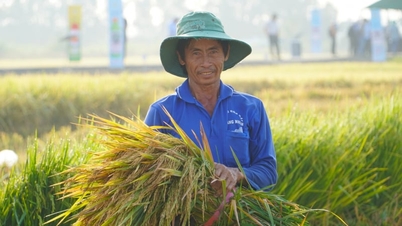
Every year, the area dedicated to rice seed production in Da Nang reaches over 5,000 hectares. Photo: LA
According to Mr. Phu, to improve the effectiveness of linkages between businesses and cooperatives, cooperatives need to continue enhancing their capacity in production organization, quality management, seasonal coordination, and protecting farmers' rights, while also promoting the application of science and technology, traceability, and selecting seed varieties suitable to market demand. Farmers participating in seed production also need to strictly adhere to technical procedures and linkage commitments.
“We need to continue building concentrated and stable production areas, facilitating production and consumption. On the business side, ThaiBinh Seed is committed to supplying quality seeds, transferring technology, investing in infrastructure, and maintaining transparent linkage contracts with cooperatives, aiming to build high-value raw material areas and develop sustainable agriculture,” Mr. Phu emphasized.
Currently, Da Nang has 764 active cooperatives, of which 458 are agricultural cooperatives (nearly 60%), with approximately 110 cooperatives producing rice and rice seeds (accounting for 24% of the agricultural sector). Annually, the area for rice seed production reaches over 5,000 hectares, with a yield of approximately 25,700 tons, basically meeting the needs of the city and supplying the Central region. Around 33 businesses and units are involved in linked rice seed production, initially forming a value chain and opening up a more stable development direction for farmers.
Source: https://nongnghiepmoitruong.vn/go-diem-nghen-chuoi-lien-ket-san-xuat-lua-giong-d813613.html
![[Photo] The heat at the fireworks display site on the opening night of the Da Nang International Fireworks Festival 2026](https://vphoto.vietnam.vn/thumb/1200x675/vietnam/resource/IMAGE/2026/05/27/1779889741485_ndo_br_z7872039145157-fecaba5112f39e8352544099d7ef4738-5140-jpg.webp)













































































Comment (0)