

We can easily name some types of carbonated drinks, but if you had to translate Vietnamese sugarcane juice, sour plum juice, or apricot juice into English, how would you say it?
Mr. Quang Nguyen, an expert in English pronunciation training, shares some ways to name common summer drinks:
"Do you want some icy cold water?" Uncle Don asked me during a hot summer camping trip. It wasn't a new word, but the way it was phrased was interesting. If I had to translate "ice water," I'd probably use "ice water" rather than "icy cold water." Actually, "ice water" is melted ice (or snow), not icy cold water.
On a restaurant outing with two American friends, when one of them ordered "orange juice," I eagerly ordered "lemon juice." The waiter stammered, "Do you mean lemonade?" It's true, "lemonade" is lemon juice, while "lemon juice" is lime juice, only used for salad dressings; nobody drinks it. Actually, "lemonade" is made from yellow lemons (lemon), and in Vietnam, lemons are called "limes," hence the name "limeade." But in America, only "lemonade" exists. So, if you order lemonade, it's either "salted lemonade" (if made with yellow lemons) or "salted limeade."
If the juice is squeezed directly from fruits like oranges or lemons, it's called "juice," for example, "apple juice," "peach juice," etc. For coconut water, you can use the terms "coconut water" or "coconut juice," and the coconut flesh is called "coconut meat."
When you blend fruit and add some ice and milk, it's called a "smoothie." There's another drink that's similar to a "smoothie," but its main ingredient is milk, blended with ice and a little fruit, called a "shake." Back in America, my kids loved milkshakes.
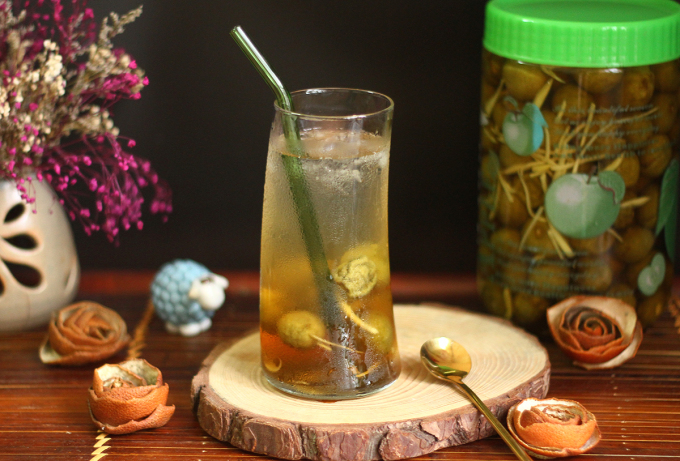
Sour plum juice. Photo: Bui Thuy
In Vietnam, the "classic" drink is undoubtedly "iced tea." In English, it's called "iced tea" (or icy cold tea). While enjoying iced tea in Vietnam, you can also drink beverages that are difficult to translate into English, such as apricot juice or sour plum juice. So, what are their names?
Apricot juice is made from apricots soaked in sugar. I think apricot concentrate could therefore be loosely translated as "sugar-soaked apricot juice," and apricot juice as "sugar-soaked apricot juice with icy cold water." But that translation isn't very practical and would make the speaker's mouth sound distorted. So, if I were to offer a glass of apricot juice to a foreigner, I would introduce it by saying: "These are apricots, then they are soaked in sugar for a few months to a few years, and from that we get 'soaked apricot juice.' Then, sugar and icy cold water are added to the concentrate and mixed together to make apricot juice." I would also add that "mơ" in Vietnamese also means "dream," so drinking this tonight "you will have sweet dreams."
The same applies to "sấu juice," as long as you remember the name of the sấu fruit, "Dracontomelon." To make it easier to remember, you can split the word into two halves: "draconto - melon" (melon is a type of melon). I haven't found the pronunciation of "sấu" in many popular online dictionaries, so I had to listen and create my own IPA, which is /ˈdreɪkəntoʊˈmɛlən/. Therefore, even if you tell a foreigner the correct name of "sấu," they won't understand what fruit it is. If you intend to introduce "sấu juice," just teach them to say "nước sấu."
While studying in the US, I was surprised to learn that the global consumption of "soft drinks" is even greater than that of "drinking water." "Soft drink" is a general term for non-alcoholic carbonated beverages like Coca-Cola, Pepsi, 7Up, etc. Beverages like beer or wine (or spirits) are generally referred to as "alcoholic drinks."
So, what is sugarcane juice called in English? Back in 2005, an older sister of mine who lived in the US came to Vietnam and used "sugar cane juice" to refer to this drink, remarking, "It's the best drink in Vietnam." So, if you have foreign friends visiting Vietnam, remember to offer them a glass of "sugar cane juice."
Quang Nguyen
Source link


























![[Video] Sunset at Lap An Lagoon – Where the sun sets over the fishing nets](https://vphoto.vietnam.vn/thumb/340x192/vietnam/resource/IMAGE/2026/05/31/1780192137701_beach-landscape-sea-water-nature-grass-745871-pxhere-com.jpeg)




































































Comment (0)