

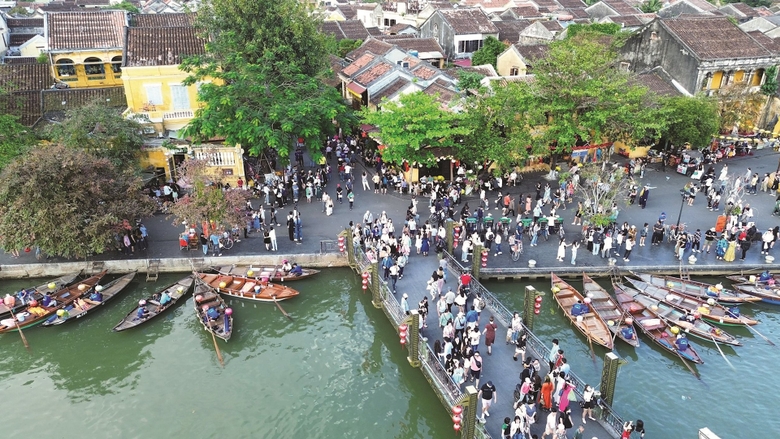
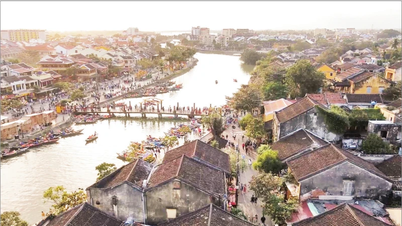
The ancient town of Hoi An (Quang Nam province) - a World Heritage site, with its moss-covered ancient houses, peaceful river landscapes, friendly and hospitable people, along with a series of vibrant cultural activities and a unique culinary style - has long been an attractive destination for domestic and international tourists.
Old houses
Walking through Hoi An's Old Town, visitors can easily spot houses over 150 years old, showcasing ancient architectural styles. Over the years, these houses have been preserved quite intact in terms of their architectural design and interior decoration, giving us a glimpse into the lives of their owners, the merchants of the Hoi An trading port in the past.
For example, at house number 77, Tran Phu Street, Minh An Ward, Hoi An City, there is the ancient Quan Thang house, located within a spacious area of about 300 square meters, which is always a popular destination for foreign tourists. Here, the owner, Mr. Diep Bao Hung (85 years old), the sixth generation to live in the Quan Thang house, shared: “This house was built by my ancestors who came to Hoi An ancient town in the late 17th century to trade and named it Quan Thang. Currently, three generations are living and doing business in this house, and we always cherish and preserve the valuable ancient features that our ancestors left behind.”
From the outside, visitors can see the exquisite tiled roof of this house, along with two large stalls displaying goods, creating a vibrant and rich atmosphere. The doors are adorned with delicate patterns and rich traditional colors. The horizontal plaques and couplets on the columns are intricately carved, authentically recreating the magnificent beauty of ancient Hoi An.
Inside the ancient Quan Thang house, visitors will be overwhelmed by the exquisite architecture, from the lim wood columns to the connecting beams. From the walls adorned with intricate patterns to the antique lim wood doors, each detail is meticulously carved. Hand-painted canvas paintings decorating the space are also a special highlight, adding to the house's antique charm.
“This is one of the most beautiful old houses in Hoi An, built by the Quan Thang trading company owner. The house has a typical wooden architectural style with large ironwood columns connected by continuous crossbeams to form a sturdy frame,” shared Ms. Vo Thi Anh Duong, a resident of Minh An ward, Hoi An city.
Besides the Quan Thang ancient house, Hoi An currently boasts approximately 1,360 historical sites, including 1,068 ancient houses, 38 ancestral temples, 19 pagodas, 43 shrines, 23 communal houses, 44 ancient tombs, and one ancient bridge, all of which are popular destinations for research and admiration from tourists near and far. For example, the Fujian Assembly Hall and the An Hoi Bridge are always crowded with visitors coming to offer incense, pray for peace, and admire the ancient charm.
Ancient wells thousands of years old
Besides ancient houses, visitors to Hoi An can also admire ancient wells. A prime example is the Ba Le well, located in a small alley on Tran Hung Dao Street. This well has existed for over a thousand years, not only witnessing the historical ups and downs of the ancient town but also becoming a sacred part of Hoi An's culture.
Mr. Huynh Ngoc Noi, from Hoi An City, said that the water in Ba Le well is very clear, sweet, and does not dry up even during severe droughts. During droughts, almost every family in the inner city of the old town hires or transports several buckets of water from this well to store for daily cooking.
According to Mr. Noi, the ancient Ba Le well dates back to the time of the ancient Cham people, around the 8th-9th centuries. Legend says that in the 20th century, a woman named Ba Le spent over 100 Indochinese francs to restore this ancient well, and from then on, the well was named Ba Le.
The Ba Le Well is square-shaped and, according to legend, was built by the Cham people. The well's walls are constructed of brick, making it sturdy and durable. At the bottom of the well is a wide, ancient wooden frame made of ironwood, which has not rotted. Layers of moss clinging to the well's walls create an antique feel.
Mr. Pham Phu Ngoc, Director of the Hoi An Cultural Heritage Conservation Management Center, said: “The ancient wells of Hoi An are a special link between the Cham and Vietnamese people in Hoi An, such as the Ba Le well. These ancient wells have created a unique feature of Hoi An culture and are an indispensable part of its tangible cultural heritage. This is a very special type of relic that needs to be studied and preserved.”
In Hoi An, besides the Ba Le well, there are 11 other ancient wells. Currently, more than half of these ancient wells are still in use, but under strict protection and preservation measures. The government and the cultural sector always guide and educate the people not to encroach upon or damage these ancient wells.
Western tourists and the old town
Besides the ancient features mentioned, Hoi An also has new cultural aspects, namely the increasing number of domestic and international tourists who come to the ancient town to shop and admire the sights, especially foreign tourists, whom the locals commonly refer to as Westerners.
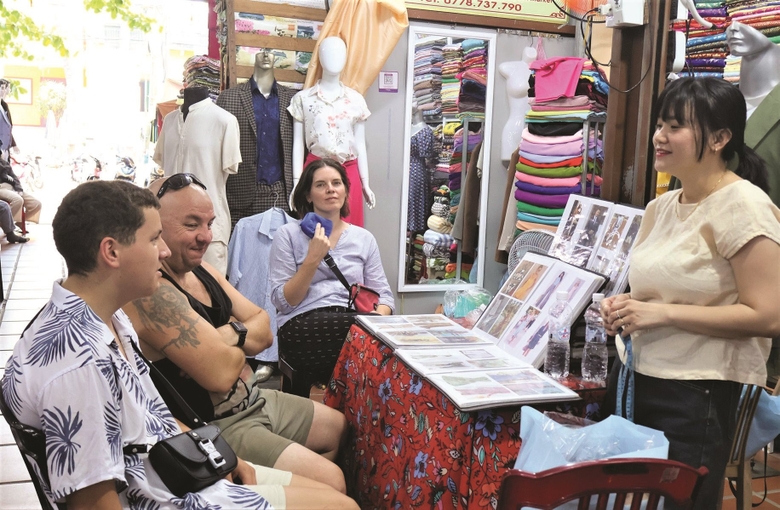
Tran Phu Street is the most visited street by Western tourists. Although it's just over 1km long, the street is lined with souvenir shops, leather shoes, clothing stores, etc., attracting many visitors for sightseeing and shopping. At these shops, Western tourists can freely choose items to buy or request custom-made clothing. The shop staff enthusiastically introduce the products they need or provide price information to help customers make their choices.
Foreign tourists also stroll through this neighborhood, admiring, checking in, and taking photos of the ancient houses nestled close together, or visit temples to light incense and pray for peace. Or simply sit and enjoy a coffee, chatting and laughing, or admire the peaceful Hoi An ancient town in the evening.
Ms. Diem Huong, owner of TaTa shop on Tran Phu street, said: “This street always attracts Western tourists, like at my shop, they come to order custom-made clothes. The customers are very diverse; they come from European countries, as well as India, South Korea, China, Japan… This place is always popular because they feel secure and don't worry about price gouging, as we have listed the prices of each garment for customers to choose from. Word spreads quickly.”
Western tourists love Hoi An ancient town not only for its ancient beauty but also for its pleasant weather—not too hot and not too cold—and affordable accommodation, with rooms ranging from 300,000 to 500,000 VND per night. Visitors can also enjoy many delicious dishes such as Quang noodles, banh xeo (Vietnamese savory pancake), and cao lau (a local noodle dish).
Laura (28 years old), a tourist from Spain, shared: “I’ve been to Hoi An twice, the scenery here is amazing, and the people are very friendly and hospitable. The food is delicious and healthy, my favorite is Cao Lau. I love Hoi An ancient town.”
Ms. Pham Thi Ngoc Dung, Deputy Head of the Culture and Information Department of Hoi An City, said: “Currently, Hoi An Ancient Town does not have any streets specifically for Western tourists; they only visit and stroll along the existing streets. However, in my opinion, Bach Dang and Tran Phu streets are the most popular with foreign tourists because they have many ancient architectural structures, museums, temples, and souvenir shops, so they attract more foreign visitors compared to some other streets in Hoi An.”
Mr. Nguyen Van Lanh, Vice Chairman of the People's Committee of Hoi An City, said that the implementation of Government Resolution 82, dated May 18, 2023, on tasks and solutions to accelerate tourism recovery and development has contributed to the gradual recovery of the tourism industry. The city government consistently promotes and reminds people to comply with regulations regarding sales practices, including displaying prices correctly and not overcharging tourists. Any violations will be dealt with severely. Hoi An City has also been organizing various events such as traditional folk singing, cultural performances, culinary events , and festivals for tourists to enjoy when visiting Hoi An ancient town.
Hoi An Voted the 4th Most Beautiful City in the World According to the annual World's Best Awards announced in July 2024 by the American travel magazine Travel & Leisure, Hoi An ranked 4th in the category of the 25 most beautiful cities in the world in 2024 with 90.67 points out of 100, after San Miguel de Allende of Mexico, Udaipur of India, and Kyoto of Japan. In addition, in the top 25 most beautiful cities in Asia, Hoi An ranked 3rd after representatives from India and Japan. In the eyes of international tourists and travel experts, "it's no surprise that Hoi An appears on the list." Besides its UNESCO World Heritage status, Hoi An Ancient Town is also an ideal destination for food lovers with delicious dishes like Cao Lau and Banh Mi, and for history enthusiasts. Hoi An is conveniently located 30 km from Da Nang International Airport. Hoi An also boasts five traditional craft villages with nearly 50 thriving handicraft industries, including carpentry, pottery, lantern making, bamboo and coconut processing, tailoring, and leatherworking.
Source

























































































Comment (0)