
|
Five young "filmmakers" |
Touching history through the language of cinema.
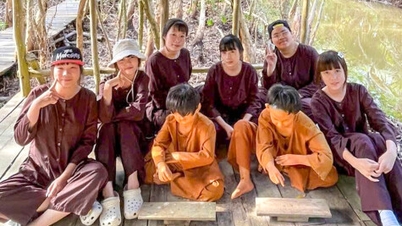
When given the task of creating a short film, five multimedia communication students (International Faculty - Hue University) – Ngo Le Minh Thu, Nguyen Le Nhu Quynh, Nguyen Thi Mai Khanh, Luu Thi My Hanh, and Nguyen Phuong Minh – thought extensively about the topic. Among countless options, the group decided to focus on history, a choice that was far from "safe" for content creation students.
After much discussion, they unanimously chose Nine Tunnels, a historical site from the anti-American war era, associated with the nation's suffering but not yet widely known among young people.
From the initial attempt to contact the Hue City History Museum to the first screening of "Inferno," only two months elapsed. This is a short timeframe for the topic the students chose. According to Minh Thu, the biggest challenge for the group was researching historical documents. History does not allow for arbitrariness; every detail, every image needed careful verification. Fortunately, the group received support, feedback, and content review from the Hue City History Museum and historian Nguyen Dac Xuan.
Besides that, very "everyday" obstacles constantly arose: the group consisted of only five people, all women; limited budget; and the weather in Hue was unpredictable, sometimes scorching hot, sometimes pouring rain, and even prone to flooding. But instead of seeing these as hindrances, the group chose to adapt. When the weather was sunny, they filmed scenes of the present, imbued with a sense of peace; when it was gloomy and rainy, scenes of the past were recreated. This contrast created a feeling of intermingling between a painful past and a peaceful present.
Minh Thu recalled the moment during the preview screening of "Inferno": "After the screening, the whole room was silent for a long time. We thought everyone didn't like it. Only when the applause rang out did the whole group breathe a sigh of relief."
A perspective from a historian.
According to Mr. Nguyen Chi Ngan, a lecturer in the History Department of the University of Science , "Inferno" demonstrates the spirit of "remembering one's roots" and the historical pride of young people. "After watching the film, I see that students love history, if they are approached in the right way," Mr. Ngan commented.
According to Mr. Ngan, to make young people love history, it's crucial to spark their curiosity. Curiosity leads to learning, and understanding leads to passion. The teaching of history also needs innovation. Instead of just reviewing previous lessons, students could be encouraged to research new material independently, present their understanding, and then the lecturer can guide, supplement, and deepen their understanding.
In fact, recent films and musical works with historical themes are receiving great public attention, especially from young people. Cinemas, online platforms, and social media are all witnessing the spread of works that explore history in a new, emotionally rich, and relatable way.
History has long been considered a difficult subject for students if they lack interest and passion. When history is primarily conveyed through textbooks and demanding rote memorization, the subject easily becomes more of a source of pressure than a journey of discovery. Therefore, films like "Peach, Pho and Piano," "The Tunnel," and "Red Rain," or songs like "What Could Be More Beautiful," "Continuing the Story of Peace," etc., show that when the past is retold through images, music, and life stories, history gradually becomes an emotional experience, not just knowledge to be memorized.
|
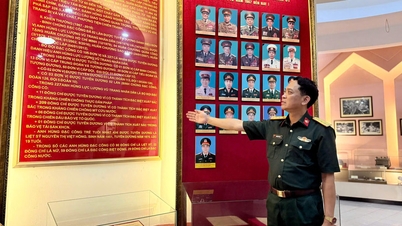
In the film "Prison Fire," soldier Mai Ca appears as one of the representative characters, alongside the general story of revolutionary cadres and soldiers who were imprisoned at Nine Tunnels. The character is based on material from the work "Living in the Grave" compiled by Master's student Nguyen Kim Thanh. Imprisoned and tortured during the resistance war against the US, after an unsuccessful escape attempt, soldier Mai Ca continued to be brutally beaten and tortured by the enemy, but he remained steadfast and unyielding. His story is a testament to the unwavering spirit and silent sacrifice of those who fell for the independence and freedom of the nation. |
Text and photos: PHAM PHUOC CHAU
Source: https://huengaynay.vn/van-hoa-nghe-thuat/hoc-lich-su-bang-cach-moi-161806.html




















![[QUIZ] Under what circumstances was Trịnh Công Sơn's passion for music "awakened"?](https://vphoto.vietnam.vn/thumb/402x226/vietnam/resource/IMAGE/2026/05/20/1779228580019_fb_thiet-ke-chua-co-ten-5072-jpg.webp)











































































Comment (0)