

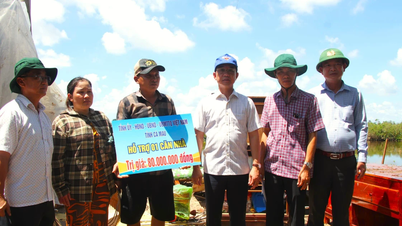
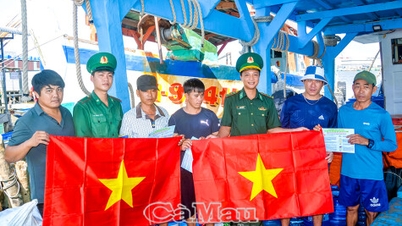
- Tet gifts from the mainland reach the soldiers and people of Hon Chuoi Island.
- Hon Chuoi Island stands firm at the forefront of the waves.
- Hon Chuoi Island completed early voting with 100% voter turnout.
Legends derived from its shape and vegetation.
The name Banana Island is not accidental. According to the elders, viewed from afar, the island resembles a giant, elongated, slightly curved banana rising from the Western Sea. In the past, this place was home to many wild banana trees, becoming a natural landmark for fishermen to identify during their fishing trips.
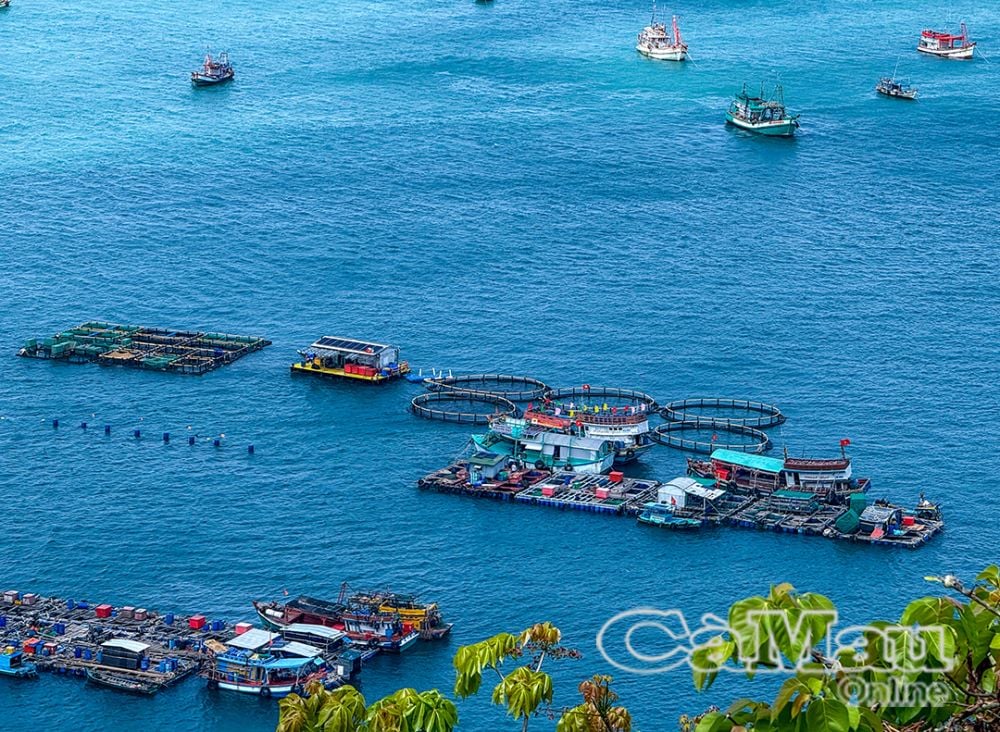 A view of the southern cliff (Hon Chuoi Island, Hamlet 1, Song Doc Commune) from the Temple of the Goddess of Hon Chuoi.
Hon Chuoi Island belongs to the western island cluster of Ca Mau , along with Hon Khoai and Hon Da Bac. Not only is it a scenic spot, the island also holds a strategic position in terms of national defense and security, with a radar station and lighthouse serving to regulate maritime traffic in the Gulf of Thailand.
A journey to the island amidst the rhythm of sea life.
On my first voyage towards the southwestern seas and islands after reunification, I hitched a ride on a squid-buying boat belonging to a fisherman from Song Doc. At just after 8 a.m. on March 9, 2026, the ship left the dock, gliding through the mouth of the Ong Doc River. Amidst the reddish, silt-laden water, a bustling coastal city emerged, with rows of boats lining both banks. Prominent on the left bank was the monument to the ship Xkilinky – a historical landmark recalling the 1954 regrouping in the North and the international friendship forged during the resistance years.
Leaving the harbor, the waves began to choke. The captain steered the ship using the navigation system while simultaneously discussing the sea conditions via radio. The conversation wasn't just about fishing grounds, but also about the worry of rising fuel prices, which forced many fishing boats to stay ashore because "going out to sea means almost certainly breaking even or losing money." On deck, life continued at a brisk pace: cooks, seafood processors, the sound of freshwater pumps mingled with the waves, creating the characteristic sounds of life at sea.
Passing the scattered squid fishing boats, An Island – a familiar storm shelter for fishermen – appeared on the left. A little further on, Hon Chuoi gradually came into view. Although only about 7 nautical miles away, in favorable weather conditions, the island's shape was clearly visible: towering high in the south, gradually sloping down towards the north. Against the backdrop of green forests and gray rocks, the Hon Chuoi Border Guard Post stood out as a solid outpost at the forefront of the waves.
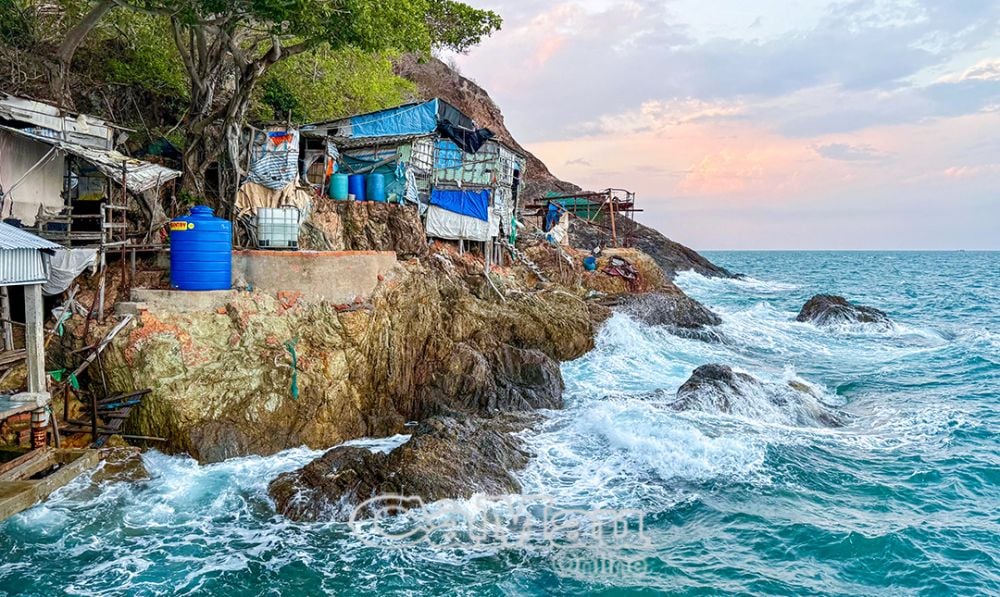 During the Lunar New Year season, to avoid the strong winds, most households on the northern cliff (Chướng cliff) move to the southern cliff to live.
Due to rough seas on the northern shore, the boat had to turn south to dock. The boat stopped at the fish farms where fishermen raised grouper. Under the clear water, schools of fish swam and thrashed about. The barking of dogs and the roar of the boats of the welcoming forces blended together, signaling the start of the journey to the island, where stories of life at sea and the defense of the island began.
Staircases reaching for the blue sky and aspirations from the floating cages.
Hon Chuoi Island doesn't welcome visitors with white sandy beaches, but with steep, jagged cliffs amidst the vast ocean. During the autumn foliage season, the forest paints a red streak halfway up the mountainside. In this precarious landscape, the houses of the local people cling to the rocks, precariously balanced but full of life.
From Ganh Nam, the journey to the island begins with a winding climb of 303 concrete steps leading to the Border Guard Post. These steps, marked by years of struggle for survival, present a real challenge for first-time visitors. After several rest stops, we finally reached the fork in the island's path, where one path leads to a charity school, radar station, and lighthouse; the other follows a trail to the Temple of the Goddess of Hon Island.
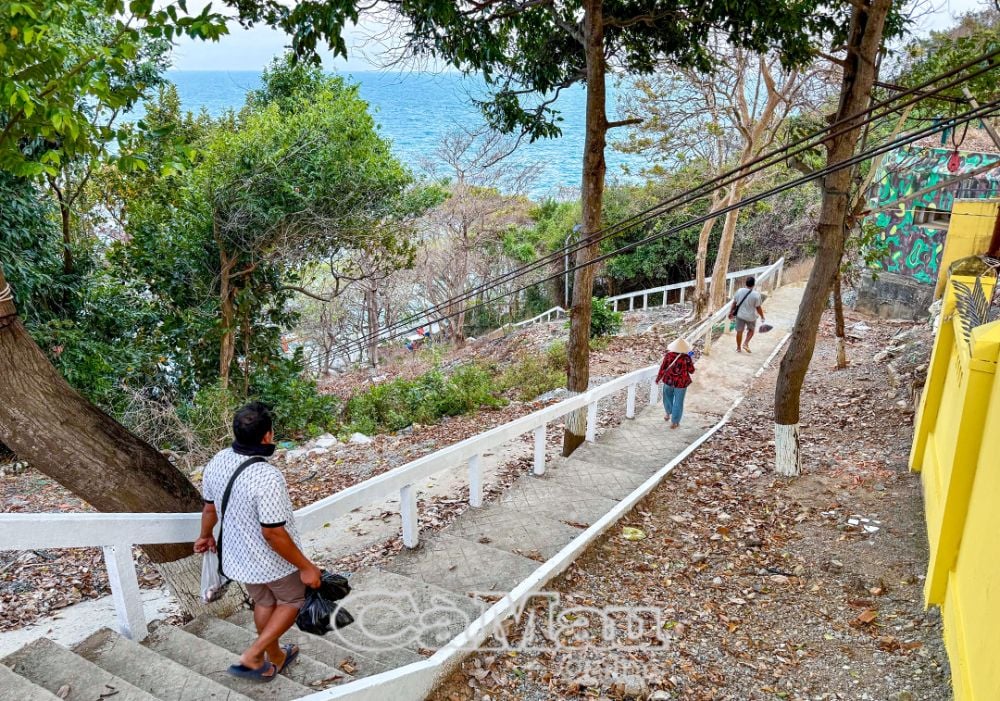 The road from Hon Chuoi Border Guard Post down to Ganh Chuong.
The small, quiet shrine was neatly arranged, proudly displaying a photograph of President Ho Chi Minh. From here, looking down, the southern cliffs appeared in their entirety, with fish cages interspersed among the clear blue water. Just then, an unexpected, unseasonal rain fell—a rare shower after many years—helping the island replenish its precious freshwater reserves.
Beneath the rafts lies the bold entrepreneurial story of Nguyen Quoc Cuong, a fisherman who has been connected to the island for nearly 20 years. “At first, when I brought out the barrels, everyone thought I was collecting rainwater. Only when the fish rafts were completed did people believe it was possible to make a living in the middle of the sea,” he recounts. His first successful farming season opened up a new livelihood, helping his family stabilize their lives and develop marine logistics services. Currently, while his eldest son is serving in the military , his wife, Ms. Kieu, and their youngest son continue to work at sea on their small cargo boat.
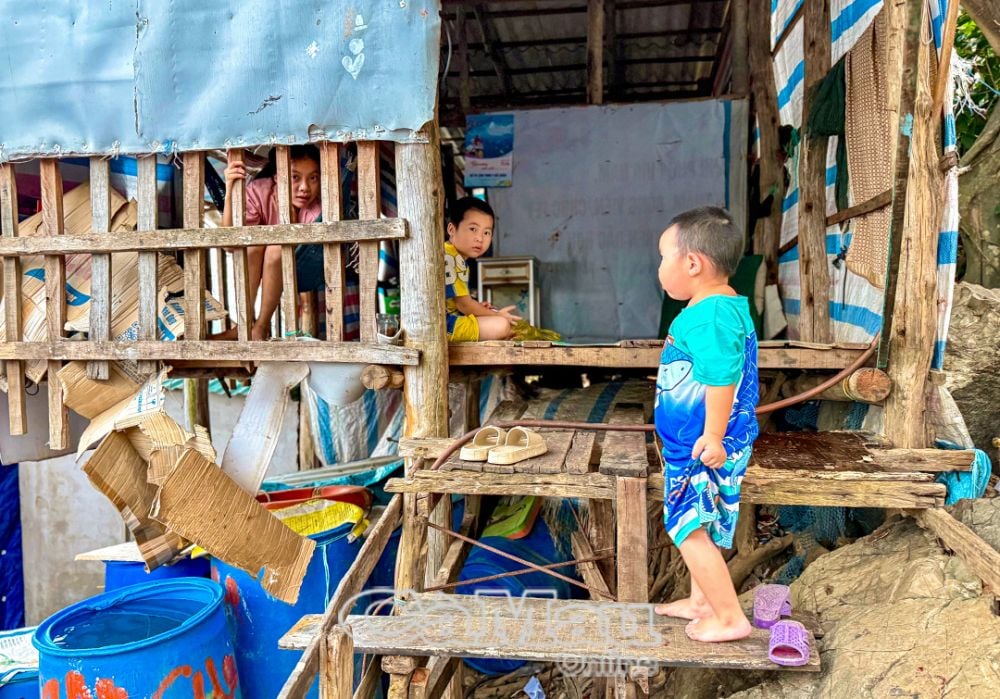 These young sprouts – the future of Hon Chuoi Island.
On that ship, stories about the island continued to unfold through the narratives of Do Trong Nghia and Duong Van Quy. I was speechless when I heard about their 12-day and 12-night journey carrying 40 tons of construction materials up the hill to build a charity school, and about the young volunteers whose ears were severely damaged by the cement. These details came alive like a documentary film about silent sacrifice, further strengthening our faith before Election Team No. 3 of Song Doc commune officially began the people's election day in this turbulent sea.
A green aspiration from four generations living by the sea.
Returning to Hon Chuoi amidst the hustle and bustle of election day, the issue of "electricity and water" remains a constant concern for the residents. On the rocky cliff, Kim Van Hau and Nguyen Thanh Trang continue their lives relying on electricity from a battery. In their precarious house perched on the rocks, Trang prepares the evening meal while Hau meticulously reconnects the electrical wires, a familiar task amidst the harsh conditions.
Hau's family is a testament to the journey of clinging to the island through many generations. From the time his grandparents came here to seek refuge, to the years of relocation to the mainland and then returning as part of the policy of bringing people to the islands while protecting sovereignty , four generations have now lived on Hon Chuoi Island. "It's tough, but we're used to it; this is our homeland," Hau shared.
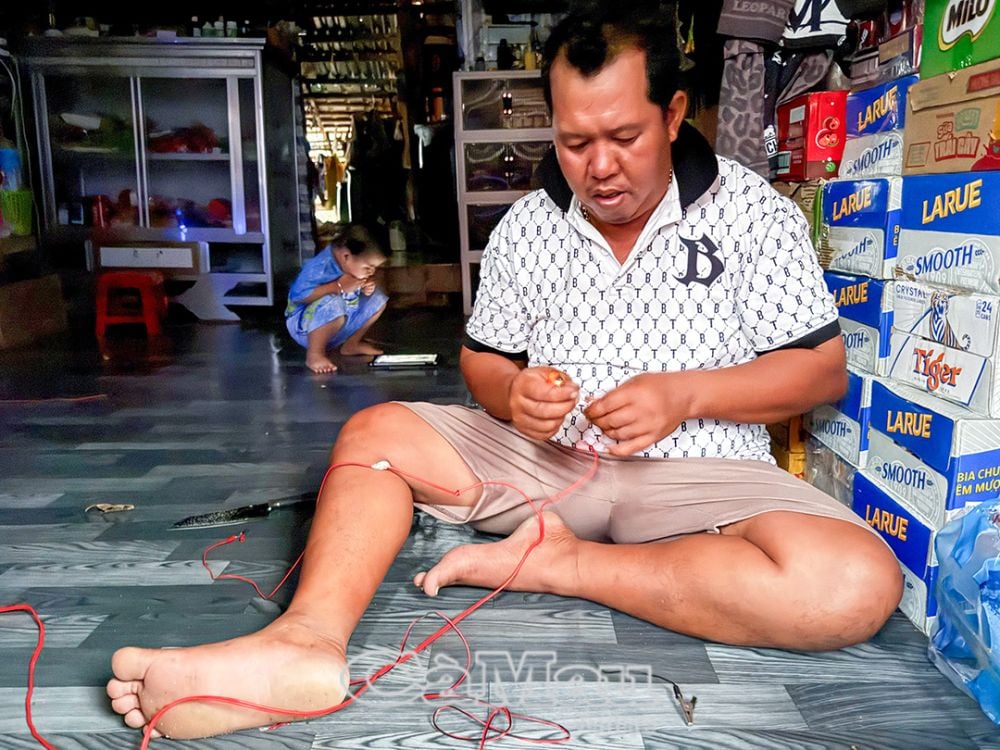 Mr. Kim Van Hau was diligently reconnecting the wires of a light bulb powered by a battery.
Sharing the same sentiment, Mr. Le Van Ut, who has been involved in cage fish farming for over 16 years, expressed: "The biggest wish of the people is to have stable electricity and clean water. Then, life will be less difficult, and business will be more convenient."
Amidst the existing challenges, Hon Chuoi Island continues to serve as a bulwark at the forefront of the waves. While Hon Khoai Island is being developed with large-scale projects, Hon Chuoi quietly fulfills its role as a "fortress" protecting maritime sovereignty.
As evening fell and we left the island, the flickering battery-powered lights on the rocky cliffs evoked many thoughts. Here, sovereignty is not only affirmed by constructions or equipment, but also nurtured by the simple aspirations of the people: the desire for electricity and fresh water. Therefore, early votes are not just a civic right, but also a belief in a brighter future on this frontier island of the Fatherland.
Nguyen Quoc
Source: https://baocamau.vn/hon-chuoi-mau-xanh-cua-niem-tin-bam-bien-a127128.html
![[Image] Close-up view of the interchange connecting the two expressways and Long Thanh Airport.](https://vphoto.vietnam.vn/thumb/1200x675/vietnam/resource/IMAGE/2026/05/25/1779703378210_ndo_br_z7863716673926-224453a31600126cce10622af6290afd-4549-jpg.webp)

![[Image] Hanoi's urban life under the challenge of a "scorching hot" environment](https://vphoto.vietnam.vn/thumb/1200x675/vietnam/resource/IMAGE/2026/05/25/1779706979265_nang-nong-t5-2026-minh-duy-7-4636-jpg.webp)










































































Comment (0)