

I've known Hua Tu Hoai since the early days of the Bac Thai Provincial Association of Literature and Arts (in 1987). He was a quiet and reserved person, so reserved that he was almost excessively sociable. I never saw him appear or speak anywhere, not even at the Association's or branch's meetings. Moreover, he was someone who didn't like to promote himself, so back then, few artists in the province knew him, or only considered him a mediocre painter.
 |
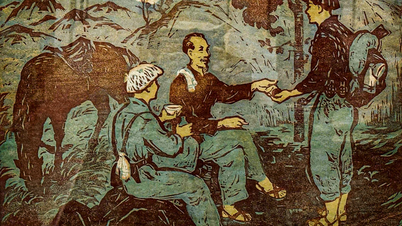
| Sketch of "Uncle Ho in the Định Hóa ATK (Anti-French Resistance Zone)". |
In fact, even in the late 1970s and early 1980s, Hua Tu Hoai's works had won many major awards. However, during those years, Bac Thai province did not yet have an Art Association, and the arts and culture movement was not yet developed, so his valuable achievements were not widely publicized. It was only in the early 1990s, when his sculptures and reliefs were continuously created, participating in national exhibitions and winning many awards, that the name Hua Tu Hoai truly became known and admired by the art community in particular and the literary and artistic community in general, both within and outside the province. For me personally, the works he created during those years left a profound surprise and impression on me. Not only because they were high-ranking awards from the Vietnam Fine Arts Association, but also for other reasons. Typically, during that period, artists in Northern Thailand and throughout the country tended to focus on one-sided praise, with few touching upon pain and loss... Hua Zi Huai was completely different. The humble people at the bottom of society, the dark sides, and the tragedies of life were among the important themes and subjects in his works. Many of Hua Zi Huai's sculptures depict characters who are sometimes just hardworking farmers, searching for crabs and snails, fishing, or going angling, their faces etched with hardship in every grain of wood – people struggling for food and clothing – deeply moving the hearts of viewers. Through Hua Zi Huai's sculptures and reliefs, I recognize that his artistic thought is very close to humanistic thought and Zen philosophy. These works consistently embody a dualistic philosophy: heroism is intertwined with tragedy, joy with sorrow, glory with pain, destruction with reconstruction, winter with spring, stillness with movement… and vice versa.
 |
| Sculptor Hua Tu Hoai (1942 - 2008) |
Being a humble person, Xu Zihai never publicly declared his artistic manifesto. However, it's evident that from the very beginning of his creative career, he had already established a very distinct artistic style. This is something few artists possess. Admiring and respecting him, I occasionally visited and chatted with Xu Zihai.
I remember the first time I went to his house. When I reached the beginning of the street, I asked some men playing chess on the sidewalk for directions. One of them looked up:
- Are you asking about Mr. Hoai the carpenter?
Mr. Hoai, a carpenter? I was somewhat surprised, but then I understood immediately, because his sculpting work didn't look much different from that of a carpenter. People in the city probably didn't know what a sculptor was.
The man looked at me searchingly and added:
"Hey, even though he's a carpenter, he's really arrogant. He's always sawing and chiseling up on the fourth floor. He only looks down when he hears the doorbell, and if it's just a visitor coming to chat, then stop, never invite him in. Look over there… He has two stone lions guarding the front door."
I thanked the person who gave me directions. I felt a little nervous when I rang his doorbell. But luckily, about five minutes later, he opened the door and invited me in.
Even after we became close friends, whenever I visited, he would usually only "welcome" me in his small room on the fourth floor, which served as his art studio. He would diligently create or refine his artwork while engaging in brief, friendly conversation. He was someone who cherished every minute for his creative work. I know that it was in this art studio, less than 20 square meters in size, that many of his works reached audiences nationwide and internationally.
Getting to know him better, I learned that Hua Tu Hoai wasn't from Thai Nguyen. He was born in 1942 in Trang Dinh, Lang Son, and was of the Nung ethnic group. After graduating from the Sculpture Department of the Hanoi University of Fine Arts, Hua Tu Hoai worked at the former Viet Bac Museum and from there established his career in Thai Nguyen city, which has become his second home.
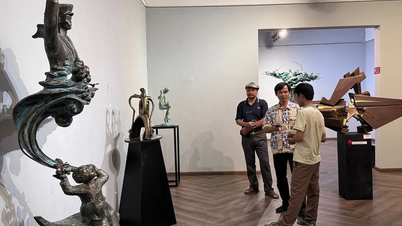
At the Vietnam Fine Arts Museum, the work "Soong sly," created during his relatively young years but already standing alongside works by master painters in Vietnam, demonstrates the significant position Hứa Tử Hoài holds in the country's art scene. Many generations of visitors to the Vietnam Museum of Ethnic Cultures have forgotten his sculptures and reliefs in bronze, wood, and stone, such as "Uncle Ho with Highland Youth," "Elephant Racing Festival," and "Highland Market," displayed in large sizes on the museum's vaulted ceilings and walls.
I know that, although he has achieved success with hundreds of statues and reliefs, including monumental monuments, what Hứa Tử Hoài cherishes most and devotes the most time and effort to are works about the fate of people in war. Works on this theme, such as "Tragic Heroism," "Stronger Than Bombs and Bullets," and "Memories of War," have all won high awards in national art exhibitions and the Vietnam Fine Arts Association. In particular, the work "Nightmare," which won first prize at the Vietnam Fine Arts Association in 1996, is a work that he once confided to me in a few brief words: "It is the culmination and condensation of my entire artistic life."
In depicting the losses of war, Xu Zihuai often effectively utilizes the "empty spaces" on the sculptures' bodies. These are wordless spaces, yet they are filled with artistic language. In other words, Xu Zihuai found a philosophy for these "empty spaces" in sculptural art. Within them, there is a profound understanding of suffering and aspirations, tragedy and indomitability, pride and sorrow, glory and bitterness. It is all that the nation had to endure during the arduous war for national liberation.
Perhaps that is why most of Xu Zi Huai's works on the theme of war have a modern feel, exuding a profound sense of humanity. Around the early 2000s, after attending the Vermont Studio Center (VSC) art workshop organized by a prestigious American art organization, Xu Zi Huai completed three works: "Memories of War," "Cold," and "Fishing." All three works are very small in size but address major issues of the era: the love of peace and the desire to dispel the shadow of war…
In particular, Hua Tu Hoai greatly admired and respected President Ho Chi Minh. He dedicated considerable time to creating statues and reliefs of the President. Since 1990, his work "President Ho Chi Minh Returning to the Village," depicting the warm and affectionate feelings of President Ho Chi Minh towards the people of the Viet Bac highlands, has been awarded a Gold Medal at the national art exhibition. Just three years later, his work "President Ho Chi Minh with Children of the Highlands" was created and displayed in the Viet Bac Museum (now the Museum of Ethnic Cultures of Vietnam).
 |
| A sketch of "Uncle Ho in the Định Hóa ATK" by sculptor Hứa Tử Hoài. |
It had been a while since I last visited the attic – the small "art workshop" of Hua Tu Hoai. Upon my return, I was surprised and moved to find him busily completing the sketches for a series of sculptures he tentatively titled "Uncle Ho in the ATK Dinh Hoa." Hua Tu Hoai had confided in me many times that this work was something he had been nurturing for a long time, or rather, it had begun when he was a high school student, after reading and studying To Huu's poem "Viet Bac." The romantic and profound image of Uncle Ho, emanating from the lines "Remembering Him in the early morning mist / Calmly riding his horse on the stream's murmur / Remembering His footsteps climbing the pass / As He goes, the mountains and forests watch His shadow," served as his initial inspiration, driving him throughout his artistic journey. According to his plan, the entire work will consist of 12 sculptures, divided into two groups, recreating the image of Uncle Ho in the Viet Bac war zone. Hứa Tử Hoài added that he will focus his essence and intellect on highlighting the image of President Ho Chi Minh "calmly on horseback" on his way to meetings and work trips, as in the poem by Tố Hữu. Each painting will represent a unique artistic style, a profound philosophy, and a warm affection for President Ho Chi Minh.
When I arrived, the sketches for the group of statues were in their final stages of completion. When I asked about the message of the work, Hua Tu Hoai enthusiastically said: “I think President Ho Chi Minh calmly seated on horseback is the most beautiful, romantic, and typical image from his days in the ATK Dinh Hoa. Although it depicts President Ho Chi Minh during wartime, my intention is to convey that it is a great symbol of peace.”
Hứa Tử Hoài hopes that, upon completion of the artwork, he will be able to request permission to display it at the Ho Chi Minh Memorial House in Phú Đình (Định Hóa - Thái Nguyên). This is his spiritual gift to President Ho Chi Minh and the resistance capital.
But then, on April 15, 2008, due to a serious illness, Hua Zi Huai unexpectedly passed away. The series of statues of President Ho Chi Minh had only been completed in its preliminary stages. From that fateful moment, the small room – the art studio – was devoid of the presence of the artist who had diligently dedicated his entire life to creation.
Like any true artist, Hứa Tử Hoài has passed away but left behind a great legacy. His works will undoubtedly endure in the history of Vietnamese art. It is regrettable that the series of works about President Ho Chi Minh, which he cherished throughout his life, has only been completed in its preliminary stages. But as someone once said, a great artist is one who, until their dying day, leaves behind a work they never had the chance to do, and the most successful works are those yet to come.
Source: https://baothainguyen.vn/van-nghe-thai-nguyen/chuyen-muc-khac/202605/hua-tu-hoai-nha-dieu-khac-tai-hoa-58b40ba/


![[Image] Hanoi's urban life under the challenge of a "scorching hot" environment](https://vphoto.vietnam.vn/thumb/1200x675/vietnam/resource/IMAGE/2026/05/25/1779706979265_nang-nong-t5-2026-minh-duy-7-4636-jpg.webp)
![[Image] Close-up view of the interchange connecting the two expressways and Long Thanh Airport.](https://vphoto.vietnam.vn/thumb/1200x675/vietnam/resource/IMAGE/2026/05/25/1779703378210_ndo_br_z7863716673926-224453a31600126cce10622af6290afd-4549-jpg.webp)
































































Comment (0)