

Reading the alphabet is a fundamental skill that everyone should know, especially young children preparing to enter first grade. Besides school time, parents should also dedicate time to guiding their children on how to read and pronounce the alphabet correctly, as children at this age lack the ability to concentrate and remember well.
 |
| How to read and pronounce the alphabet. |
Detailed instructions on how to read and pronounce the Vietnamese alphabet.
The Vietnamese alphabet consists of a total of 29 letters, including 11 vowels and 18 consonants. In addition, there are 10 numbers from 0 to 9 and 5 tone marks (tilde, question mark, acute accent, grave accent, and dot below) to distinguish the sounds in words.
Alphabet
- Vowels: a, ă, â, e, ê, i, o, ô, ơ, u, ư
- Consonants: b, c, d, đ, g, h, k, l, m, n, p, q, r, s, t, v, x, y
Digits
- 0, 1, 2, 3, 4, 5, 6, 7, 8, 9
Tone mark
- Tilde (~)
- Question mark (?)
- Accent mark (´)
- grave accent (`)
- Dot (.)
Each letter in the Vietnamese alphabet has its own pronunciation and sound combination to form meaningful words. Mastering the correct pronunciation of the alphabet will help children build a solid language foundation, thereby developing writing and communication skills confidently.
Learning and practicing the alphabet is not simply about studying; it's also a process of discovering the culture and traditions of the country. Therefore, choosing appropriate educational resources is crucial.
The alphabet chart at Thepoetmagazine.org is the perfect choice to help children access and learn in the most comprehensive and effective way possible. This is a new section recently created and shared for free by our editorial team. Simply visit the website, select the "Academic" section, and choose the Vietnamese alphabet chart to receive pronunciation guidance and listen to the correct pronunciation for each letter.
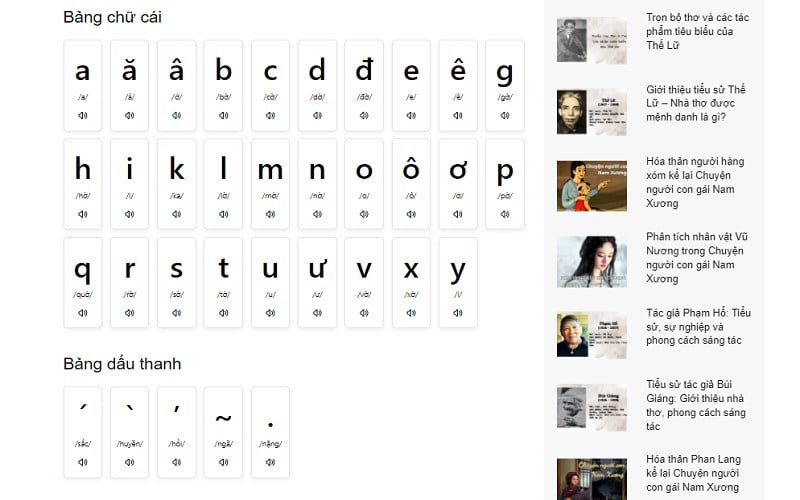 |
| Learn the alphabet at Thepoetmagazine. |
The website currently compiles comprehensive content related to teaching and learning the alphabet, such as:
- How to read the 29 letters of the alphabet, 10 numbers, and 5 tone marks.
- How to pronounce single, double, and triple vowels.
- How to pronounce single, double, and triple consonants.
- How to write the printed and cursive alphabet.
Sharing tips for learning the alphabet quickly.
To help children learn the Vietnamese alphabet quickly and effectively, you can apply some of the following learning tips:
Regular practice: To remember and master something, regular practice is crucial. Children should dedicate time each day to reinforcing and improving their skills. By repeatedly reading and writing letters, they will gradually become familiar with the correct pronunciation and spelling.
Using the alphabet at The POET magazine: The POET magazine provides a free and easily accessible resource to help children learn anytime, anywhere. The alphabet chart is not only comprehensive but also includes supporting features such as pronunciation guides and fun activities to help children absorb knowledge naturally.
Combining practice with literature: To make learning the alphabet more enjoyable and effective, children can combine practice with reading poetry, folk songs, and nursery rhymes. These literary works not only help children become familiar with the language but also help them understand more about the culture and traditions of their nation.
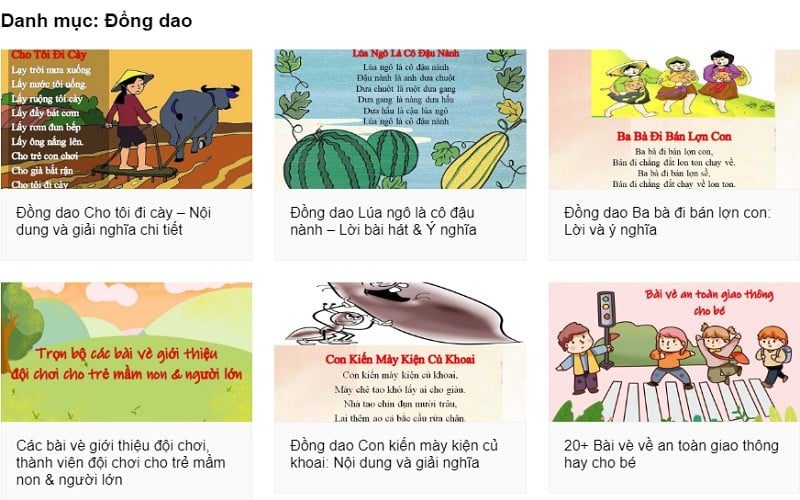 |
| Here are some great nursery rhymes for children to practice. |
Group learning: Create a communal learning environment where children can learn together with their peers. Group learning fosters connection and support among children, making them feel more comfortable during the learning process and promoting progress. At home, parents can show their children alphabet learning videos on YouTube or TikTok with lively sounds and colorful images to stimulate their interest and love of learning.
Developing a positive learning environment: Ultimately, children's learning environment needs to be positive, encouraging learning and self-challenge. Parents and teachers should create conditions where children can learn freely and without pressure.
Encouraging and motivating children as they achieve their learning goals is also crucial to keeping learning a positive and enjoyable experience.
These learning tips not only help children quickly access and grasp the alphabet but also help them develop comprehensive language skills. Learning the alphabet is a crucial first step in language learning and will provide a solid foundation for their later literary and writing skills.
Conclusion
Learning the Vietnamese alphabet is a crucial first step in a child's language learning journey. With the support of educational resources like The POET magazine, children can easily access and grasp the knowledge effectively. Hopefully, this article will provide parents and teachers with more fun and effective learning methods for children.
Source: https://baoquocte.vn/huong-dan-cach-doc-phat-am-bang-chu-cai-viet-nam-276382.html

![[Photo] General Secretary and President To Lam presides over a meeting with the Central Organizing Committee.](https://vphoto.vietnam.vn/thumb/1200x675/vietnam/resource/IMAGE/2026/06/03/1780482764658_a1-bnd-4741-3342-jpg.webp)
![[Photo] First session of the 14th Congress of the Vietnam Trade Union](https://vphoto.vietnam.vn/thumb/1200x675/vietnam/resource/IMAGE/2026/06/03/1780465947883_ndo_br_img-3852-jpg.webp)


![[Photo] Secretary of the National Assembly Party Committee, Chairman of the National Assembly presides over the meeting of the Standing Committee and Executive Committee of the National Assembly Party Committee.](https://vphoto.vietnam.vn/thumb/1200x675/vietnam/resource/IMAGE/2026/06/03/1780480353201_ndo_br_bnd-2585-jpg.webp)

















































![[Video] Sunset at Lap An Lagoon – Where the sun sets over the fishing nets](https://vphoto.vietnam.vn/thumb/1200x675/vietnam/resource/IMAGE/2026/05/31/1780192137701_beach-landscape-sea-water-nature-grass-745871-pxhere-com.jpeg)







































Comment (0)