

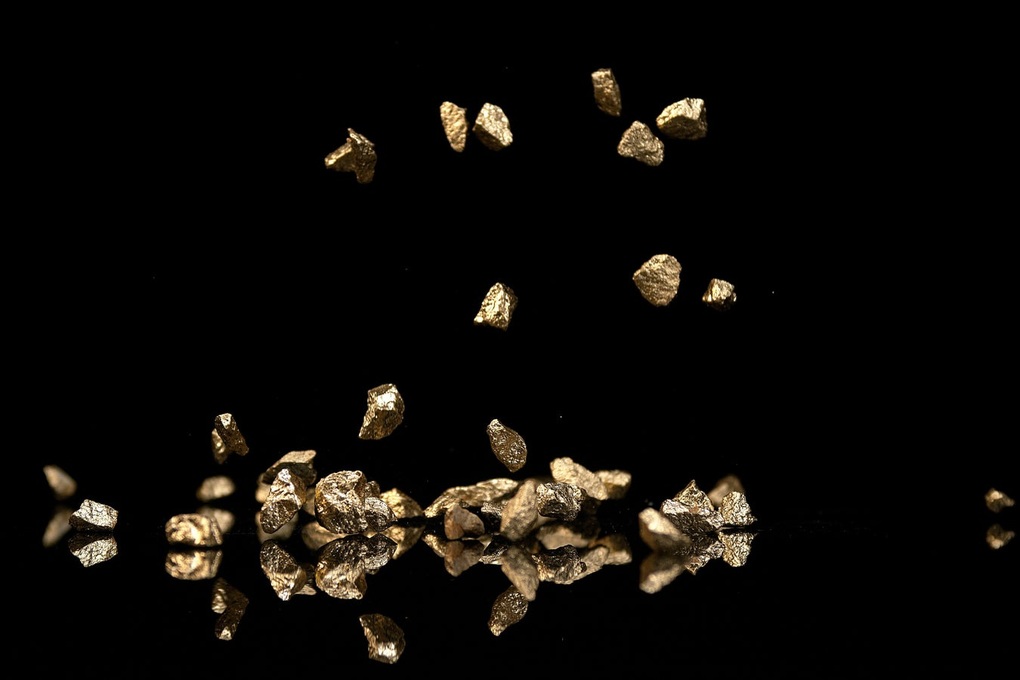
LHC experiments don't produce large lumps of gold, but some particles in the lead ion beam can turn into gold in about a microsecond (Illustration: Getty).
The dream of 17th-century alchemists was realized by physicists at the Large Hadron Collider (LHC) when they turned lead into gold - albeit in a fraction of a second and at great cost.
The process takes place at the European Organization for Nuclear Research (CERN), which houses the multi-billion-dollar LHC machine that can collide lead ions.
Ancient chemists hoped to turn the abundant element lead into the rare gold. However, the difference in the number of protons between the two elements (82 for lead and 79 for gold) made this impossible by conventional chemical methods.
Researchers at CERN achieved this by aiming beams of lead ions at each other, moving at nearly the speed of light. Sometimes the ions brushed past each other instead of colliding head-on.
When this happens, the powerful electromagnetic field surrounding an ion can create a pulse of energy, stimulating the incoming lead nucleus to shoot out three protons – and turn it into gold.
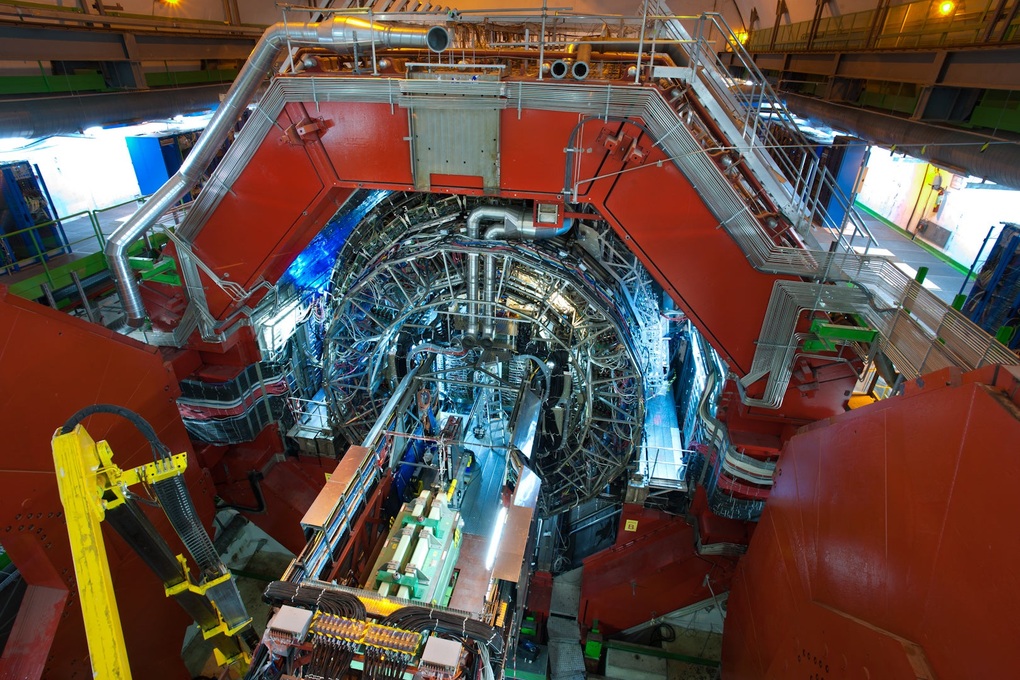
ALICE detector at CERN (Photo: CERN).
The LHC’s ALICE experiment separated these mutant cases from larger collision debris. In an analysis published on May 7 in the journal Physical Review, the team calculated that between 2015 and 2018, collisions at the LHC created 86 billion gold nuclei—equivalent to about 29 trillionths of a gram.
Most of these unstable, fast-moving gold atoms only exist for about 1 microsecond before hitting the experimental equipment or breaking into other particles.
Gold is created whenever lead beams collide at the LHC, but ALICE is the only experiment with detectors set up to detect this process.
“This analysis is the first time that a signature of gold production at the LHC has been experimentally detected and systematically analyzed,” said Uliana Dmitrieva, a physicist and member of the ALICE collaboration.
According to Jiangyong Jia, a physicist at Stony Brook University in New York, another CERN accelerator called SPS observed lead turning into gold between 2002 and 2004. However, he added, the latest experiments at the LHC have higher energies, a much greater ability to create gold, and clearer observations.
CERN researchers have no plans to produce gold as a sideline. Instead, they say a better understanding of how photons can change nuclei will help them improve the LHC's performance.
"Understanding such processes is important for controlling the quality and stability of particle accelerator beams," says Jia.
Source: https://dantri.com.vn/khoa-hoc/khoa-hoc-thanh-cong-bien-chi-thanh-vang-20250510225039126.htm








![[Video] Producing high quality dried bamboo shoots using heat pump drying technology](https://vphoto.vietnam.vn/thumb/402x226/vietnam/resource/IMAGE/2025/12/08/1765155799525_avatar-of-video-1031232-png.webp)









































































Comment (0)