

During a roundtable conference on inclusive governance of climate change, I was startled to hear indicators that the frequency of natural disasters and floods is increasing rapidly in many places around the world , and Vietnam is no exception.
The damage figures and the unusual floods make everyone think. Survival skills, especially swimming, are no longer a "nice to have", but have become a "must have". I am clearly aware that I am lacking an important skill that can protect myself in an emergency.
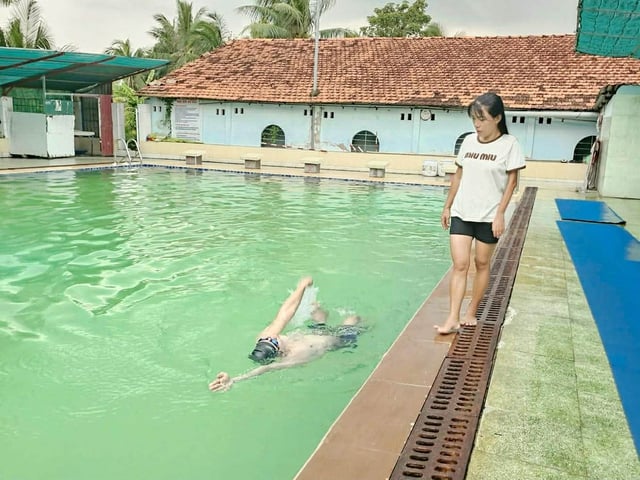
In the early days, I was taught swimming for free by a disabled teacher.
Photo: NVCC
The real push came to me when I wrote the article "For a greener life" - a story about a disabled swimmer who tirelessly spreads knowledge to poor students, published in Thanh Nien Newspaper. The character's journey of overcoming her limits made me wonder: "If she can do it, why don't I try?". So, I decided to learn to swim.
Luckily, my instructor was also disabled. We met through the understanding of imperfect bodies. She patiently showed me every little movement, from how to breathe, relax, to how to let my body blend into the water.
And after just one session, I was able to swim. That feeling, light and happy, I felt like a new door had opened for myself. A deep, unforgettable impression.
The circle of connection is wider and warmer
Since I started swimming in the blue water, my health has changed significantly: better physical strength, deeper sleep, more stable mood. My weak legs are also more flexible and less painful than before. At the pool, I also meet many people: elderly people practicing to improve their health, children learning to prevent drowning, young people looking for relaxation after work. My circle of connections has become wider and warmer.
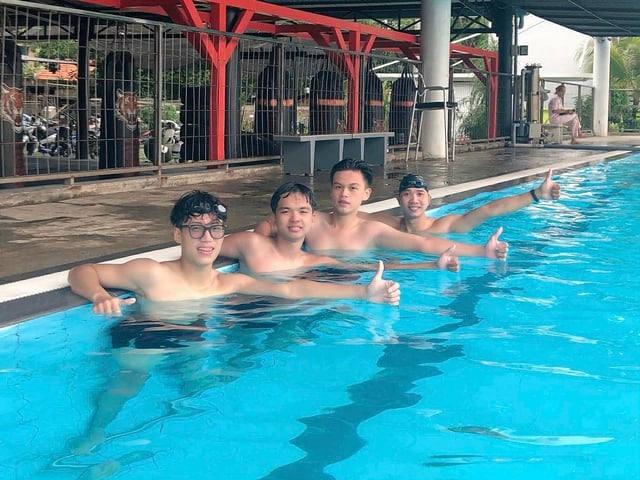
Since I learned to swim, I have made many new friends.
Photo: NVCC
From a psychological perspective, swimming not only brings physical benefits but is also an effective therapy for mental health care. Many studies have shown that swimming helps reduce stress hormones, increases the secretion of endorphins - "happy hormones", bringing a state of deep relaxation similar to meditation. The feeling of the body being supported in the water helps us return to inner balance.
In other words, swimming is also a way to take care of your own "mental garden": water soothes stress, washes away worries and waters the "lands" we have long forgotten to care for.
During my seminars at schools, I often ask students, "How many of you know how to swim?". What I get is a surprisingly small number of raised hands. Many admit that they are afraid of water, or have never been exposed to it. This makes me worried, because in times of unpredictable natural disasters, knowing how to swim not only helps ensure personal safety but is also a social responsibility.
From my journey, I always encourage young people: don't wait, start learning to swim as soon as possible. Change only comes when we dare to overcome fear. And I am happy when I receive messages from students: "Teacher, thanks to your inspiration, I have registered to learn and know how to swim!", or "Teacher, knowing how to swim is so great!". And even greater joy is when a friend who used to be very afraid of water proactively asks: "When there is a chance, can we swim together?".
For me, swimming is not only for healthy people but for all those who want to become stronger. So, are you ready to immerse yourself in the cool water to make life more refreshing and happier?
Water is always there, gentle, clear and ready to support us. Just give it a try, and you might find a "garden of the heart" waiting to be revived.
Source: https://thanhnien.vn/khoe-cuoi-tuan-cham-soc-vuon-tam-tu-lan-nuoc-xanh-185251129200547862.htm

![[Photo] Dan Mountain Ginseng, a precious gift from nature to Kinh Bac land](/_next/image?url=https%3A%2F%2Fvphoto.vietnam.vn%2Fthumb%2F1200x675%2Fvietnam%2Fresource%2FIMAGE%2F2025%2F11%2F30%2F1764493588163_ndo_br_anh-longform-jpg.webp&w=3840&q=75)






















































Comment (0)