

“Vast fields of lush green rice paddies / Tall towers stand majestically, moonlight casting shadows on the betel nut trees / A landscape before and after / An ancient painting imbued with the colors of the land.” These verses skillfully paint a picture of the countryside of But Thap ( Bac Ninh province) that is both simple and charming.
The simple colors, combined with the elegant harmony of the countryside, create a scene as beautiful as a fairy tale. Following those poetic words, we journeyed to But Thap, nestled beside the lush green embankment of the Duong River, where year-round the wind stirs the water's surface, and the rice and corn fields rustle like a lullaby of the countryside.
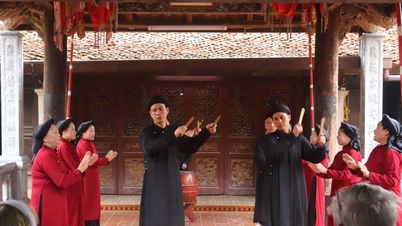
Another opportunity to return here arose from the warm invitation of Mr. Nguyen Sy Luong, the chairman of the Phu My Singing Club (Tri Qua ward, Bac Ninh province), a Quan Ho folk singer. He invited us to attend a Quan Ho folk singing performance on the occasion of the 20th anniversary of Vietnam's Cultural Heritage Day (November 23, 2025), held within the grounds of the renowned But Thap Pagoda, famous for its four national treasures.
|
Male and female singers participate in a Quan Ho folk singing performance within the grounds of But Thap Pagoda (Bac Ninh). Photo: DUC NAM |
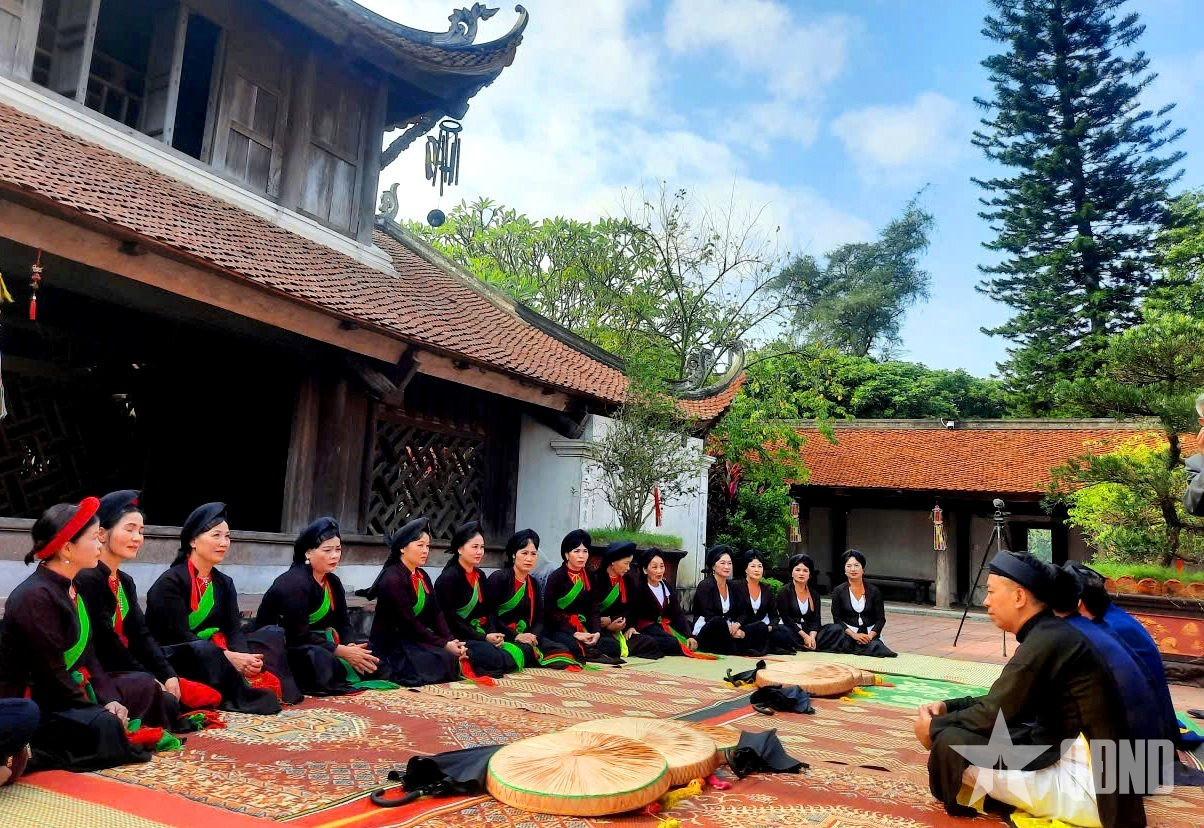
Winter had arrived, but the weather wasn't yet bitterly cold; the sun shone brightly, and the grass rustled. We followed the embankment of the Duong River to But Thap Pagoda. The ancient temple stood out like a vibrant brushstroke amidst a verdant landscape. Its dark brown tiled roof, the gracefully curved eaves, and the gleaming pen-shaped pagoda painted against the clear blue sky. As soon as we reached the main gate, we recognized Mr. Nguyen Sy Luong, with his refined appearance and gentle smile. He shook our hand firmly and greeted us warmly. Following the custom of the Quan Ho people, even the elderly address each other as "brother" or "sister" and refer to themselves as "younger sibling." Following the local custom, we also respectfully called him "Brother."
I've known Mr. Luong since our enrollment at the Political Officer Training School. The school is located within the ancient citadel, nestled in a region rich in Kinh Bac culture. Back then, I was a cadet and he was a company officer. I respected him for his tolerance, sincerity, and approachability. Perhaps these qualities stemmed from his background in Bac Ninh, deeply imbued with the beauty of Quan Ho folk music. I vividly remember the first two months of the year, sitting within the citadel, listening to the sweet melodies of Quan Ho folk songs carried on the wind. Then I also had the opportunity to participate in the spring festival, immersing myself in the spirit of the Quan Ho people. Even now, after many years, I still feel his genuine warmth and kindness. Mr. Luong is deeply devoted to his homeland; after completing his official duties and retiring, he established the Phu My Singing Club. The name is truly meaningful, signifying a prosperous and beautiful region, rich in both material life and spiritual culture. The people in his hometown are hardworking and diligent, striving to build spacious houses, but they also love music and singing, working together to preserve the cultural heritage left by their ancestors. The club was established to serve as a bridge connecting those who enjoy singing, fostering interaction and sharing with friends near and far.
Taking advantage of the leisurely winter season, brothers Nguyen Sy Luong and Ngo Thanh Giang, both well-versed in culture and Quan Ho folk songs, along with their friends, extended an invitation to a "reunion of bamboo and plum blossoms" with the male and female singers from the three ancient Quan Ho villages of Bac Ninh: Diem, Hoai Thi, and Thi Cau, to participate in a traveling singing program. Accepting the invitation, despite the long distance, the male and female singers from the three ancient Quan Ho villages prepared betel nuts, incense, flowers, tea, and fruit to attend the singing performance.
Entering the main hall of But Thap Pagoda, the group lit a week's worth of incense, clasped their hands in prayer, and sang the song: "Entering the pagoda, the pagoda opens its doors, oh oh oh / The pagoda doors open, I enter..." The fragrant incense and the resonant song warmed the entire ancient temple space. After the Buddhist ritual, the whole group prepared to begin the singing session. Sitting on a red-bordered mat, Mr. Nguyen Van Thuong, a visitor from Diem village, spoke: "We are so fortunate to be here to visit the pagoda and hear the ancient stories. The warm welcome from you, sir and madam, is truly precious. We would like to offer this song as a token of our gratitude for your kindness."
Following the opening lines of the song, the male duo Nguyen Sy Yen and Nguyen Van Quan sang: "Today, friendship reigns throughout the four seas / Though from four corners of the earth, we are born as one family..." In response, the female duo Ngo Thi Tien and Nguyen Thi Chieu sang: "Today, orchids and lilies are paired together / The eastern peach blossoms ask the western willows a few words..." The perfectly matched and harmonious singing style pleased both sides.
![[Photo] General Secretary and President To Lam presides over a working session with the Central Policy and Strategy Committee on the development of the materials industry.](https://vphoto.vietnam.vn/thumb/1200x675/vietnam/resource/IMAGE/2026/05/21/1779359935432_a3-bnd-3129-1412-jpg.webp)
![[Photo] National Assembly Chairman Tran Thanh Man working with the Standing Committee of the Law and Justice Committee](https://vphoto.vietnam.vn/thumb/1200x675/vietnam/resource/IMAGE/2026/05/21/1779378929214_ndo_br_1-4610-jpg.webp)
































































Comment (0)