


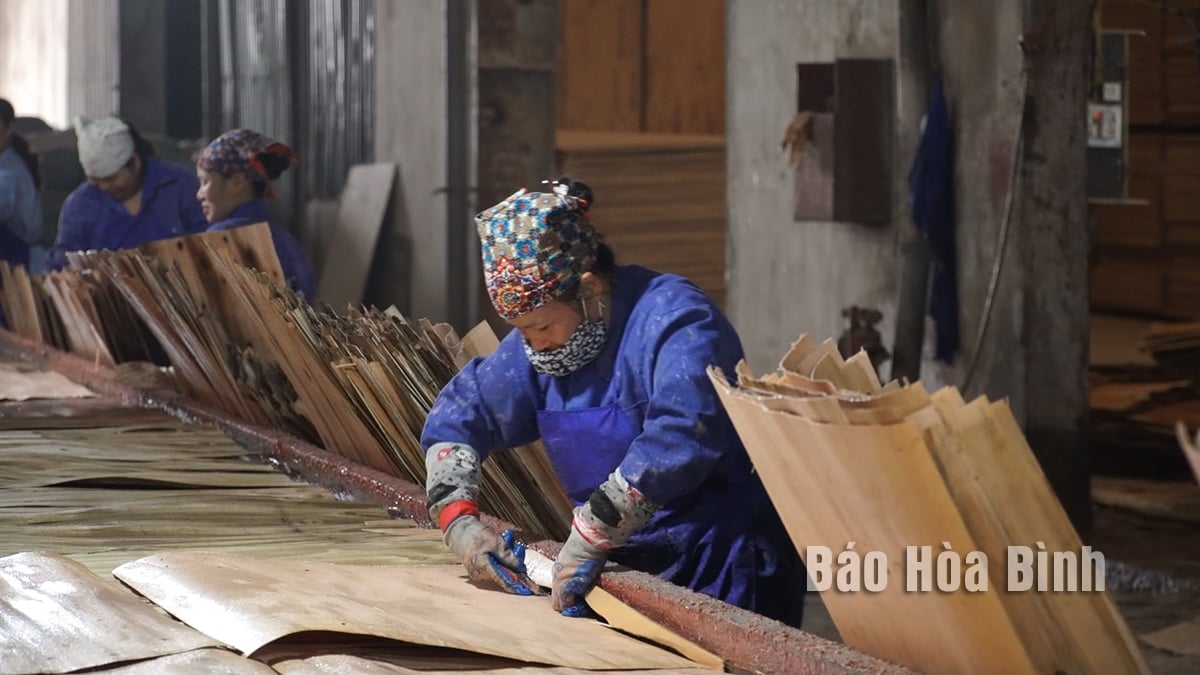
Son Thuy Co., Ltd. (Mong Hoa commune, Hoa Binh city) not only focuses on exploiting raw timber, but also contributes to the development of the forest product value chain in Hoa Binh - from forest planting to deep processing.
Hundreds of billions of dong are earned from forests every month.
There's no need to wait until the end of the year; in May alone, the forests of Hoa Binh province "paid" over 134 billion VND to those who know how to live in harmony with them. This is the result of controlled exploitation, responsible care, and calculated commitment.
According to a report by the People's Committee of Hoa Binh province, the entire province has harvested over 1,560 hectares of concentrated plantation forests, yielding over 135,000 m³ of timber, including 3,200 m³ of large timber – a high-value type favored by the market. But the special thing is not in the "large timber," but in the smaller products.
During the same period, people harvested 383,800 bamboo trees, yielding 293 tons of fresh bamboo shoots, 99 tons of medicinal herbs, 28,585 kg of forest honey, along with tens of thousands of banana leaves, firewood, and other forest products. While these amounts might seem insignificant individually, the total income earned by people and economic organizations from the forest in May reached 134.7 billion VND.
According to the Department of Agriculture and Environment, this is a very noteworthy figure, especially since it does not originate from large-scale logging. This shows that the sub-forest economy, particularly non-timber forest products, is becoming a real pillar in the lives of people in mountainous areas.
On average, the people of Hoa Binh earn more than 4.5 billion VND per day from what quietly grows beneath the forest canopy. From an economic perspective, forests are no longer an impenetrable "green wall," but are gradually becoming a "treasure trove of soft resources" that can be sustainably exploited if appropriate policies are in place.
Preserve the forest - preserve livelihoods.
Forest-based economies are thriving, but sustainability is another matter entirely. A forest that generates good income today can be depleted after just a few seasons if there's no planned staggered planting, no controlled harvesting, and no preservation of seed sources and the understory ecosystem. Preserving forests to ensure a sustainable livelihood has never been an easy task.
In May, two forest fires occurred in the province (in Lac Thuy and Cao Phong districts), damaging over 6 hectares. One case of illegal deforestation was also discovered. These are issues that cannot be taken lightly, as overexploitation, slash-and-burn farming, and land expansion for agricultural production still persist in traditional livelihoods.
According to the Forestry and Forest Protection Department of Hoa Binh province, the department is focusing on reviewing the planning of three types of forests, monitoring projects that convert forest land use, and promoting FSC-certified logging models linked to resource conservation.
In localities, the orientation of preserving forests and livelihoods from forests has been integrated into many programs such as: developing OCOP products from forest products; promoting the economy under the forest canopy; protecting forests in conjunction with people's livelihoods through projects under the National Target Program for socio-economic development in ethnic minority and mountainous areas.
Specific support has been provided through technical training in the preliminary processing of indigenous medicinal herbs; connecting the consumption of natural honey... If these actions are implemented synchronously, they will create a more effective forest protection belt than any prohibition signs or guard posts. Because people only truly protect the forest when they can make a living from it. And only policies that encourage sustainable exploitation are the longest stick, helping to lift the forest out of the endless cycles of cutting - planting - cutting.
Forestry, especially non-timber forest products, is quietly providing stable livelihoods for thousands of households in the province. Each bundle of bamboo shoots, liter of honey, each ton of medicinal herbs… is not just a raw product, but also the culmination of sweat, indigenous knowledge, and the way people choose to live in harmony with nature.
However, simply focusing on the 134 billion VND generated in a month is only a superficial observation. More importantly, how can we ensure the forest continues to generate income without being destroyed? How can we organize these silently productive products into value chains, process them further, build brands, and reach more distant markets, as envisioned by the province's OCOP program, digital transformation, and sustainable development? Forests are only truly green when they are not just places to live, but also places to work. Only then will the canopy cease to be merely shade and become a foundation for livelihoods, an ecological buffer, a boundary protecting land, villages, and preserving the dream of living amidst nature, not abandoning it.
Sea Swallow
Source: https://baohoabinh.com.vn/12/201783/Kinh-te-duoi-tan-rung.htm




















































































Comment (0)