

Establishing villages and building schools on the border.
In May, the border region of Quang Truc commune, Lam Dong province, is bustling with construction sites, sparkling with joy. Amidst the vast green of forests and coffee plantations, many new projects are springing up, demonstrating the special attention the Party, State, and Army are giving to the western border strip of Lam Dong province. In Bu Dar hamlet (Quang Truc commune), a residential area adjacent to the border militia outpost, comprising 60 houses, a football field, a community center, internal roads, and a lighting system, is forming a new, spacious, and beautiful village, bringing great joy to dozens of households.
Mr. Dieu Lot, born in 1994, a resident of the new village, excitedly said: “My family is in difficult circumstances, and the dream of a sturdy, spacious house to raise our children in peace, stay on the border, and develop the economy has been a long-held aspiration. We are deeply moved to receive this new house and would like to thank the local authorities and the soldiers for giving us a new home.”
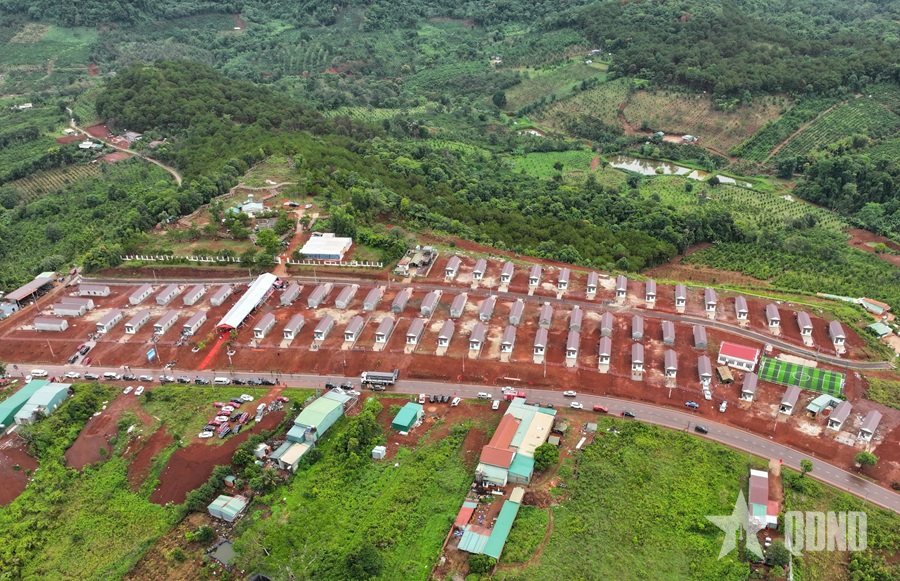 |
| An aerial view of a residential area adjacent to a border militia outpost in Quang Truc commune, Lam Dong province. |
The residential area adjacent to the border militia outpost, which commenced construction on February 6, 2026, has a total budget of 12.5 billion VND, of which Military Region 7 contributed 6.5 billion VND and the Lam Dong Provincial People's Committee contributed 6 billion VND. After two months of rapid implementation, it was completed and handed over to the households in time for the 51st anniversary of the Liberation of Southern Vietnam and National Reunification (April 30, 1975 / April 30, 2026). Spanning nearly 2 hectares, the residential area near the border marker is built uniformly, with each house having an area of nearly 50m² , including a living room, two bedrooms, a kitchen, a bathroom, a front yard, and a complete electricity and water system.
In addition to the new house, at the handover ceremony, each household also received a breeding cow, two beds, two wardrobes, a gas stove, and a television. For many families in difficult circumstances, the house and these meaningful gifts truly represent a dream home, helping them to have a better life and future.
Not far from the new village, the Quang Truc Primary and Secondary Boarding School is also nearing completion. Built on approximately 5 hectares of land, the school features a modern, open-plan design, suitable for the local terrain and landscape. It includes administrative blocks, a library, classrooms, a principal's office, a multi-purpose hall/cafe, dormitories, and other supporting facilities, ensuring optimal support for teaching and learning. It is expected that children from the new village will attend this school starting in the 2026-2027 school year. Along with the new school in Quang Truc commune, three other large and beautiful boarding schools are also under construction in Dak Wil, Tuy Duc, and Thuan Hanh communes, each covering 5 hectares and accommodating approximately 1,050 students, with a total construction cost of 225 billion VND. These schools demonstrate the special attention that the Party and the State have given to the younger generation in border areas.
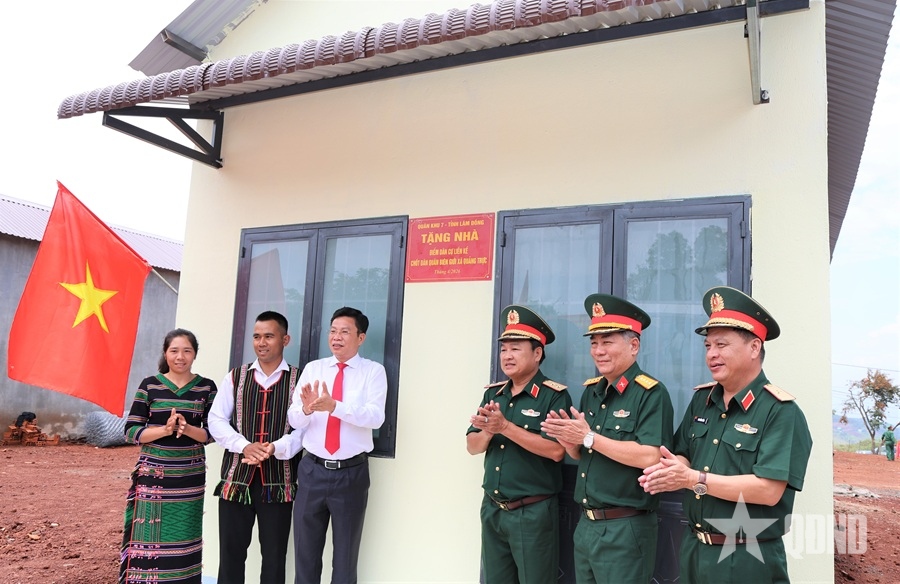 |
| Handing over houses to residents at the residential project adjacent to the border militia outpost in Quang Truc commune, Lam Dong province. |
Working together to build the border region.
Lam Dong province has approximately 141km of land border. Border communes are home to a large number of ethnic minorities, have underdeveloped infrastructure, and face many difficulties in people's lives. Therefore, developing the economy and culture, strengthening national defense and security, and building a peaceful, stable, friendly, and cooperative border are among the key tasks of the Lam Dong provincial Party committee and government after the merger. In early 2026, the Lam Dong Provincial People's Committee issued Decision No. 65/QD-UBND approving the project to stabilize the population in border communes and create livelihoods for ethnic minority people. The project is being implemented in five border communes: Tuy Duc, Quang Truc, Thuan Hanh, Thuan An, and Dak Wil. The goal is to reduce the poverty rate in these five border communes to below 3% by 2030; and strive for more than 80% of the workforce to receive training and have stable employment. Completing essential infrastructure systems for 36 villages and hamlets in ethnic minority areas facing extreme difficulties; allocating housing land for 860 households; providing production land for 1,027 households; supporting the construction of 402 houses that meet safety and sustainability standards; developing sustainable livelihoods linked to the transfer of advanced technologies and improving people's lives...
To implement the above plan, from the beginning of 2026 to the present, a series of projects in border communes have been launched, especially projects to build rural roads, provide healthcare, technical support, and support the provision of seedlings and livestock to households.
Throughout the project implementation, Lam Dong province has consistently received effective support and cooperation from the Central Government, the armed forces, and businesses. For the armed forces units, in addition to excelling in training, combat readiness, and firmly protecting national sovereignty and border security, they have also actively participated in socio-economic development. From the beginning of 2026 to the present, the Command of Military Region 7 has contributed funds and provided labor to build 60 houses in residential areas adjacent to border militia posts in Quang Truc commune; donated 10 houses of compassion to ethnic minority families in particularly difficult circumstances; and organized visits, gift-giving, and New Year celebrations for thousands of families in border areas. Lieutenant General Tran Vinh Ngoc, Secretary of the Party Committee and Political Commissar of Military Region 7, affirmed: "Joining hands to build the border of Lam Dong province is not only a responsibility but also an expression of the affection of the armed forces of Military Region 7 towards the people in general, and the people in the border areas of the province in particular, contributing to realizing the views of our Party and State on building a national defense posture, developing socio-economic conditions, consolidating national defense and security, and maintaining a peaceful, friendly, cooperative, and developing border."
Source: https://www.qdnd.vn/quoc-phong-an-ninh/quoc-phong-toan-dan/lam-dong-xay-dung-bien-gioi-binh-yen-giau-manh-1038872

![[Image] A brilliant symphony and explosive power in the skies of Da Nang.](https://vphoto.vietnam.vn/thumb/1200x675/vietnam/resource/IMAGE/2026/05/31/1780193150738_anh-bia-copy-jpg.webp)
![[Video] Sunset at Lap An Lagoon – Where the sun sets over the fishing nets](https://vphoto.vietnam.vn/thumb/1200x675/vietnam/resource/IMAGE/2026/05/31/1780192137701_beach-landscape-sea-water-nature-grass-745871-pxhere-com.jpeg)












![[Video] Sunset at Lap An Lagoon – Where the sun sets over the fishing nets](https://vphoto.vietnam.vn/thumb/800x450/vietnam/resource/IMAGE/2026/05/31/1780192137701_beach-landscape-sea-water-nature-grass-745871-pxhere-com.jpeg)


































![[Video] Sunset at Lap An Lagoon – Where the sun sets over the fishing nets](https://vphoto.vietnam.vn/thumb/402x226/vietnam/resource/IMAGE/2026/05/31/1780192137701_beach-landscape-sea-water-nature-grass-745871-pxhere-com.jpeg)































Comment (0)