
International tourists experience the local vegetable farming in Thanh Dong village (Hoi An Dong ward). Photo: QUOC TUAN
Freshening up the traditional craft village space.
In recent months, handicraft village tourism in Hoi An has continued to show significant progress.
In Thanh Dong vegetable village, residents have boldly organized small markets right in their gardens, selling organic vegetables and showcasing traditional farming tools and processes. The production space has thus become a tourist attraction, both intimate and authentic.
Bringing the farmers' market into the middle of the fields and gardens not only creates a new highlight for tourism products but also helps tourists directly interact with farmers, better understand the story of planting and cultivation, and the value of organic farming , aiming to reduce carbon emissions. This is a new approach but still based on the traditional way of life in Hoi An's countryside.
At Tra Que vegetable village, honored by UN Tourism as the "Best Tourist Village 2024," the experiential space has been upgraded to be more professional. Visitors not only tour the village but also get to experience life as a farmer, learning how to grow vegetables using seaweed harvested from the lagoon and understanding the unique cultivation techniques that have made Tra Que a renowned brand. The experience often concludes with a cooking class featuring local specialties, allowing visitors to fully connect from production to cuisine.
In traditional craft villages, innovation is clearly demonstrated through the way the story of the craft is told.
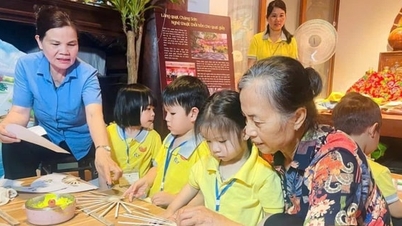
At Kim Bong carpentry village, experiential activities are designed with an educational focus, suitable for families and students. Visitors can learn about the history of the craft village, observe carpenters at work, and try their hand at simple tasks.
At Thanh Ha Terracotta Park, pottery is not just a display item but has become a tool for conveying knowledge about local history, architecture, and culture, gradually shaping the destination's brand as an educational tourism destination.
Notably, some production facilities have incorporated contemporary creative elements into the traditional craft village setting. At Taboo Bamboo workshop, bamboo is no longer just a familiar material in rural life but has been elevated to an artistic medium. Visitors can directly participate in crafting and creating personalized products, while also gaining a deeper understanding of the philosophy of using natural materials in a modern context.
These innovations show that Hoi An's craft village tourism is shifting from a "visit and observe the craft" model to an "experiential, interactive, and storytelling" model, helping to extend the length of stay and enhance the emotional quality of tourists.
Establishing a sustainable chain of destinations.
Along with refreshing experiential spaces, sustainability is gradually becoming an important criterion in the development of craft village tourism in Hoi An. Many community tourism models in suburban areas are being built with a focus on minimizing environmental impact, reducing waste, and using resources rationally.
In Thanh Dong vegetable village, organic production not only serves agriculture but also forms the foundation for sustainable tourism development. Locals focus on recycling waste, reducing plastic use, and expanding the area under organic farming. Experiential activities are organized on a moderate scale, suitable for the carrying capacity of the rural area, avoiding overcrowding like in the old town.
At some riverside community tourism destinations like Triem Tay and The Field, visitors are encouraged to use environmentally friendly transportation and listen to stories about the lives of local farmers, fishermen, and artisans. The experience is no longer just about "going out for fun," but becomes a process of understanding the harmonious relationship between humans and nature, between livelihoods and conservation.
Mr. Tae Il, a representative of a South Korean travel agency who recently participated in a tourism survey of craft villages in Hoi An, said that previously, the company mainly focused on traditional tourism products such as food, accommodation, and sightseeing in the ancient town. However, through the survey trip, the company recognized the enormous potential of rural tourism and craft village tourism in the areas surrounding Hoi An as well as in rural Da Nang. In the future, the company will rebuild its tour routes, strongly promoting agricultural and craft village tourism products to diversify its offerings and focus more on community benefits.
According to travel agencies, the handicraft village tourism product chain in Hoi An has now been relatively fully developed in terms of space, content, and message. The destinations are of appropriate scale, close to nature; the products are diverse and easily connected into tour routes; and they meet the requirements for cultural preservation and livelihood development.
The link between travel businesses and local communities is also gradually becoming closer. Instead of focusing on short-term gains, many businesses and local authorities are discussing ways to develop long-term products, emphasizing training tourism skills for locals, standardizing guest reception procedures, while still preserving the inherent rustic charm of the traditional craft villages.
According to Mr. Le Quoc Viet, Chairman of the Quang Nam Destination Club (Da Nang Tourism Association), nine travel agencies, both international and domestic, recently participated in a survey of Hoi An's traditional craft village products to supplement and improve tour routes.
“In reality, each village and each tourism model is changing in a more creative and flexible direction while still preserving the core local values. Localities are constantly investing in upgrading infrastructure and diversifying rural and community tourism products. This is an important foundation for businesses to expand their market and promote this sector more extensively in 2026 and the following years,” Mr. Viet said.
Source: https://baodanang.vn/lan-gio-moi-du-lich-lang-nghe-hoi-an-3320828.html





![[Photo] National Assembly Chairman Tran Thanh Man working with the Standing Committee of the Law and Justice Committee](https://vphoto.vietnam.vn/thumb/1200x675/vietnam/resource/IMAGE/2026/05/21/1779378929214_ndo_br_1-4610-jpg.webp)
![[Photo] General Secretary and President To Lam presides over a working session with the Central Policy and Strategy Committee on the development of the materials industry.](https://vphoto.vietnam.vn/thumb/1200x675/vietnam/resource/IMAGE/2026/05/21/1779359935432_a3-bnd-3129-1412-jpg.webp)



































































Comment (0)