

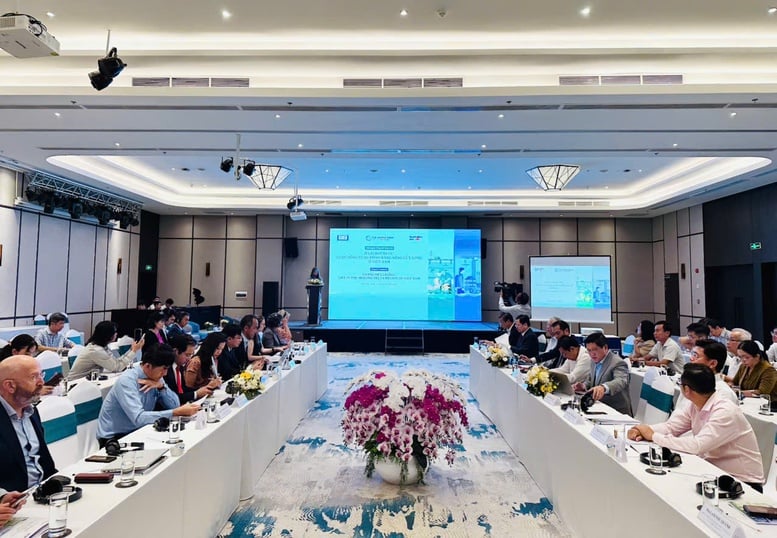
Leaders from central government agencies, provinces in the Mekong Delta, managers, and scientists attended the announcement ceremony - Photo: VGP/LS
World Bank Report: Warnings and Strategic Suggestions
On the afternoon of December 17th, in Can Tho City, the World Bank in Vietnam, Cambodia, and Laos, in collaboration with the Can Tho Institute of Economics and Society, held a conference to announce the results of a study titled: “Stay or Migrate: Life in the Mekong Delta in Vietnam.” The report, based on updated data on households and the labor market, focuses on analyzing the profound changes taking place in the country's largest delta region.
According to the World Bank, the Mekong Delta is increasingly affected by drought, saltwater intrusion, floods, and extreme heatwaves. These successive environmental shocks over the past decade have eroded agricultural incomes – the mainstay of livelihoods for millions of households in the region – while also increasing migration pressure.
The report shows that over the past 10 years, nearly 1.7 million people in the Mekong Delta have migrated in search of more stable livelihoods. However, migration is not always an effective "escape" from economic shocks. Although about 14% of households in the region have members working away from home, only 58% of them receive remittances. Notably, nearly half of these remittances are worth less than 5 million VND per year, an amount insufficient to lift households out of poverty according to national standards.
The region's economic role is declining, and the challenges are becoming increasingly apparent.
Not only is the Mekong Delta facing livelihood pressures, but its economic standing within the national economy is also declining. The report indicates that the region's contribution to the national GDP has decreased from nearly 20% before 2000 to 12.4% in 2024. Meanwhile, its ability to attract foreign investment remains limited, with the region attracting only 3% of Vietnam's total FDI in 2023.
The above figures show that the current development model of the Mekong Delta is revealing many limitations, especially in the context of increasingly fierce competition between regions and the increasingly profound impacts of climate change. According to the World Bank, without strategic adjustments, the risk of falling behind and increasing vulnerability of people in the region will grow even greater.
Based on this, the report affirms that the future of the Mekong Delta cannot revolve solely around its existing development space, but must be built upon a new development strategy that places people at the center. This approach aims to ensure that all citizens, whether they choose to stay or migrate, have the opportunity to improve their livelihoods and quality of life.
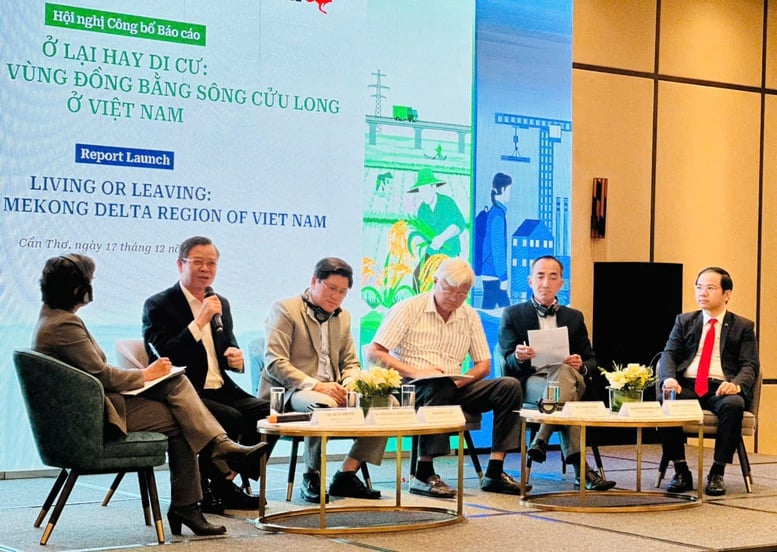
Chairman of Can Tho City People's Committee Truong Canh Tuyen and speakers exchange views at the Announcement Ceremony - Photo: VGP/LS
5 key policy priorities for a long-term adaptation strategy.
Based on analyses of livelihoods, migration, and environmental risks, the World Bank has identified five priority policy areas for the Mekong Delta to adapt, recover, and develop in the context of an uncertain future.
First, invest in education and skills development to expand opportunities for success for everyone, especially young people.
Secondly, modernize and transform agriculture towards reducing labor use, increasing adaptability, and generating greater profits.
Third, invest in local infrastructure to attract businesses, enhance connectivity, and reduce transaction costs for farmers.
Fourth, promote safe, voluntary migration, viewing it as an adaptation strategy for those seeking opportunities outside the Mekong Delta region.
Fifth, build an adaptive social security system that can support those affected by shocks, especially those who cannot or do not want to migrate.
Putting people at the center of the adaptation strategy.
Speaking at the conference, Mariam J. Sherman, World Bank Country Director for Vietnam, Cambodia, and Laos, emphasized: “Given the scale of environmental damage the region is facing, the question is no longer whether adaptation is necessary, but how to adapt. Public investment needs to find a balance between protecting land and infrastructure—essential to local livelihoods—and equipping people with skills, enhancing resilience, and supporting them to seize opportunities in an uncertain future.”
According to Mariam J. Sherman, prioritizing investment in people not only helps people better withstand climate change, but also lays the foundation for a more sustainable and inclusive economic transition.

Dr. Nguyen Anh Tuan, Deputy Head of the Central Policy and Strategy Committee, exchanges views with delegates on the sidelines of the Conference - Photo: VGP/LS
Policy planning: Not about staying or migrating, but about living better.
From the perspective of domestic policy planning, Mr. Nguyen Anh Tuan, Deputy Head of the Central Policy and Strategy Committee, highly appreciated the scientific and practical value of the World Bank report, considering it an important source of arguments for the development of policies in the Mekong Delta region.
Mr. Nguyen Anh Tuan emphasized that the core issue for the Mekong Delta is not whether people stay or migrate, but how to ensure people can live better lives, regardless of where they choose to live. According to him, in the coming period, the region needs to pay special attention to three major directions.
Firstly, we must continue to improve the institutional framework for regional development coordination, commensurate with the new administrative and economic scale, ensuring close and effective coordination between the central government and local authorities.
Secondly, strongly promote the transformation of the Mekong Delta's growth model towards green, high-value, and sustainable development. In this model, agriculture continues to play a fundamental role, but is no longer viewed purely as a production activity; rather, it is a part of a broader socio-economic ecosystem, linked to processing, logistics, markets, science and technology, and environmental protection.
Thirdly, placing investment in human resources at the center of the regional adaptation and development strategy is in line with the spirit of the draft Political Report submitted to the 14th National Congress of the Party, which identifies the development of high-quality human resources and the enhancement of labor productivity as key drivers of rapid and sustainable growth.
According to Mr. Nguyen Anh Tuan, the issues analyzed in the World Bank Report, from livelihoods, poverty reduction, migration to climate and environmental risks, need to be viewed within a comprehensive and long-term context. These are not isolated issues, but reflect structural challenges in the region's development process over many stages.
He argued that this spirit is also consistent with Resolution No. 13-NQ/TW of the Politburo on the direction of socio-economic development and ensuring national defense and security in the Mekong Delta region until 2030, with a vision to 2045, which requires a shift from a sector- and local-specific approach to an integrated, inter-regional approach; from "reactive" to proactive adaptation, consistently considering people as the center of development.
From a national strategic perspective, Mr. Nguyen Anh Tuan emphasized the need to create a sufficiently attractive, safe, and inclusive development environment so that people in the Mekong Delta can feel secure in their commitment to the region or proactively seek new development opportunities without falling into a vulnerable position.
As the Mekong Delta enters a period of profound transformation, it is crucial to have sufficient vision, institutions, and effective coordination to lead and manage this transformation well in a sustainable and inclusive manner.
Le Son
Source: https://baochinhphu.vn/lay-con-nguoi-lam-trung-tam-dinh-huong-chinh-sach-cho-tuong-lai-dbscl-102251217183423378.htm
![[Image] The tenacious fighting spirit of Vietnamese women's football](/_next/image?url=https%3A%2F%2Fvphoto.vietnam.vn%2Fthumb%2F1200x675%2Fvietnam%2Fresource%2FIMAGE%2F2025%2F12%2F17%2F1765990260956_ndo_br_4224760955870434771-copy-jpg.webp&w=3840&q=75)
![[Image] Leaked images ahead of the 2025 Community Action Awards gala.](/_next/image?url=https%3A%2F%2Fvphoto.vietnam.vn%2Fthumb%2F1200x675%2Fvietnam%2Fresource%2FIMAGE%2F2025%2F12%2F16%2F1765882828720_ndo_br_thiet-ke-chua-co-ten-45-png.webp&w=3840&q=75)
![[Live] 2025 Community Action Awards Gala](/_next/image?url=https%3A%2F%2Fvphoto.vietnam.vn%2Fthumb%2F1200x675%2Fvietnam%2Fresource%2FIMAGE%2F2025%2F12%2F16%2F1765899631650_ndo_tr_z7334013144784-9f9fe10a6d63584c85aff40f2957c250-jpg.webp&w=3840&q=75)
![[Photo] Prime Minister Pham Minh Chinh receives the Governor of Tochigi Province (Japan)](/_next/image?url=https%3A%2F%2Fvphoto.vietnam.vn%2Fthumb%2F1200x675%2Fvietnam%2Fresource%2FIMAGE%2F2025%2F12%2F16%2F1765892133176_dsc-8082-6425-jpg.webp&w=3840&q=75)
![[Photo] Prime Minister Pham Minh Chinh receives Lao Minister of Education and Sports Thongsalith Mangnormek](/_next/image?url=https%3A%2F%2Fvphoto.vietnam.vn%2Fthumb%2F1200x675%2Fvietnam%2Fresource%2FIMAGE%2F2025%2F12%2F16%2F1765876834721_dsc-7519-jpg.webp&w=3840&q=75)




![[Video] Exhibition space "Great Poet Nguyen Du - Remembered for a Thousand Years"](https://vphoto.vietnam.vn/thumb/402x226/vietnam/resource/IMAGE/2025/12/17/1765983645796_khong-gian-trung-bay-dai-thi-hao-nguyen-du-ngan-nam-nho-mai-3610-jpg.webp)




































![[Live] Closing Ceremony and Award Presentation for the "Impressive Vietnam Tourism" Video/Clip Creation Contest 2025](https://vphoto.vietnam.vn/thumb/402x226/vietnam/resource/IMAGE/2025/12/17/1765974650260_z7273498850699-00d2fd6b0972cb39494cfa2559bf85ac-1765959338756946072104-627-0-1338-1138-crop-1765959347256801551121.jpeg)














Comment (0)