

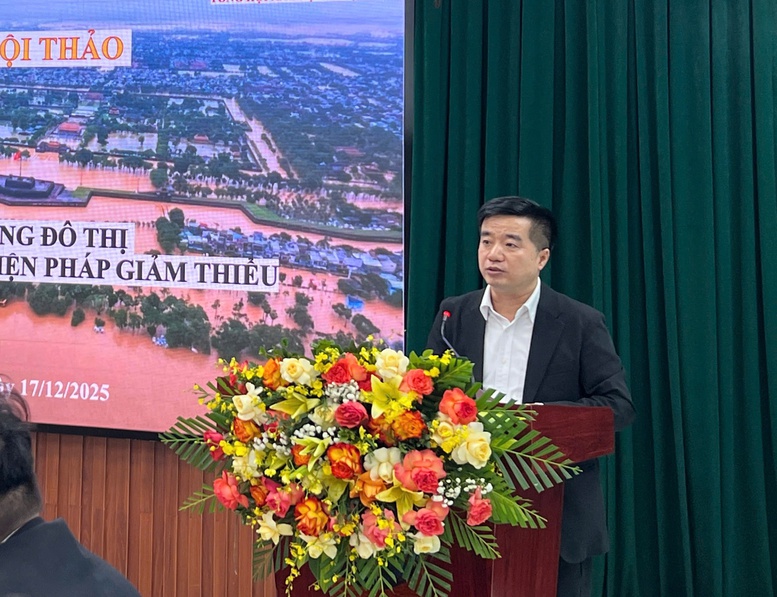
Nguyen Quyet Chien, Secretary General of the Vietnam Union of Science and Technology Associations, delivered the opening remarks at the workshop. Photo: VGP/Ngoc Han
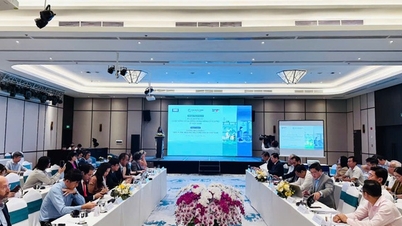
On December 17th, in Hanoi, the Vietnam Union of Science and Technology Associations, in collaboration with the Vietnam Construction Association, organized the seminar "Urban Flooding - Challenges and Mitigation Measures".
In his opening remarks at the workshop, Mr. Nguyen Quyet Chien, Secretary General of the Vietnam Union of Science and Technology Associations, stated that the rapid urbanization process in recent years has revealed many challenges to sustainable urban development. Currently, there are approximately 900 urban areas nationwide, with an urbanization rate exceeding 44% and projected to reach over 50% by 2030. However, the concretization, filling in of ponds and lakes, and narrowing of canals are seriously degrading the natural drainage capacity.
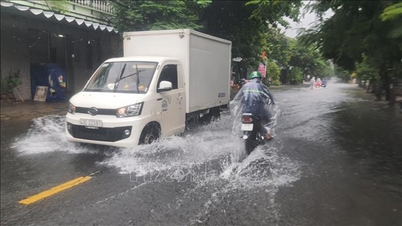
Statistics up to 2024 show that urban areas recorded approximately 397 flooded areas, affecting over 900 hectares; flooding not only occurs in large cities but also spreads to medium and small cities, causing estimated economic losses of 1-1.5% of urban GDP each year.
In his opening remarks at the workshop, Dr. Dang Viet Dung, President of the Vietnam Construction Association, emphasized the context of rapid urbanization and the increasingly serious impacts of climate change. Urban flooding has become a major challenge to sustainable urban development in Vietnam. Many cities, especially large cities and regional centers, are frequently affected by heavy rains, high tides, rising sea levels, and overloaded drainage systems, causing significant economic damage, disrupting people's lives, and posing risks of environmental pollution and urban safety.
According to Dr. Dang Viet Dung, the increasingly serious, prolonged, and unpredictable flooding situation stems not only from climate change but also reflects limitations in the urbanization process, technical infrastructure, urban management, and planning thinking.
Furthermore, the legal framework for drainage and water supply is not yet synchronized, forecasting capabilities and calculation models are limited, while the ability of urban areas to adapt to increasing climate risks still does not meet practical requirements.
Comprehensive solutions for urban areas in the Red River Delta region.
During the workshop, experts discussed in depth the current state of urban drainage systems, the causes of flooding, especially in large cities; international experiences in urban drainage and lessons that can be applied to Vietnam; as well as solutions to mitigate flooding in the context of climate change and rapid urbanization.
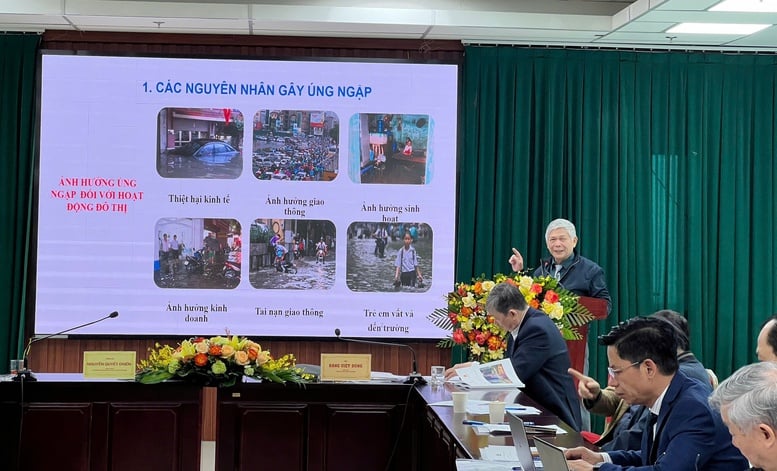
Professor Tran Duc Ha, former Director of the Institute of Water Supply, Drainage and Environment Research (Vietnam Water Supply and Drainage Association), presents his paper. Photo: VGP/Ngoc Han
In practice, Vietnam's current legal system, regulations, and standards primarily approach urban rainwater management from a drainage perspective, lacking mandatory regulations on water storage, infiltration, reuse, and cyclical rainwater management. Factors such as retention ponds, green spaces, and permeable surfaces are only considered as supporting solutions for drainage and have not been integrated into a comprehensive, purposeful rainwater utilization system.
Treating urban rainwater as a resource requiring integrated management is no longer an experimental option but a necessity, contributing to flood reduction, promoting ecological and environmental values, and enhancing the resilience of cities to climate change.
Traffic congestion and flooding are a "double impact" with a reciprocal relationship in the urbanization process; a separate approach between traffic expansion and drainage improvement is likely to be wasteful and ineffective.
Experience from other countries also indicates that only integrated planning, linking transportation, drainage, green spaces, and smart management technologies, can ensure sustainable urban development.
To break free from the vicious cycle of "traffic congestion and flooding," Vietnamese cities need to quickly innovate their thinking towards integrated and inclusive planning (UN-Habitat), while flexibly applying models such as green and smart cities, compact cities, sponge cities, and resilient and sustainable cities.
To address urban flooding in the Red River Delta, comprehensive solutions are needed, combining technical measures, management mechanisms, raising community awareness, and strengthening human resources. Technical solutions include both structural measures such as improving the drainage capacity of rivers, canals, reservoirs, pumping stations, and sewer systems, and non-structural solutions such as reviewing and adjusting drainage plans to suit urban development and the impacts of climate change.
Furthermore, the construction of a data center and a system for managing urban drainage is essential to ensure efficient operation. Solutions should be implemented in the short, medium, and long term, aiming for the development of ecological, safe, and sustainably disaster-resistant urban areas.
Solving flooding problems in Hanoi cannot rely solely on engineering solutions; it requires a multidisciplinary approach, integrating water management, environmental protection, and architectural planning, with urban spatial management playing a key role. Urban development driven by excessive concrete construction, hindering natural water flow, will negate all efforts to improve the drainage system.
Hanoi needs to shift its planning mindset towards "living with and dedicating space to water," coupled with controlling building density, increasing water surface area, green spaces, and drainage corridors in urban areas. Simultaneously, forecasting and planning should move from relying on historical data to future climate change scenarios, combining flood risk zoning based on the specific characteristics of each area to develop appropriate solutions, thereby aiming for a sustainable balance between urban development and the unique riverine characteristics of the capital city.
Ngoc Han
Source: https://baochinhphu.vn/ngap-ung-do-thi-thach-thuc-lon-doi-voi-phat-trien-ben-vung-102251217150034615.htm
![[Photo] Prime Minister Pham Minh Chinh receives the Governor of Tochigi Province (Japan)](/_next/image?url=https%3A%2F%2Fvphoto.vietnam.vn%2Fthumb%2F1200x675%2Fvietnam%2Fresource%2FIMAGE%2F2025%2F12%2F16%2F1765892133176_dsc-8082-6425-jpg.webp&w=3840&q=75)

![[Photo] Prime Minister Pham Minh Chinh receives Lao Minister of Education and Sports Thongsalith Mangnormek](/_next/image?url=https%3A%2F%2Fvphoto.vietnam.vn%2Fthumb%2F1200x675%2Fvietnam%2Fresource%2FIMAGE%2F2025%2F12%2F16%2F1765876834721_dsc-7519-jpg.webp&w=3840&q=75)

![[Image] Leaked images ahead of the 2025 Community Action Awards gala.](/_next/image?url=https%3A%2F%2Fvphoto.vietnam.vn%2Fthumb%2F1200x675%2Fvietnam%2Fresource%2FIMAGE%2F2025%2F12%2F16%2F1765882828720_ndo_br_thiet-ke-chua-co-ten-45-png.webp&w=3840&q=75)
![[Live] 2025 Community Action Awards Gala](/_next/image?url=https%3A%2F%2Fvphoto.vietnam.vn%2Fthumb%2F1200x675%2Fvietnam%2Fresource%2FIMAGE%2F2025%2F12%2F16%2F1765899631650_ndo_tr_z7334013144784-9f9fe10a6d63584c85aff40f2957c250-jpg.webp&w=3840&q=75)
































































Comment (0)