

Under the AI Act, AI systems used in fields such as law enforcement and employment will have to demonstrate that they are sufficiently transparent and accurate, meet cybersecurity standards, and satisfy criteria for the quality of the data used to train them.
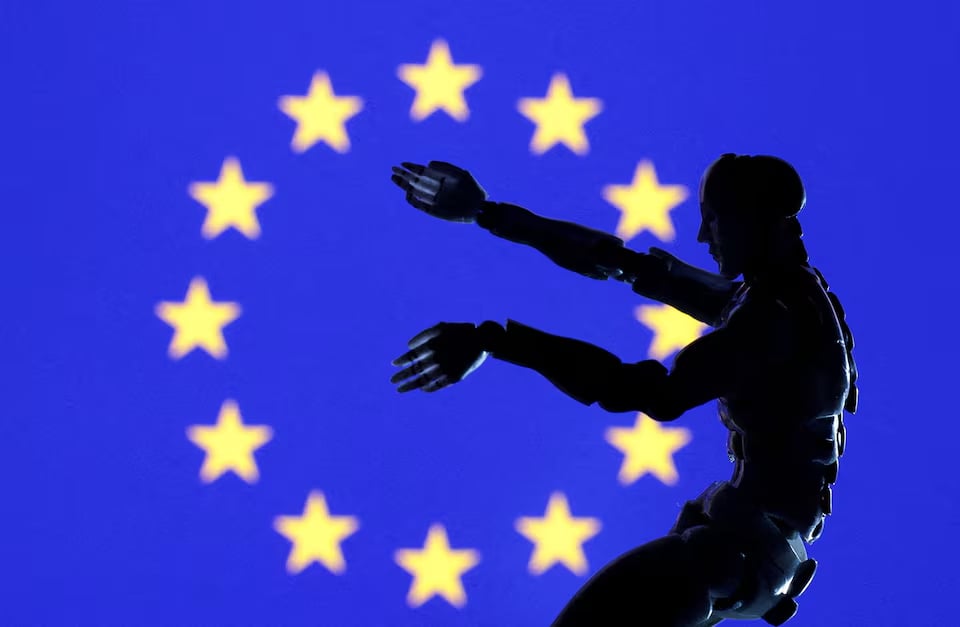
The AI Act will have a global reach. Photo: Reuters
The EU vote came two months after the European Parliament endorsed AI legislation. The law stipulates that systems used in "high-risk" situations must be certified by approved bodies before being placed on the EU market.
"High-risk" scenarios include situations where the use of AI could harm health, safety, fundamental rights, the environment, democracy, elections, and the rule of law.
The AI Act restricts the use of real-time biometric surveillance in public spaces, except for certain criminal cases such as preventing terrorist attacks and searching for the most serious suspects.
Systems such as social scoring will be completely banned, as will biometric classification systems based on people's religion or race, sexual orientation, and other worldviews .
The law also prohibits facial recognition in surveillance cameras, except for use in law enforcement purposes such as finding missing persons or victims of kidnapping, preventing human trafficking, or searching for suspects in serious criminal cases.
Legal expert Patrick van Eecke at the law firm Cooley said the new law will have an impact beyond the 27-nation bloc: "The act will have a global reach. Companies outside the EU that use EU customer data in their AI platforms will need to comply."
"For the first time in the world, this landmark law addresses the global technological challenge while creating opportunities for our society and economy," said Mathieu Michel, Belgium's Minister for Digitalization.
He said: "With the AI Act, Europe underscores the importance of trust, transparency and accountability when dealing with new technologies, while ensuring that this rapidly changing technology can thrive and drive European innovation."
The new law will come into effect in 2026. Penalties for violations range from 7.5 million euros, or 1.5% of revenue, to 35 million euros, or 7% of global revenue, depending on the type of violation.
In another sign of widespread concern surrounding AI, more than a dozen of the world's leading AI companies, including Microsoft, Amazon, and OpenAI, made new safety commitments at the AI Safety Summit in Seoul on May 21.
"These commitments ensure that the world's leading AI companies will provide transparency and accountability in their plans for developing safe AI," British Prime Minister Rishi Sunak stressed.
Under the agreement, companies from various countries, including the United States, China, Canada, the United Kingdom, France, South Korea, and the United Arab Emirates, will make voluntary commitments to ensure the safe development of cutting-edge AI models.
Ngoc Anh (according to Reuters, FT)
Source: https://www.congluan.vn/lien-minh-chau-au-ky-luat-tri-tue-nhan-tao-cac-cong-ty-ai-dua-ra-cam-ket-post296442.html
![[Image] Hanoi Police officially crowned champions of V-League 2025/2026](https://vphoto.vietnam.vn/thumb/1200x675/vietnam/resource/IMAGE/2026/05/31/1780244769054_ndo_br_039d561b692be875b13a-jpg.webp)
![[Photo] Admire the coral "masterpiece" amidst the million-year-old heritage of Dak Lak province.](https://vphoto.vietnam.vn/thumb/1200x675/vietnam/resource/IMAGE/2026/05/31/1780221235105_anh-man-hinh-2026-05-31-luc-16-53-27.png)
![[Photo] The General Secretary, President and his wife begin their state visit to the Philippines.](https://vphoto.vietnam.vn/thumb/1200x675/vietnam/resource/IMAGE/2026/05/31/1780230559452_anh-man-hinh-2026-05-31-luc-19-28-11.png)


![[Photo] Solemn bathing ceremony and Buddha procession in Hue](https://vphoto.vietnam.vn/thumb/1200x675/vietnam/resource/IMAGE/2026/05/31/1780228263543_1-jpg.webp)



















![[Video] Sunset at Lap An Lagoon – Where the sun sets over the fishing nets](https://vphoto.vietnam.vn/thumb/340x192/vietnam/resource/IMAGE/2026/05/31/1780192137701_beach-landscape-sea-water-nature-grass-745871-pxhere-com.jpeg)





































![[Photo] Admire the coral "masterpiece" amidst the million-year-old heritage of Dak Lak province.](https://vphoto.vietnam.vn/thumb/402x226/vietnam/resource/IMAGE/2026/05/31/1780221235105_anh-man-hinh-2026-05-31-luc-16-53-27.png)





































Comment (0)