

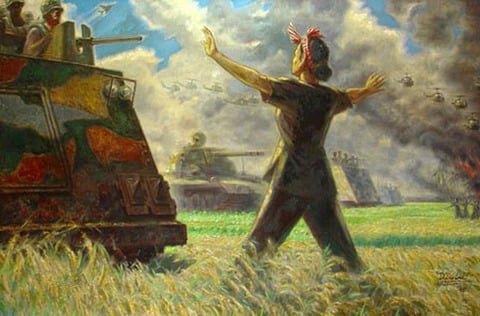
The propaganda painting "Stop" by the late artist Le Lam is a sacred symbol of the indomitable and resilient spirit of the women of Long An.
Stop – the image of a strong, indomitable son of Long An.
Among the treasure trove of Vietnamese resistance art, the propaganda painting "Stop" by the late artist Le Lam is a sacred symbol of the indomitable and resilient spirit of the women of Long An. The work is based on a true event: a protest by the people of Duc Hoa district to stop enemy armored vehicles from ramming into ripening rice fields. The painting touches the hearts of viewers with the image of a small woman – Ms. Tu Cao – single-handedly blocking the enemy's armored convoy.
Ms. Tư Cào, whose real name was Võ Thị Cào, was born in 1939 and resided in Đức Hòa district, Long An province. She was a woman who specialized in midwifery. Despite her simple, petite appearance, limping gait, and betel-chewing habit, she was incredibly brave, daring to jump in front of enemy vehicles, "spreading her arms and legs and shouting repeatedly: Stop! Stop!" to prevent them from destroying the crops.
Artist Le Lam used oil paint to convey the intensity of the Southern battlefield with towering columns of smoke, contrasting with the peaceful yellow and green hues of the Southern rice fields. The highlight of the painting is the image of Sister Tu Cao wearing a brown traditional Vietnamese blouse and a checkered headscarf, arms outstretched, directly confronting an armored vehicle. The strong lines, powerful colors, and tight composition captivate the viewer.
After its creation, "Stop" quickly became a symbol of courageous spirit that spread throughout the South and North of Vietnam. In 1969, when President Ho Chi Minh personally visited to see the painting, the work was subsequently printed in millions of copies and appeared in newspapers and exhibitions both domestically and internationally. Today, the Long An Museum (part of the Provincial Museum and Library) still preserves the handwriting of the late artist Le Lam and the comment of the late General Secretary Truong Chinh: "Stop not only contributes to recreating the heroic history of the people of Long An in particular, and of our nation in general, but also clearly demonstrates the Vietnamese spirit."
The tranquil countryside - the serene beauty of the Dong Thap Muoi region.
After years of fierce war, the southern land today wears a peaceful "garment" - a place where life is slow-paced, nature is gentle, and people are kind-hearted. This beauty has become an endless source of inspiration for many artists. Among them, painter Nguyen Tam chose to express his feelings for the Dong Thap Muoi countryside in his painting "The Peaceful Countryside."
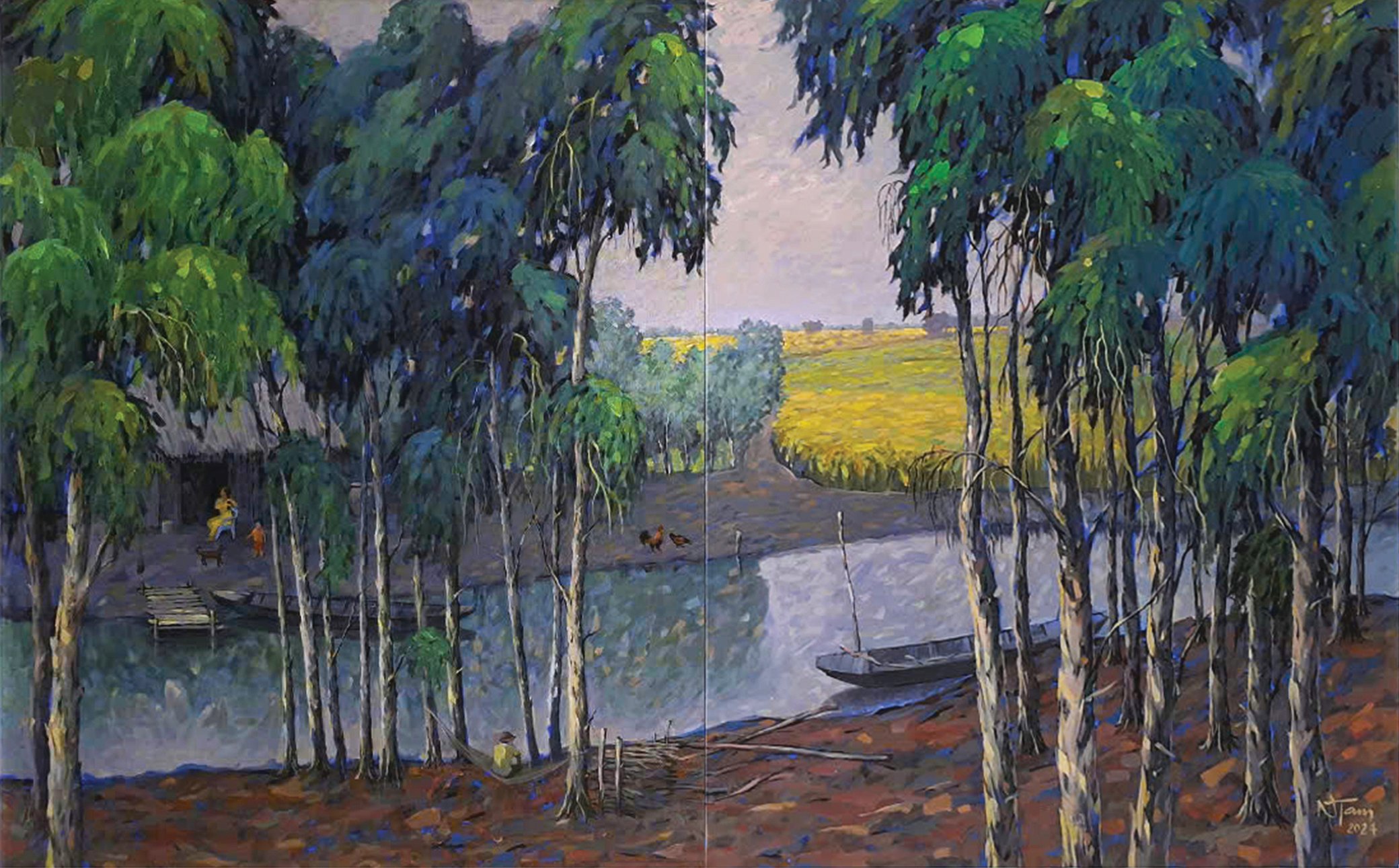
Artist Nguyen Tam chose to express his feelings about the Dong Thap Muoi countryside in his painting "Peaceful Countryside".
Like a sweet, gentle, yet profound melody, "Peaceful Countryside" depicts a lush green landscape and a tranquil, poetic way of life. The open composition, without a clear ending point, gives viewers the feeling of sitting under the canopy of a verdant mangrove forest, gazing out at the golden fields in the distance. The harmonious blend of soft light and subtly handled shades of blue, green, and yellow creates a visual whole that is both profound and refreshing.
The distinctive feature of "Tranquil Countryside" lies in its use of acrylic paint and spatial manipulation, creating emotional depth. The straight, straight melaleuca trees with their characteristic silvery-tinged bark resemble a natural curtain, revealing scenes of simple daily life: a thatched house, a few figures in the distance, a boat moored ashore, chickens roaming, a small dirt road leading to distant fields. Every detail is small, yet it evokes a profound sense of nostalgia, affection, and childhood memories for those who have a connection to the waterways of Southern Vietnam.
According to artist Nguyen Tam, the scenes in his paintings were selected from his field trips to the Thanh Hoa, Tan Thanh, Moc Hoa, and Kien Tuong areas. It was this overflowing emotion about the tranquil, vibrant countryside that inspired him to create this artwork. Without a main character or a dramatic story, "The Peaceful Countryside" remains captivating precisely because of its simplicity and familiarity.
The work was awarded the C Prize at the 29th Regional Fine Arts Exhibition of the Mekong Delta in 2024. In the context of modern art tending towards the unusual and unconventional, "Peaceful Countryside" takes viewers back to traditional beauty, to a story of the countryside stemming from a passionate love for the Southern land.
Spring arrives - a belief in new beginnings.
In the ever-changing flow of time, Long An province is not only a place to return to, but also a symbol of positive change and hope for the future. As spring arrives in Tan An City, photographer Kieu Oanh has captured this beauty with a creative perspective in her work, "Spring Arrives."
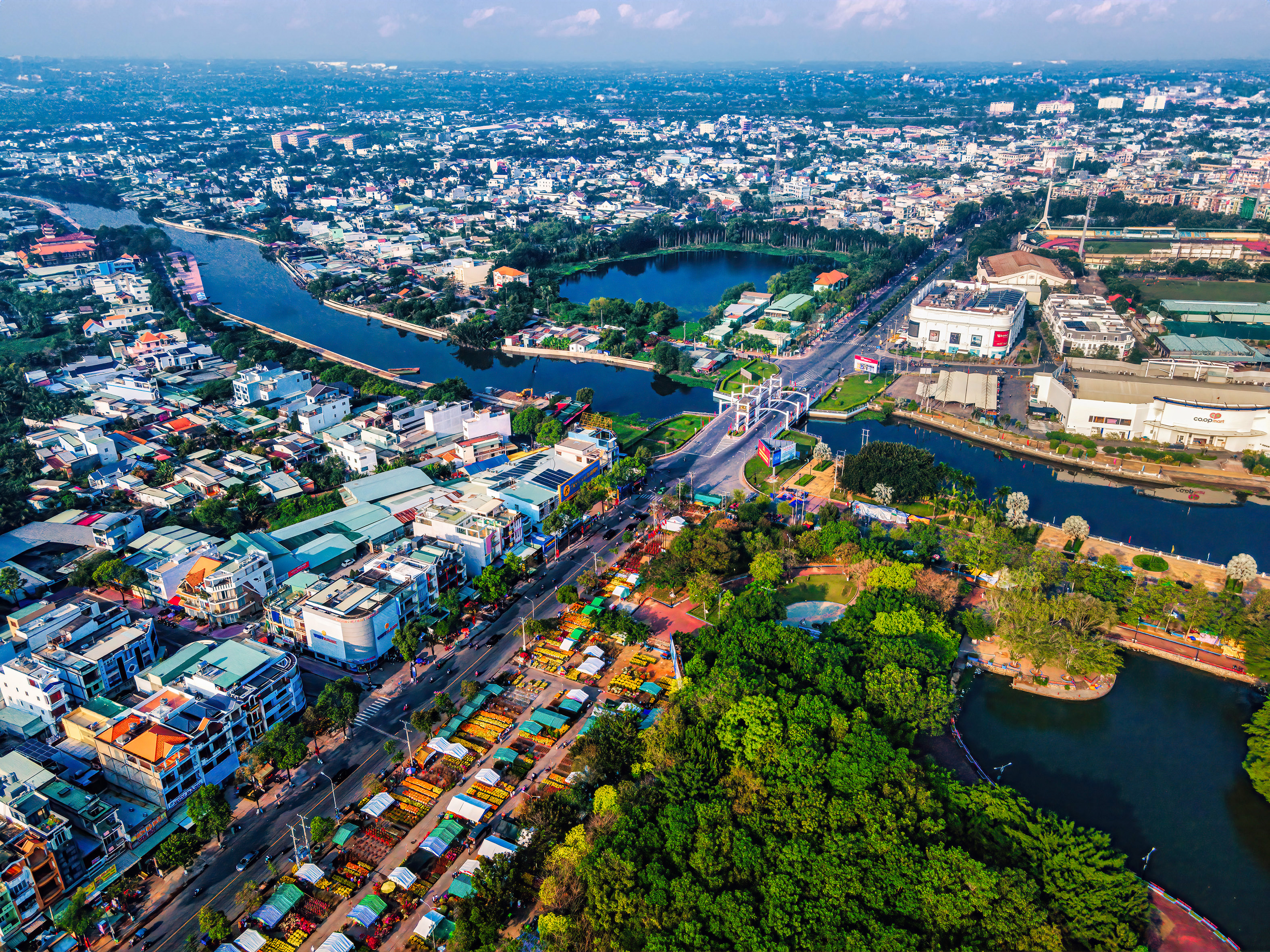
The photograph "Spring Arrives" by photographer Kieu Oanh captures the beauty of Tan An City during the spring season.
For photographer Kieu Oanh, spring in her hometown is not just a time of year, but also a source of pride as she watches the city transform, becoming more friendly and modern while still harmonizing with nature. The photograph "Spring Arrives" was selected by the artist from many images after numerous drone flight trials, carefully adjusting the lighting, and waiting for the ideal moment.
Looking at the photo, the distinctive X-shaped layout is formed by the intersection of the Vam Co Tay River and Hung Vuong road leading into the city. This tight composition creates visual balance and opens up harmonious living spaces that blend modernity and nature within the urban environment.
According to photographer Kieu Oanh, she wanted to evoke the image of a migratory bird: a symbol of the yearning for freedom, enduring vitality, and faith in the future through this composition.
The colors in the photograph are skillfully handled, ensuring both vibrant hues and the gentle charm of spring in Southern Vietnam. The green of the trees, the yellow and red of the Tet flower market, and the early morning sunlight spreading across the rooftops and canals create a fresh, lively, and welcoming atmosphere. Tan An City, as depicted in the frame, is not a bustling metropolis but a youthful, civilized, and friendly city where development goes hand in hand with preserving traditional values and natural landscapes.
This work won first prize at the 35th Long An Homeland Art Photography Contest in 2023, organized by the Long An Provincial Union of Literature and Arts in collaboration with the Provincial Photography Association. Springtime is not just an artistic photograph, but also a way for the artist to express their deep love for their homeland. Long An is depicted through each work not only with its beautiful landscapes but also with its profound cultural depth. Regardless of its form, the homeland remains forever intact with its familiar values, deeply ingrained in the hearts of generations.
Orchid
Source: https://baolongan.vn/long-an-qua-lang-kinh-nghe-thuat-a194393.html

![[Photo] The General Secretary, President and his wife begin their state visit to the Philippines.](https://vphoto.vietnam.vn/thumb/1200x675/vietnam/resource/IMAGE/2026/05/31/1780230559452_anh-man-hinh-2026-05-31-luc-19-28-11.png)
![[Photo] Admire the coral "masterpiece" amidst the million-year-old heritage of Dak Lak province.](https://vphoto.vietnam.vn/thumb/1200x675/vietnam/resource/IMAGE/2026/05/31/1780221235105_anh-man-hinh-2026-05-31-luc-16-53-27.png)
![[Photo] Solemn bathing ceremony and Buddha procession in Hue](https://vphoto.vietnam.vn/thumb/1200x675/vietnam/resource/IMAGE/2026/05/31/1780228263543_1-jpg.webp)







![[Video] Sunset at Lap An Lagoon – Where the sun sets over the fishing nets](https://vphoto.vietnam.vn/thumb/340x192/vietnam/resource/IMAGE/2026/05/31/1780192137701_beach-landscape-sea-water-nature-grass-745871-pxhere-com.jpeg)


































![[Photo] Admire the coral "masterpiece" amidst the million-year-old heritage of Dak Lak province.](https://vphoto.vietnam.vn/thumb/402x226/vietnam/resource/IMAGE/2026/05/31/1780221235105_anh-man-hinh-2026-05-31-luc-16-53-27.png)
































Comment (0)