

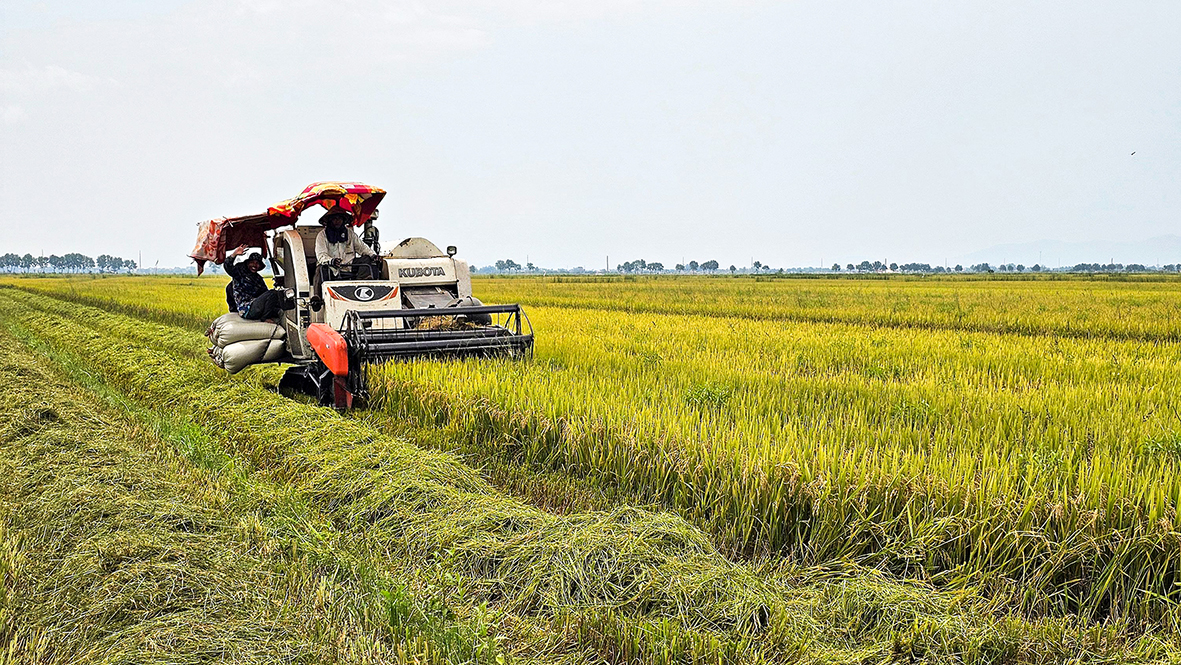
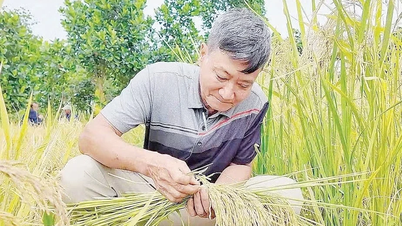
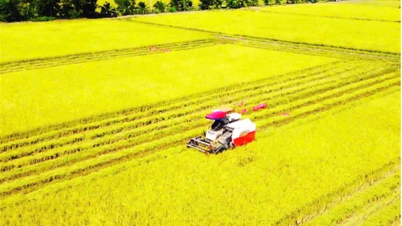
Harvesting the winter-spring rice crop in Hai Duong commune, Hai Lang district - Photo: LA
While harvesting the remaining 2 sao (approximately 0.2 hectares) of rice, Mr. Nguyen Ty from Kim Long Cooperative, Hai Binh commune, Hai Lang district, said that this year's winter-spring crop saw his family planting nearly 10 sao with two main rice varieties: Khang Dan and HG12. The average yield was only about 2.5 - 2.8 quintals of fresh rice per sao, nearly 1 quintal lower than the previous winter-spring crop. According to Mr. Ty, the reason for the decrease in rice yield is due to the prolonged cold spells after the Lunar New Year this year, and frost during the rice flowering period, resulting in many empty grains.
“From planting to flowering, the weather has been very unpredictable, with prolonged cold spells and strong winds, which have significantly affected the rice crop. Last year, I harvested nearly 4 tons of rice from the same area, but this year I only got about 3 tons. In particular, not only has the yield decreased, but the price of rice has also dropped, to only about 7,200 VND/kg, so after deducting expenses, the profit is minimal,” Mr. Ty said.
Meanwhile, at the Dien Khanh Cooperative in Hai Duong commune, Hai Lang district, Mrs. Phan Thi Yen, intently watching the rice harvester on her field, expressed her disappointment, stating that compared to last year, the yield of this year's winter-spring crop has decreased significantly. Last year, on her family's 1-hectare field, with the two main rice varieties Khang Dan and HG244, the yield reached about 4 quintals of fresh rice per sao (approximately 1000 square meters), while this winter-spring crop only yielded about 3 quintals of fresh rice per sao.
Furthermore, the current rice purchase price offered by traders is low, only 7,000 - 7,200 VND/kg, compared to 8,300 - 8,500 VND/kg last year, resulting in significantly reduced profits. “This year, both seed and fertilizer prices have increased compared to last year, not to mention the labor costs for tending and harvesting. Last year, after deducting expenses, I made over 20 million VND in profit during the winter-spring crop season, but this year I'll probably only get around 10-12 million VND,” Ms. Yen said.
According to Vo Trung Hieu, Vice Chairman of the People's Committee of Hai Duong commune, farmers in the commune have harvested approximately 200 hectares out of a total area of over 900 hectares. Field inspections indicate an estimated yield of around 66.4 quintals/hectare, which is about 1.7 quintals/hectare lower than the previous winter-spring crop.
According to the commune's survey, the yield of early-season rice only reached about 2.9 - 3 quintals of fresh rice per hectare, while the yield of rice planted in the 2nd and 3rd seasons still reached nearly 3.5 quintals per hectare. Furthermore, the purchase price of rice this year has also decreased by nearly 1,300 - 1,500 VND/kg, resulting in significantly lower profits compared to previous seasons.
According to Vo Chi Truong, Deputy Head of the Agriculture and Environment Department of Hai Lang district, the entire district has harvested more than 1,500 hectares out of a total of nearly 6,900 hectares of winter-spring rice. The average yield is estimated at about 61.05 quintals/hectare, lower than last year by about 6.2 quintals/hectare. Currently, Hai Lang district is directing localities to focus manpower and resources to accelerate the winter-spring harvest, while preparing the necessary conditions to immediately implement the summer-autumn crop to avoid damage from late-season floods.
According to Nguyen Hong Phuong, Deputy Director of the Department of Agriculture and Environment, the entire province has harvested over 3,000 hectares of winter-spring rice so far. The expected yield is about 60 quintals/hectare, only slightly lower than last year's yield of about 1.6 quintals/hectare.
According to Ms. Phuong, the main reason for the decrease in yield is that a large portion of the early-planted rice crop was affected by early-season rain and cold weather, especially during the flowering stage. The remaining areas of rice planted in the second and third seasons, and flowering after April 20th, are developing well. Currently, farmers in the province are focusing on harvesting from now until May 15th and are expected to complete the winter-spring rice harvest before May 20th.
According to Ms. Phuong, because it is currently the transitional period between seasons, extreme weather phenomena such as thunderstorms accompanied by tornadoes and strong gusts of wind often occur, posing a significant risk to the yield and quality of rice, as well as the harvesting and storage of the winter-spring rice crop.
Therefore, localities need to take advantage of favorable weather conditions to concentrate manpower and resources to quickly and efficiently harvest the winter-spring rice crop as soon as it ripens to prevent lodging caused by tornadoes and flooding due to heavy rains. Immediately after harvesting, farmers need to promptly clean the fields and prepare the land early by plowing, drying the fields, and treating with lime and stubble decomposition products to eliminate disease germs and limit the emergence and damage caused by dangerous pests in the summer-autumn crop such as white-backed planthoppers, black striped dwarf disease, and rice spider mites.
Ensure that all necessary supplies such as seeds, fertilizers, and pesticides are prepared to guarantee planting of the summer-autumn crop according to the seasonal schedule and crop varieties issued by the Department of Agriculture and Environment...
Le An
Source: https://baoquangtri.vn/lua-vu-dong-xuan-nang-suat-giam-gia-thap-193574.htm


![[Image] National Assembly discusses the implementation of the socio-economic development plan.](https://vphoto.vietnam.vn/thumb/1200x675/vietnam/resource/IMAGE/2026/04/20/1776696707422_ndo_br_img-20260420-185419-jpg.webp)
![[Photo] General Secretary and President To Lam meets with National Assembly delegates from ethnic minorities.](https://vphoto.vietnam.vn/thumb/1200x675/vietnam/resource/IMAGE/2026/04/20/1776696701056_a1-bnd-8331-3342-jpg.webp)































































Comment (0)