

The plan to merge Dong Son district into Thanh Hoa city has been postponed to 2024 or 2025 due to the need to wait for the urban master plan and the reorganization of communes and wards.
On June 15th, Mr. Le Anh Xuan, Secretary of the Thanh Hoa City Party Committee, stated that the initial plan was for Dong Son district to merge into Thanh Hoa City in July 2023. However, the plan has been postponed to 2024 or 2025.
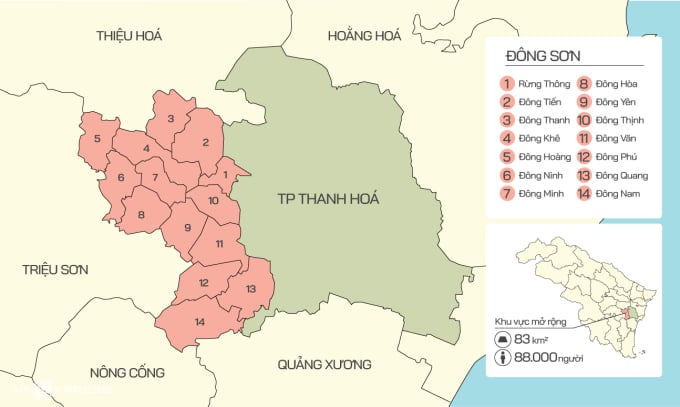
The new Thanh Hoa urban area will include Dong Son district. Graphic: Tien Thanh
In March, the Prime Minister signed a decision approving the general urban plan for Thanh Hoa. According to Mr. Xuan, this serves as the basis for the province to develop and adjust the plan and implement the merger process. The People's Committee of Thanh Hoa city and Dong Son district are urgently reviewing the procedures and criteria for a first-class urban area and establishing wards based on existing communes. Currently, many communes and wards do not meet the criteria, so administrative units need to be reorganized.
Thanh Hoa province plans to propose two options to the National Assembly Standing Committee. The first is to merge Dong Son district into the city, maintaining the current status of its communes and wards. This option, if implemented quickly, could be completed in the second quarter of 2024.
The second option is to merge Dong Son district into the city simultaneously with the reorganization of commune and ward-level administrative units. If this option is chosen, it is expected to be completed by the end of 2024 or the beginning of 2025.
"The merger process is very complex, involving many tasks such as reorganizing administrative units, civil servants, and handling public assets. Therefore, we must proceed cautiously, follow the correct legal procedures, and gain high consensus among officials and the public," Mr. Xuan said.
Thanh Hoa City was established in 1993 from the former Thanh Hoa town, becoming a type two urban area in 2003, and then recognized as a type one urban area in 2014. Currently, the city has a natural area of 147 km2, 30 wards and 4 communes, with a population of nearly 500,000. It is the provincial city with the most wards in the country.
According to the draft plan, the entire area of nearly 83 square kilometers and a population of over 88,000 of Dong Son district will be merged into Thanh Hoa City. After the merger, the city will have a natural area of over 228 square kilometers and a population of nearly 594,000, with 37 wards and 11 communes. Seven new wards are planned to be established: Rung Thong, Hoang Quang, Hoang Dai, Dong Tien, Dong Van, Dong Khe, and Dong Thinh.
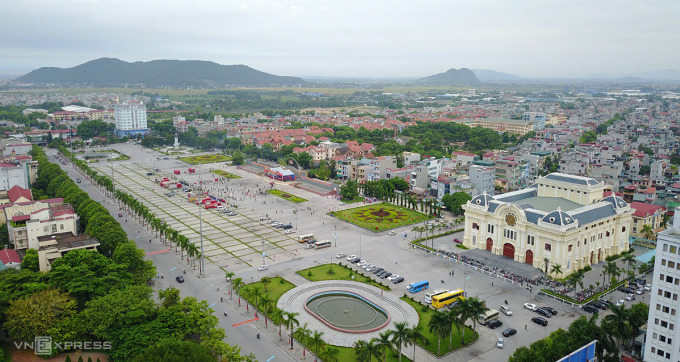
A view of Thanh Hoa city today. Photo: Le Hoang
Thanh Hoa province will reduce one district-level administrative unit, leaving two cities (Sam Son, Thanh Hoa), two towns (Nghi Son, Bim Son), and 22 districts with 559 commune-level administrative units.
The draft plan clearly states that the merger aims to meet the requirements for building and developing the city to be worthy of a first-class urban area, with the role and position of being the political, administrative, economic, cultural, social, and scientific and technological center of one of the largest provinces in the country. The merger is also consistent with the local culture and history, contributing to streamlining the organizational structure of administrative units.
In addition, the drafting committee proposed two options for the new name after the merger: Thanh Hoa City or Dong Son City.
A first-class city directly under the provincial administration functions as a center for economy, culture, science and technology, administration, education and training, tourism, services, transportation hub, and domestic exchange, playing a role in promoting the socio-economic development of one or more inter-provincial territories.
Conditions for becoming a first-class urban area directly under the province: Population size of 500,000 or more, with the inner city area reaching 200,000 or more; population density of 2,000 people/km2 or more, with the inner city area (calculated based on urban built-up land area) reaching 10,000 people/km2 or more; non-agricultural labor rate of 65% or more, with the inner city area reaching 85% or more; level of infrastructure development and urban architecture and landscape meeting prescribed standards.
Source link
![[Photo] General Secretary To Lam visits the exhibition space showcasing books, photo exhibitions, and achievements of digital transformation in journalism.](/_next/image?url=https%3A%2F%2Fvphoto.vietnam.vn%2Fthumb%2F1200x675%2Fvietnam%2Fresource%2FIMAGE%2F2025%2F12%2F19%2F1766110879215_1766110240024-jpg.webp&w=3840&q=75)
![[Photo] Enchanting ancient rose garden on the mountainside in Nghe An](/_next/image?url=https%3A%2F%2Fvphoto.vietnam.vn%2Fthumb%2F1200x675%2Fvietnam%2Fresource%2FIMAGE%2F2025%2F12%2F19%2F1766109900916_vuon-hong-chin-do-thu-hut-du-khach-toi-check-in-o-ha-noi-3-20162778-1671624890024-1671624890104198100259.jpeg&w=3840&q=75)









































![[INFOGRAPHIC] Overview of the Hoa Phat Dung Quat Rail and Special Steel Production Plant Project](https://vphoto.vietnam.vn/thumb/402x226/vietnam/resource/IMAGE/2025/12/19/1766111183203_z7339170069817-126a3e5a095f62e606a0be41015c1b80.jpeg)












































Comment (0)