

Ho Chi Minh City – Mr. Loc, 74 years old, had a 5 cm brain tumor but hesitated to have surgery for 8 months due to fear of complications. This time, doctors, guided by AI robots, safely removed the tumor.
On October 21st, Dr. Chu Tan Si, Head of the Neurosurgery Department, Neuroscience Center, Tam Anh General Hospital, Ho Chi Minh City, stated that Mr. Nguyen Dang Loc (Hanoi) submitted his medical records online for assessment. He came for examination the following day with mild headaches and no weakness or paralysis in his limbs.
The MRI combined with DTI (Deep Tissue Imaging) revealed a tumor in the patient's brain, located in the right parietal-occipital lobe. According to Dr. Tan Si, this is a low-grade astrocytoma belonging to the glioma group. The nerve fibers were pushed aside, enveloping the tumor.
The family said that eight months ago, Mr. Loc was picking up food with chopsticks when he suddenly became motionless for about a minute, but afterwards he couldn't remember what had happened. Doctors at a Hanoi hospital diagnosed him with a brain tumor in a dangerous area, even though he didn't have headaches or any functional weakness. The doctors recommended surgery, but the patient was at risk of complications.
This time, Dr. Tan Si assessed that if left untreated, the tumor would grow larger, occupying space in the brain, and the patient's health would deteriorate, making surgery more difficult. If the tumor were removed using traditional techniques, the patient could face the risk of complications such as bleeding, cerebrospinal fluid leakage, weakness, and paralysis. After consultation, the doctors decided to perform robotic surgery using artificial intelligence (AI) on Mr. Loc.
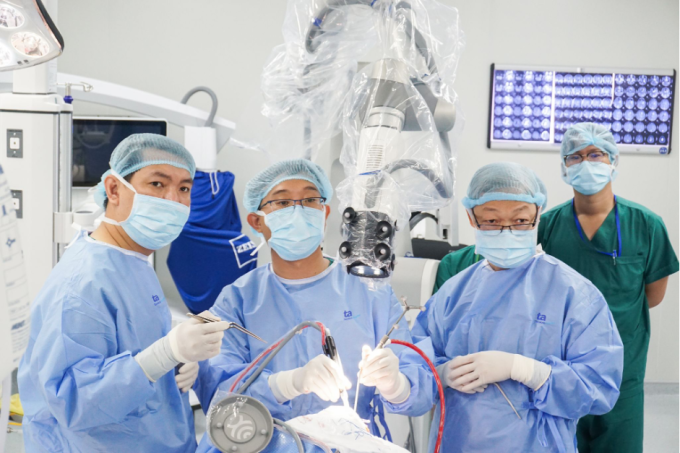
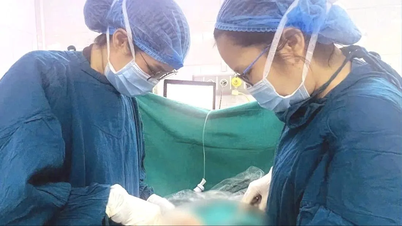
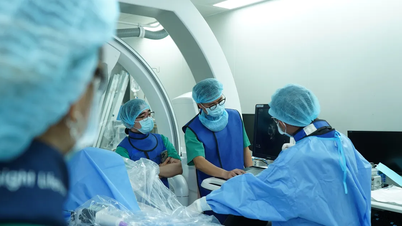
Surgeons remove a brain tumor from a patient. Photo: Provided by the hospital .
Dr. Tan Si and his surgical team performed a preliminary simulation using specialized software on the Modus V Synaptive robotic brain surgery system, which utilizes artificial intelligence (AI). They selected the location for the skull incision and the approach to the tumor in the grooves of the cerebral cortex, avoiding damage to adjacent nerve bundles.
During the actual surgery, the team followed a simulated incision line with the assistance of an AI-powered Neuro-Navigation system to access the fibrous and easily bleeding tumor. The surgeon dissected the tumor, used a Cusa ultrasound machine to break it down, and suctioned it out completely.
Two days after the surgery, Mr. Loc was feeling better, able to walk normally, and was discharged from the hospital a week later.
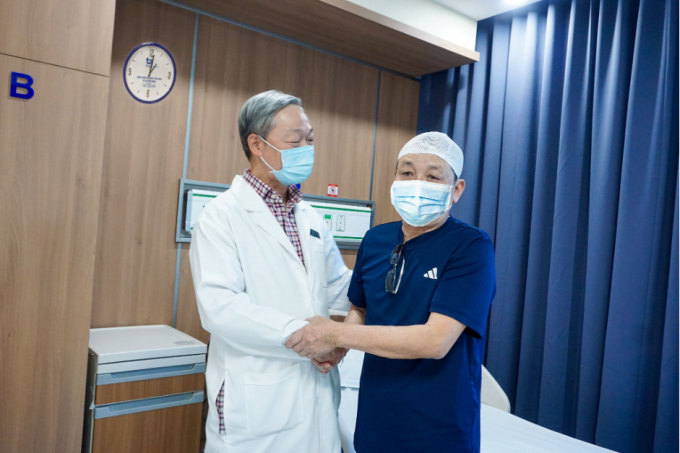
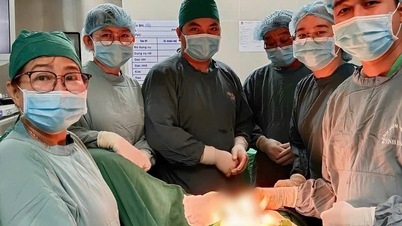
Mr. Loc thanked Dr. Tan Si and arranged for the surgical team to operate. Photo: Provided by the hospital.
Dr. Tan Si explained that traditional surgical methods (microsurgery, open surgery) only help doctors mark the coordinates of the tumor using navigation guidance. With robotic brain tumor surgery, doctors are further assisted by DTI imaging of the nerve fibers surrounding the tumor. This allows for the identification of a safe approach to the tumor, avoiding damage to surrounding nerve fibers and healthy brain tissue, thus preserving the patient's neurological functions to the maximum extent.
Mr. Minh
| Readers can ask questions about neurological disorders here for doctors to answer. |
Source link


![[Photo] Conference announcing the Politburo's Decision on organizational and personnel matters](https://vphoto.vietnam.vn/thumb/1200x675/vietnam/resource/IMAGE/2026/04/01/1775017881825_bnd-2410-1472-jpg.webp)






























































































Comment (0)