

The CPI in 2024 increased by 3.63% compared to 2023. This marks the 10th consecutive year that Vietnam has successfully controlled average inflation at below 4%.
List the three main causes.
According to the latest figures released by the General Statistics Office, the consumer price index (CPI) in December 2024 increased by 0.29% compared to the previous month. Compared to the same period last year, the CPI increased by 2.94%. On average, the CPI in 2024 increased by 3.63% compared to 2023. Thus, this marks the 10th consecutive year that Vietnam has successfully controlled average inflation at below 4%.
 |
| Consumers shop for Tet (Lunar New Year) goods at Co.op Mart supermarket in Ha Dong. Photo: Nguyen Hanh |
During the period 2015-2024, inflation averaged only 2.8% per year, significantly lower than the average of 10.2% per year in the previous 10 years (2005-2014). According to Dr. Nguyen Duc Do, Deputy Director of the Institute of Economics and Finance (Academy of Finance), the low inflation over the past 10 years is due to three main reasons.
Firstly , the rate of increase in the money supply during the period 2014-2023 (with a 1-year lag) was only 13.8%, much lower than the average of 27.1% during the period 2004-2013.
Secondly , interest rates during the period 2014-2024 consistently remained positive in real terms, averaging 3.7% per annum for 12-month term deposits. In contrast, the average real interest rate during the period 2004-2014 was 0% per annum.
Thirdly , the USD/VND exchange rate in the period 2014-2024 has also been more stable compared to the period 2004-2014. While the depreciation rate of the VND against the USD averaged 2.9% per year in the period 2004-2014, it decreased to 1.6% per year in the period 2014-2024.
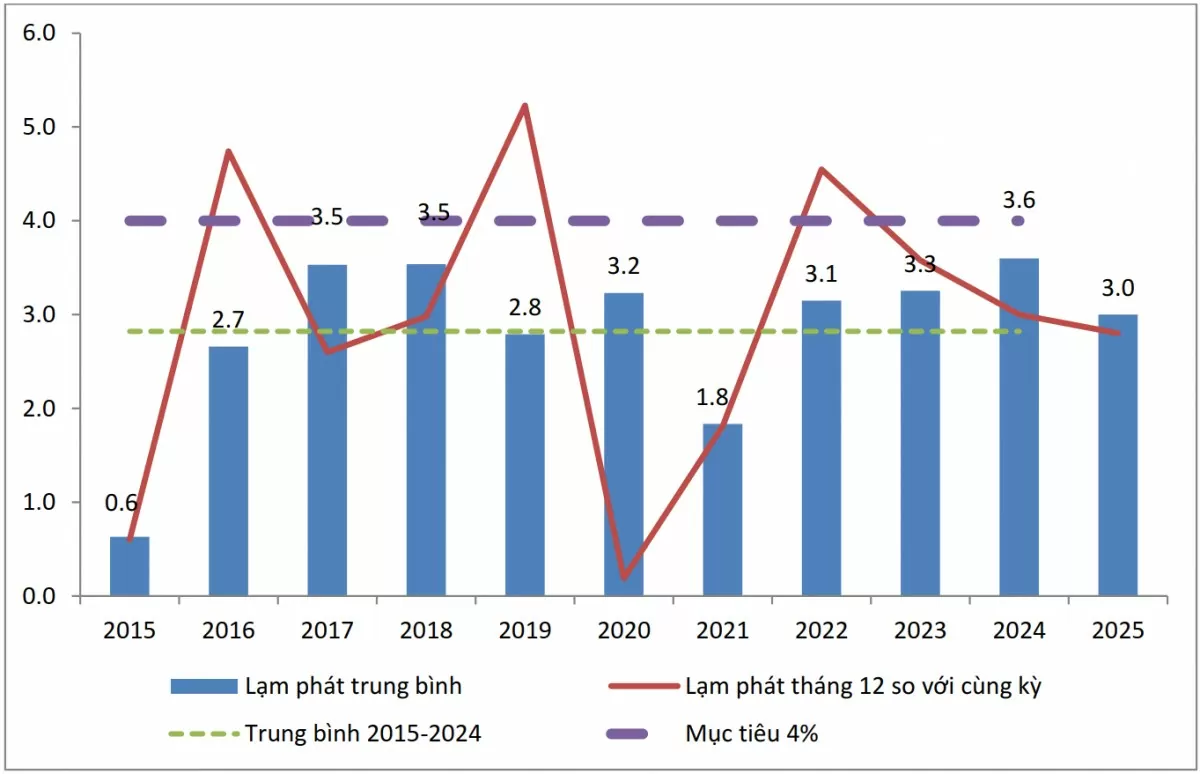 |
| Inflation chart in Vietnam from 2015-2024 and forecast (%). Source: General Statistics Office. |
Thus, low money supply growth, positive real interest rates, and a stable exchange rate are the fundamental factors explaining why inflation in Vietnam has remained stable at a low level over the past 10 years.
In fact, inflation during the period 2015-2024 has essentially remained flat (around an average of 2.8% per year or 0.23% per month), meaning it has been anchored by stable monetary policy and exchange rates. Fluctuations in inflation (higher or lower than the average) are mainly due to changes in oil prices, raw material prices, as well as the prices of healthcare and education services controlled by the State.
3 inflation scenarios for 2025
In 2024, the money supply was controlled at 9.42%, significantly lower than the average for the 2014-2023 period. This is a factor that will help control inflation in 2025. However, in 2024, real interest rates, although still positive, are lower than the average for the 2014-2024 period, and the rate of appreciation of the USD is also higher than the average for the same period. These factors could put pressure on prices in the near future.
Besides the monetary and exchange rate factors mentioned above, inflation in 2025 will also depend on other factors such as global economic growth and the prices of oil and input materials. According to forecasts from international organizations, the global economy will continue to grow steadily at 3.2% in 2025, similar to 2024, while the average price of oil and basic input materials is expected to slightly decrease. However, exchange rates and interest rates will remain uncertain factors that will impact prices in Vietnam.
Against this backdrop, Dr. Nguyen Duc Do presented three inflation scenarios for 2025. According to these scenarios, in the baseline scenario, the USD/VND exchange rate remains stable and interest rates only increase slightly due to increased credit demand. The CPI is projected to increase by an average of 0.23% per month, and the average inflation rate for the whole year 2025 will be around 3.0%.
In the high-scenario, with significant exchange rate pressure due to the strong appreciation of the US dollar in the global market, and the State Bank of Vietnam sharply raising interest rates to stabilize the exchange rate and control inflation, the CPI could increase by 0.28% per month and average inflation would be around 3.3%.
In the low-growth scenario, with weak global and Vietnamese economic growth, a significant drop in oil prices, and stable or slightly declining USD exchange rates and interest rates, the CPI could increase by only 0.18% per month, and average inflation would be around 2.7%.
According to Dr. Nguyen Duc Do, the above forecasts do not take into account the case where the Government increases prices for healthcare and education services according to the planned schedule, as well as the possibility of the global economy falling into recession due to interest rates in developed countries being maintained at high levels for a long time. If the Government adjusts service prices in the second half of 2025, average inflation could reach 3.5% in the high-scenario.
In the low-growth scenario, if the global economy falls into recession in 2025 and oil prices plummet, average inflation could drop to 2.5% or even lower.
| With stable and reasonable monetary and exchange rate policies, Vietnam has kept inflation below 4% for the past decade. In 2025, average inflation is likely to remain under control at 3.0% (+/- 0.5%), significantly lower than the 4-4.5% target approved by the National Assembly. |
Source: https://congthuong.vn/mot-thap-ky-lam-phat-thap-368973.html




![[Photo] General Secretary and President To Lam presides over a working session with the Central Policy and Strategy Committee on the development of the materials industry.](https://vphoto.vietnam.vn/thumb/1200x675/vietnam/resource/IMAGE/2026/05/21/1779359935432_a3-bnd-3129-1412-jpg.webp)
![[Photo] National Assembly Chairman Tran Thanh Man working with the Standing Committee of the Law and Justice Committee](https://vphoto.vietnam.vn/thumb/1200x675/vietnam/resource/IMAGE/2026/05/21/1779378929214_ndo_br_1-4610-jpg.webp)


























































































Comment (0)