

The problem isn't money.
According to an analysis by the Center for Strategic and International Studies (CSIS) published on May 27, U.S. defense contractors will need at least three years to replenish their stockpiles of three key weapons systems that were used extensively in the war in Iran. These three weapons are the Tomahawk cruise missile, Patriot interceptor missiles, and the Terminal High Altitude Area Defense (THAAD) missile defense system.
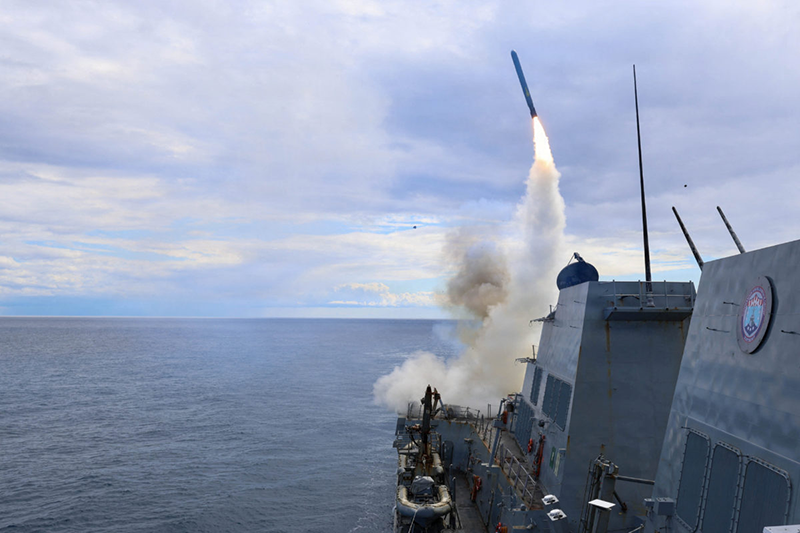
A US destroyer fired Tomahawk missiles at Iran in March. Photo: Reuters
“The U.S. has enough ammunition for any scenario in a war with Iran, but dwindling arms stockpiles have created a vulnerable gap in the event of conflict in the Western Pacific. Therefore, the time required to rebuild these stockpiles has become a major concern,” CSIS stated.
CSIS also took into account the proposed historic $1.5 trillion defense budget for fiscal year 2027 under President Donald Trump, marking a 42% increase over the current year. This plan would significantly accelerate spending on ammunition and high-tech weapons.
According to the report, expanding production capacity and developing complex weapons systems takes years. Therefore, the period of vulnerability in U.S. military capabilities could last for several years until stockpiles return to their previous levels, and several more years before reaching the levels desired by war planners.
However, President Trump and Defense Secretary Pete Hegseth insist that the U.S. remains capable of waging any war. Last month, Secretary Hegseth stated that military spending under Trump would allow defense manufacturers to double, or even triple, their production capacity. At a cabinet meeting on May 27th, Hegseth said that private defense companies are investing in new factories and production lines so that the U.S. can acquire weapons faster than ever before.
Weapons used by the US in the conflict.
Last month, CSIS identified seven main types of munitions that the U.S. dropped on Iran, including Tomahawk, Patriot, THAAD, SM-3, and SM-6 missiles, along with the JASSM long-range air-to-ground missile and the PrSM precision-strike missile.
Specifically, the US launched over 1,000 Tomahawk missiles at Iran, nearly one-third of its pre-war stockpile. Patriot missiles were even more heavily depleted. An estimated 1,060-1,430 of these missiles were fired during Operation Fierce Fury, while the total stockpile before that was only 2,330. For weapons with smaller stockpiles, such as the PrSM and THAAD missiles, the war is believed to have consumed nearly 50% of their reserves.
These types of ammunition were fired with great intensity during nearly 40 days of fighting before the two sides reached a fragile ceasefire.
CSIS estimates that it may not be until the end of 2030 that the U.S. fully restore its pre-war Tomahawk missile stockpile. For other air defense systems in high demand, replacing 290 THAAD interceptor missiles could take until the end of 2029, and adding over 1,000 Patriot missiles is expected to be completed by mid-year.
According to analysts, the reason for the extended production time is due to the limited investment in US procurement in previous years and the fact that the defense industry's production capacity has not been expanded proportionally.
Currently, the country produces fewer than 200 Tomahawk missiles per year, while purchasing an average of only 225 Patriot missiles per year.
The allocation of Patriot missiles puts Washington in a difficult position. The U.S. must both replenish its domestic stockpile and help Ukraine defend against missile attacks from Russia, while also meeting the needs of 17 other countries that use the system.
Raytheon aims to increase its capacity to over 1,000 Tomahawk missiles per year. Lockheed Martin is also ramping up production for both interceptor systems. THAAD deliveries have been rescheduled to prioritize U.S. needs over those of allies and partners.
HANH NGUYEN (According to AP, News Week)
Source: https://baocantho.com.vn/my-can-nhieu-nam-de-khoi-phuc-kho-vu-khi-a205779.html

![[Photo] The General Secretary, President and his wife begin their state visit to the Philippines.](https://vphoto.vietnam.vn/thumb/1200x675/vietnam/resource/IMAGE/2026/05/31/1780230559452_anh-man-hinh-2026-05-31-luc-19-28-11.png)
![[Photo] Solemn bathing ceremony and Buddha procession in Hue](https://vphoto.vietnam.vn/thumb/1200x675/vietnam/resource/IMAGE/2026/05/31/1780228263543_1-jpg.webp)
![[Photo] Admire the coral "masterpiece" amidst the million-year-old heritage of Dak Lak province.](https://vphoto.vietnam.vn/thumb/1200x675/vietnam/resource/IMAGE/2026/05/31/1780221235105_anh-man-hinh-2026-05-31-luc-16-53-27.png)
![[Image] Hanoi Police officially crowned champions of V-League 2025/2026](https://vphoto.vietnam.vn/thumb/1200x675/vietnam/resource/IMAGE/2026/05/31/1780244769054_ndo_br_039d561b692be875b13a-jpg.webp)




















![[Video] Sunset at Lap An Lagoon – Where the sun sets over the fishing nets](https://vphoto.vietnam.vn/thumb/340x192/vietnam/resource/IMAGE/2026/05/31/1780192137701_beach-landscape-sea-water-nature-grass-745871-pxhere-com.jpeg)






































































Comment (0)