
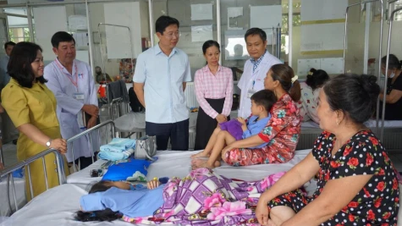
The patient is being treated at the National Hospital for Tropical Diseases.
Approximately three days before hospitalization, Mr. HMP (45 years old, from Hanoi ) fell from scaffolding, resulting in swelling and bruising around his left ankle and foot, significant pain, and difficulty moving. Upon examination, he was diagnosed with soft tissue edema and hematoma, with no fractures, and prescribed painkillers and anti-inflammatory medication (it is unclear whether it contained corticosteroids). After taking the medication at home, the pain subsided, but he developed a fever, muscle pain, cough with phlegm, and progressively worsening shortness of breath.
On November 1st, he was admitted to a specialized pulmonary hospital and diagnosed with influenza A pneumonia accompanied by respiratory failure. His condition deteriorated rapidly, requiring intubation and mechanical ventilation, kidney function declined, and lung damage was severe despite broad-spectrum antibiotic treatment.
After 11 days of treatment with no improvement, the patient still had a persistent fever. Culture results revealed an Aspergillus fungal infection, and he was transferred to the National Hospital for Tropical Diseases.
At the Intensive Care Unit, Dr. Hong Ky stated that the patient was admitted in a very critical condition: sedated, muscle relaxants, on a ventilator, requiring vasopressors, with severe edema, abdominal distension, green gastric fluid, dark yellow urine; bruising around the left ankle and foot; grade 3 ulcers on the back and sacral region; low blood pressure, requiring maintenance of noradrenaline.
Bronchoscopy revealed a firmly attached pseudomembrane in the left upper segmental bronchus, prone to bleeding. The patient was diagnosed with invasive Aspergillus infection of the lungs on a background of severe influenza A pneumonia, respiratory failure, acute renal failure, heart failure, and congestion. The patient underwent continuous hemodialysis and antifungal treatment.
However, treatment is complicated because the patient has renal failure and cardiovascular disease, which reduces drug absorption and complicates treatment combinations.
After one day, lung function began to improve. But on the seventh day, the patient's fever returned to 38.8°C, and a bacterial infection developed, requiring an increase in the dose of vasopressors.
After 10 days of intensive treatment and optimal resuscitation, the patient gradually stabilized, recovered from shock, regained kidney function, and became conscious. However, he still needs to continue antifungal medication for at least 6 weeks.
Dr. Pham Van Phuc, Deputy Director of the Intensive Care Unit, said: “Influenza not only causes viral pneumonia but also weakens the respiratory tract's 'protective barrier,' creating opportunities for bacteria and fungi to attack. One of the most dangerous complications is invasive Aspergillus fungal infection. Aspergillus fungi are common in the environment and are usually harmless to healthy people, but in severe influenza patients – especially those with underlying conditions, weakened immune systems, or requiring mechanical ventilation – the fungus can penetrate deep into the lungs, causing widespread damage and rapid respiratory failure.”
Secondary infections, particularly invasive Aspergillus, are a major cause of increased mortality in influenza patients. Patients may experience sudden deterioration, prolonged fever, increased shortness of breath, or worsening lung imaging despite antibiotic treatment. Early detection through specialized tests and timely treatment are crucial for successful treatment.
Dr. Phuc advises that if a person with the flu experiences prolonged fever, progressively worsening shortness of breath, or if their condition does not improve after 3-5 days of treatment, they should immediately go to a medical facility for assessment of secondary infections. Early detection and timely treatment are crucial in preventing dangerous complications. Those with underlying health conditions or weakened immune systems should be especially vigilant, get an annual flu vaccine, and seek medical attention early if they experience any unusual symptoms.
MANH TRAN
Source: https://nhandan.vn/nam-aspergillus-tan-cong-phoi-benh-nhan-cum-a-post928161.html




![[Photo] General Secretary and President To Lam presides over the meeting to approve the draft report on the results of the second inspection by the Politburo of the Standing Committee of the Hanoi City Party Committee.](https://vphoto.vietnam.vn/thumb/1200x675/vietnam/resource/IMAGE/2026/05/26/1779789811432_a2-bnd-4430-9620-jpg.webp)
































































Comment (0)