

In every strand of dried banana fiber, every hand-woven hammock weave, lies a cultural essence, preserving the soul of the people of Southern Vietnam: simplicity, diligence, depth, and rich emotions. In Southern Vietnam, culture is not found in grand gestures, but in the everyday way of life.
That culture is encapsulated in lullabies sung to put children to sleep and in the simple hammocks made of banana fiber rope, where the images of mothers and grandmothers—the women who silently preserved the family and the soul of the homeland—are deeply imprinted.
SIMPLE YET PROFOUND
In a quiet corner of Tan Phong islet, Ms. Doan Thi Phuong (residing in Tan Thai hamlet, Hiep Duc commune, Dong Thap province) still sits on her porch every day, diligently weaving hammocks from dried banana fibers with her hands, calloused by time. Having been involved in hammock weaving for 45 years, Ms. Phuong is not only creating a handcrafted product but is also quietly preserving a part of her homeland's soul.
Tourists are very impressed with the craft of weaving hammocks from banana fibers at Tan Phong islet. |
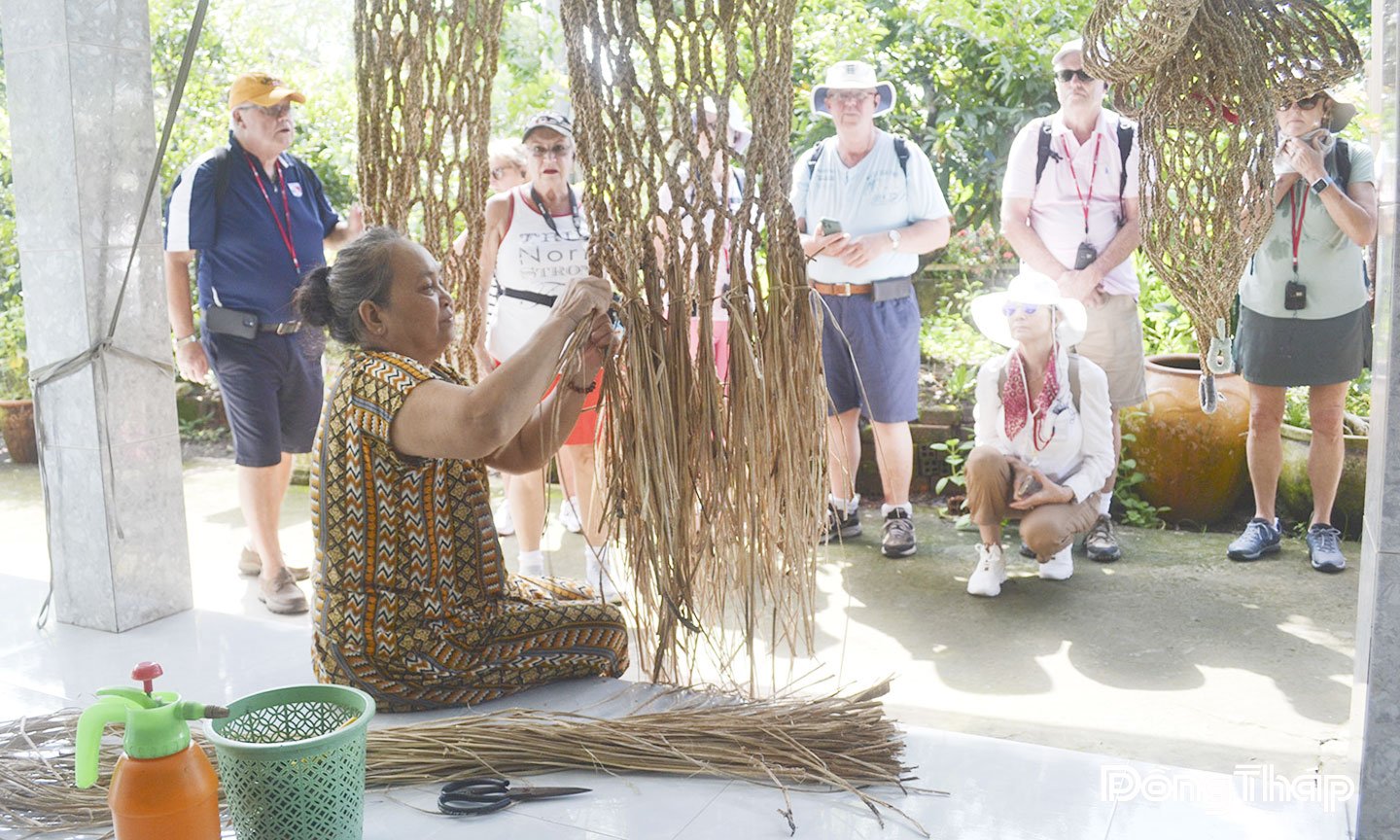
Ms. Phuong recounted her days of working in hammock weaving with a nostalgic look in her eyes. In the 1980s, when rural life was still full of hardships, people here utilized readily available materials from their gardens for daily life. Among them, banana fiber taken from young, unripe Siamese banana trees was used as the raw material for weaving hammocks.
“Back then, we didn’t have money to buy cloth hammocks. Almost every household grew banana trees, so people would often cut down Siamese banana trees to use the ropes for weaving hammocks. Hammocks woven from banana ropes were economical, cool to lie on, and durable,” Ms. Phuong recalled.
According to Tran Van Trung, Vice Chairman of the People's Committee of Hiep Duc commune, in the coming time, the People's Committee of the commune will create favorable conditions for traditional crafts, including the craft of weaving hammocks with banana fiber in Tan Phong islet, to be maintained and developed. In addition, local traditional crafts such as hammock weaving will become a highlight attracting tourists to visit and experience Tan Phong islet, thereby contributing to improving the lives of the people and building an increasingly developed image of Hiep Duc commune. |
More than just a household item, the hammock woven from banana fibers has become a symbol associated with the childhood of many generations of people in Southern Vietnam. The image of children sleeping peacefully in hammocks lined with sedge grass mats, gently swaying to their mother's lullabies, is a warm and unforgettable memory. Ms. Phuong shared: "My two children also grew up in hammocks made of banana fibers like that. Every noon and every afternoon, they would listen to their mother's lullabies, and then they would fall asleep without even realizing it."
According to Ms. Phuong, making a beautiful and durable hammock from banana fiber is not a simple matter. First, you have to know how to choose the right type of young, unripe Siamese bananas, because the fiber is strongest at this stage. After being cut from dried banana leaves, the fiber is washed and dried in the sun for 1-2 days, enough to dry but not become brittle.
After drying, each strand is split into 10-12 thin strands, then twisted and woven into the main thread used for weaving. Each hammock requires approximately 11-12 main strands to complete. "When weaving, you must work evenly, dividing the hammock slats precisely so that when lying down, there is no discomfort or back pain."
"The ropes shouldn't be too thick or too thin; each strand must be perfectly uniform," Ms. Phuong said, meticulously weaving each link of the hammock with practiced skill. A finished hammock made from banana fiber rope is about 2.8-3 meters long, depending on the user's requirements. On average, it takes her 30 hours to weave one hammock.
PRESERVING THE SOUL OF THE COUNTRYSIDE THROUGH EVERY HAMMOCK
Perhaps nothing evokes childhood memories for people in the Mekong Delta more than the image of a hammock strung up on the porch, a child sleeping peacefully on a mat of sedge grass, lulled to sleep by the lullabies of their grandmother or mother. This simple image has become a cultural hallmark of the riverine region.
With her skillful hands, Ms. Doan Thi Phuong has created hammocks that reflect the unique character of her homeland. |
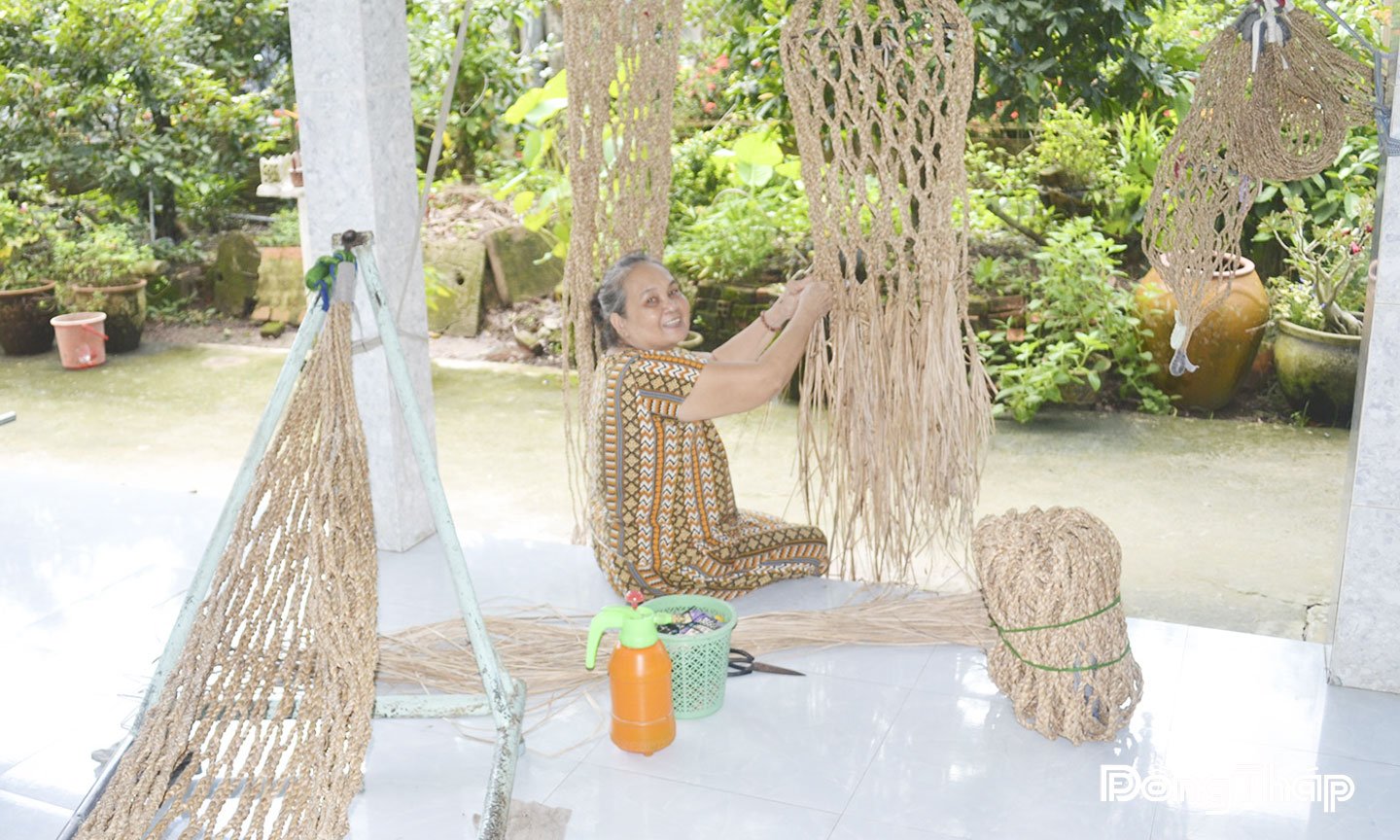
According to Ms. Phuong, hammocks woven from banana fibers have many advantages over hammocks woven from fabric because they are cooler to lie on, don't sag, and don't cause back pain. On average, a hammock can be used for 2-3 years, and with proper care, it will last even longer.
Besides traditional hammocks, she also created smaller versions to use as souvenirs. These products are especially popular with tourists visiting Tan Phong islet, not only for their unique appearance, but also because they embody the spirit of the countryside, a story, and a "slice" of Southern Vietnamese culture.
Although her monthly income from weaving hammocks is only a few million dong, Ms. Phuong still cherishes the craft as a part of her memories and a responsibility. For her, each finished hammock is not simply a product to sell, but a piece of the soul of her village, where the sound of hammocks swaying is an unforgettable part of her memories.
"She does it out of love for the craft, for the old traditions, because it's a part of her hometown's memories. She wants her descendants to know about the old craft, to know about the hammock woven from banana fibers, to hear the sound of the hammock swaying and the sweet lullabies," Ms. Phuong confided.
In this riverside region, it's not just the orchards laden with fruit or the cool, green canals that create the beauty of the homeland, but also people like Ms. Phuong, with their diligent, meticulous hands and hearts dedicated to preserving their craft, who have contributed to making Tan Phong islet rich in identity and full of human warmth.
HỮU THÔNG
Source: https://www.baodongthap.vn/van-hoa-nghe-thuat/202509/nghe-dan-vong-noi-luu-giu-hon-que-1049504/



























































Comment (0)