

In Nghe An , the mudworms are washed clean, placed in earthenware jars with salt and spices, and after a month, they yield a thick, viscous fish sauce that is amber or honey-yellow in color.
In the lower reaches of the Lam River, many households in Hung Nguyen district make fermented mudworm paste. This invertebrate lives in brackish water at river and sea estuaries and is rich in protein and minerals such as calcium, phosphorus, iron, and zinc. From September to December of the lunar calendar each year, people usually enclose rice paddies along the river with nets to catch mudworms, which they then sell to traders or traditional fermented fish paste and sausage producers for 400,000-500,000 VND per kilogram.
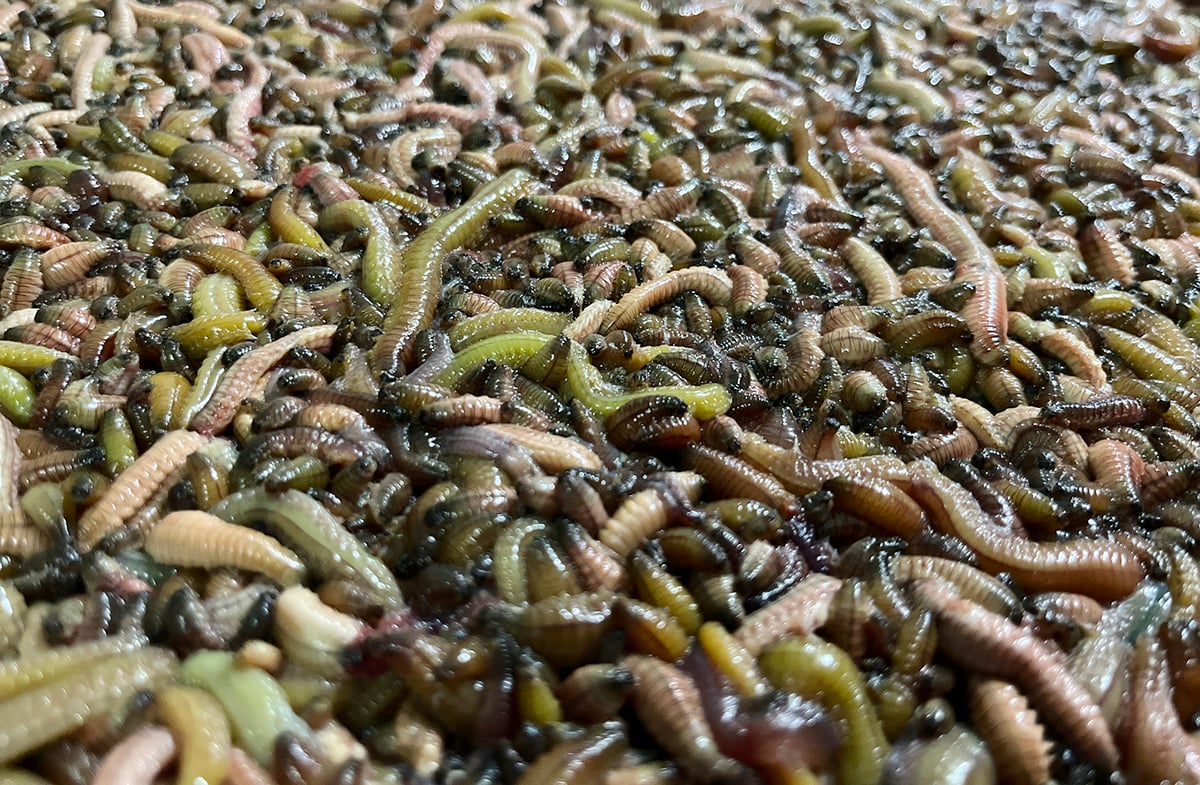
The process of making fermented mudskipper paste by the people of Hung Nguyen. Video : Hung Le
Having worked in the business of making fermented mudworm paste for nearly 20 years, Ms. Vo Thi Ngoc Lan, 44 years old, residing in Chau Nhan commune, Hung Nguyen district, said that in the past, mudworms were abundant, and some nights people in Chau Nhan commune would catch dozens of kilograms to bring home as food. Unable to consume it all, and lacking refrigeration for preservation, some families came up with the idea of making fermented mudworm paste (ruoc) for later use. Over time, fermented mudworm paste has become a specialty of Hung Nguyen, favored by customers both within and outside the province.
To make fermented mudskipper paste, you need to prepare spices such as orange peel, salt, chili powder, brown glutinous rice, fresh turmeric, shallots, ginger, etc. According to Ms. Lan, the glutinous rice must be roasted until it turns a golden brown color, then ground into a fine powder and sieved to make the seasoning. Shallots, orange peel, ginger, chili powder, and fresh turmeric help to enhance the aroma and color; all are ground into a fine powder. Roasted salt adds a rich flavor to the paste.
Having prepared all the seasonings, Ms. Lan washed 10 kg of fresh sea worms, let them drain for about two hours, then put them into a ceramic jar 40 cm high and 20 cm in diameter, and sprinkled the seasonings evenly over them. Using two bamboo chopsticks over 50 cm long, she stirred them well so that the sea worms and other ingredients were thoroughly mixed.
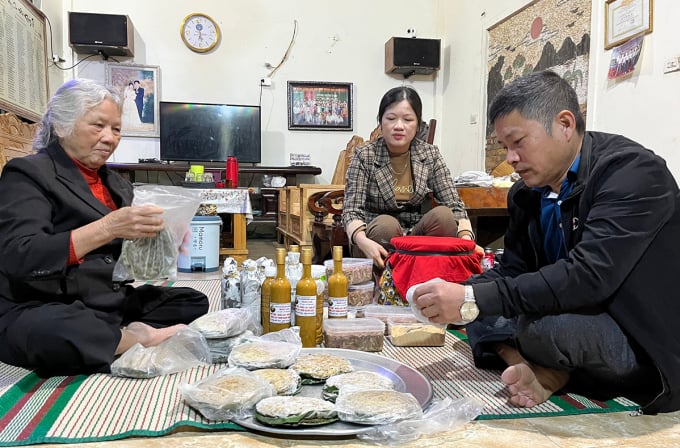
Ms. Lan and her family members prepare the spices for making fermented mudskipper paste. Photo: Hung Le
Once she feels the sea worms and spices have blended well, Ms. Lan covers the earthenware jar with cloths, seals it tightly with rubber bands, and takes the jar out to dry in the sun on sunny days. After about 2-3 days, she opens the jar and stirs it with chopsticks for 3-5 minutes to allow the fermented fish sauce inside to absorb the ingredients and ripen evenly. After a month, the fish sauce is ripe, thick, turns amber or honey-yellow, and has a mild aroma.
The best time to make fermented mudworm paste is in October-November, when it's peak season and the worms are large and plump. During processing, if cold water gets into the paste, it will ruin the entire jar, so care must be taken to avoid rain when drying it in the sun. "I usually make the paste at night to avoid wind and insects," Ms. Lan said.
A single batch of salted mudworms takes about 3 hours, with an average of 10 kg of fresh mudworms yielding 10 liters of fish sauce. Each mudworm season lasts 3 months, during which Lan's family processes nearly 400 kg of mudworms, producing over 400 liters of fish sauce.
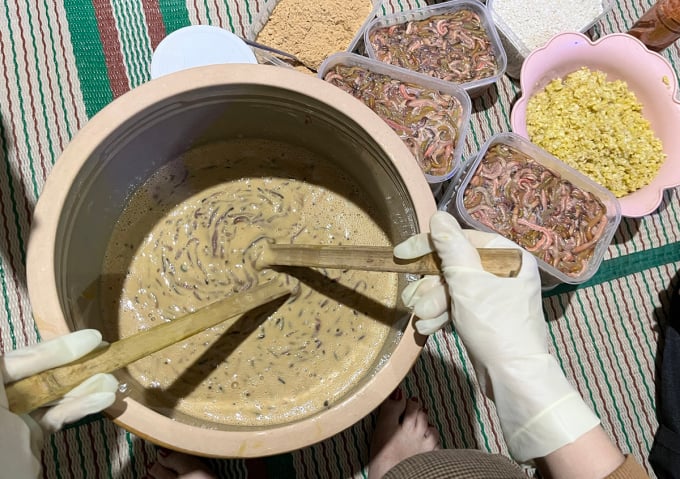
The sea worms are placed in earthenware jars, mixed thoroughly with spices such as orange peel, roasted rice powder, ginger, and turmeric, then salted for a month. Photo: Hung Le
One month after fermentation, when the fish sauce meets the standards, Lan's family bottles it into 500ml and 1000ml glass or plastic bottles. The bottles are tightly sealed and wrapped in nylon or newspaper. A 500ml bottle of fermented fish sauce costs 400,000-450,000 VND, and each 10kg jar of fish sauce generates a revenue of 8-10 million VND.
According to Mr. Nguyen Van Tai, 45 years old, residing in Chau Nhan commune, fermented mudskipper paste has a rich, fatty, and slightly spicy flavor, often used as a dipping sauce for boiled, roasted, steamed, or grilled meat. Many people initially find it unappealing, but after trying it a few times, they become addicted and call the facility to order large quantities. Previously, his family fermented 300 kg of mudskippers per season, but now that mudskippers are scarce, they only produce about 150 kg.
"During Tet (Lunar New Year), fermented fish paste is always sold out, with many customers placing orders but a shortage of fresh salted mudworms. Each season, after deducting expenses, the business earns tens of millions of dong. Many families with a large workforce and a large supply of mudworms make hundreds of millions of dong in profit," Mr. Tai said.
Besides making fermented fish paste, fresh ragworms can be used to prepare many delicious dishes such as: omelets, stir-fried with bamboo shoots, soups, etc. Some establishments in Hung Nguyen district also make ragworm patties, selling for 300,000-500,000 VND/kg. Grilled ragworm patties wrapped in banana leaves are also one of the specialties of the people living along the Lam River. After grilling, this dish is wrapped in bags, frozen, and then shipped to customers.
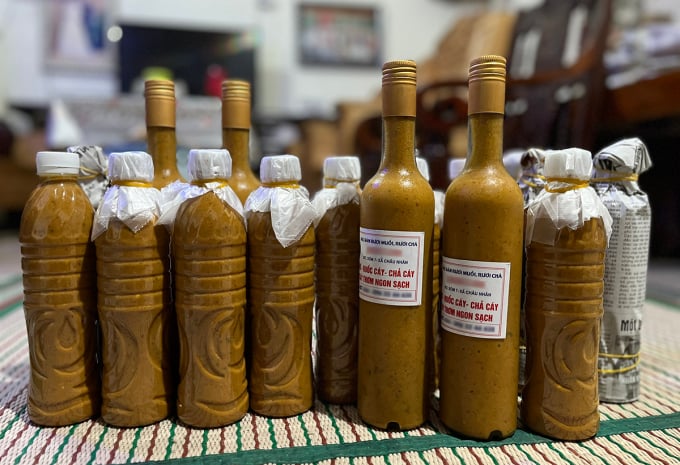
Fermented mudskipper paste is packaged in plastic and glass bottles. Photo: Hung Le
Ms. Ba Thi Dung, Deputy Head of the Agriculture and Rural Development Department of Hung Nguyen District, said that Chau Nhan and Hung Loi communes currently maintain the processing of products from mudworms. More than 10 families have opened large-scale trading businesses, generating a decent income, while the rest mainly produce seasonally, usually for personal use and as gifts during Tet (Lunar New Year).
"Currently, the natural supply of mudworms in the area is becoming increasingly scarce. The Department of Science and Technology of Nghe An province is working on a project to breed mudworms, supplementing the stock in areas where mudworms are found to improve productivity and develop the craft village," Ms. Dung said.
Source link





































































































Comment (0)