

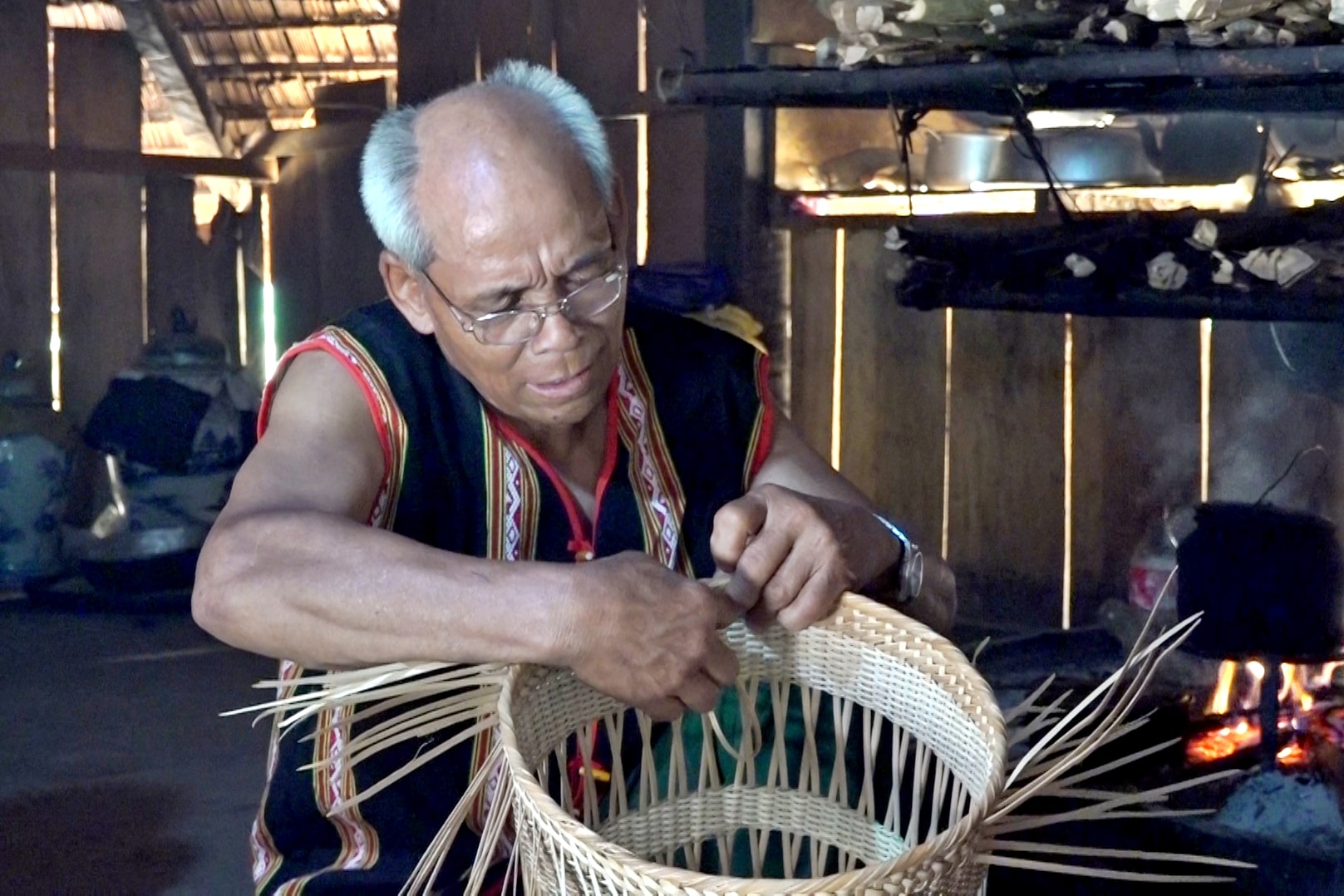
Cozy under the stilt house roof
In a traditional stilt house in village 49B (Dak Pring commune), village elder Phong Nhat is diligently weaving baskets. His hands move swiftly and skillfully, as if he is very familiar with each rattan fiber and each weave. Village elder Nheo said that the Ve people have maintained the custom of weaving baskets to give to their daughters-in-law to make farming easier.
Before a daughter-in-law goes to her husband's home, the men of the family will go to the forest to gather rattan to weave baskets. If a family doesn't have them, they'll buy them, as this is a meaningful gift for the daughter-in-law, hoping she will feel the warm family affection of her husband's family. And through these baskets, the daughter-in-law will be reminded to work diligently, helping her husband with farming to provide food for the whole family.
"I make a lot of baskets so that my new daughter-in-law can clearly see my love, and so that my children can use them gradually in the future. As for my old daughter-in-law, I weave two more baskets as a gift for her so that she doesn't have to work so hard. Thanks to that, the family atmosphere is always warm, everyone loves each other, and we build a strong family," said village elder Nhat.
[ VIDEO ] - Village elder Phong Nhat talks about how to weave a basket as a gift for his daughter-in-law:
According to the customs of the Ve people, a family consists of many generations living together, resulting in a very strong sense of community. Ve men have a high sense of responsibility in working and producing to support their family members. Women, on the other hand, are responsible for helping their husbands in the fields with farming and "keeping the fire burning" by taking care of the children and doing housework.
And now, thanks to the government's efforts in promoting marriage laws, family happiness among the Ve people has become even more secure, with the elimination of child marriage, large families, and men becoming addicted to alcohol.
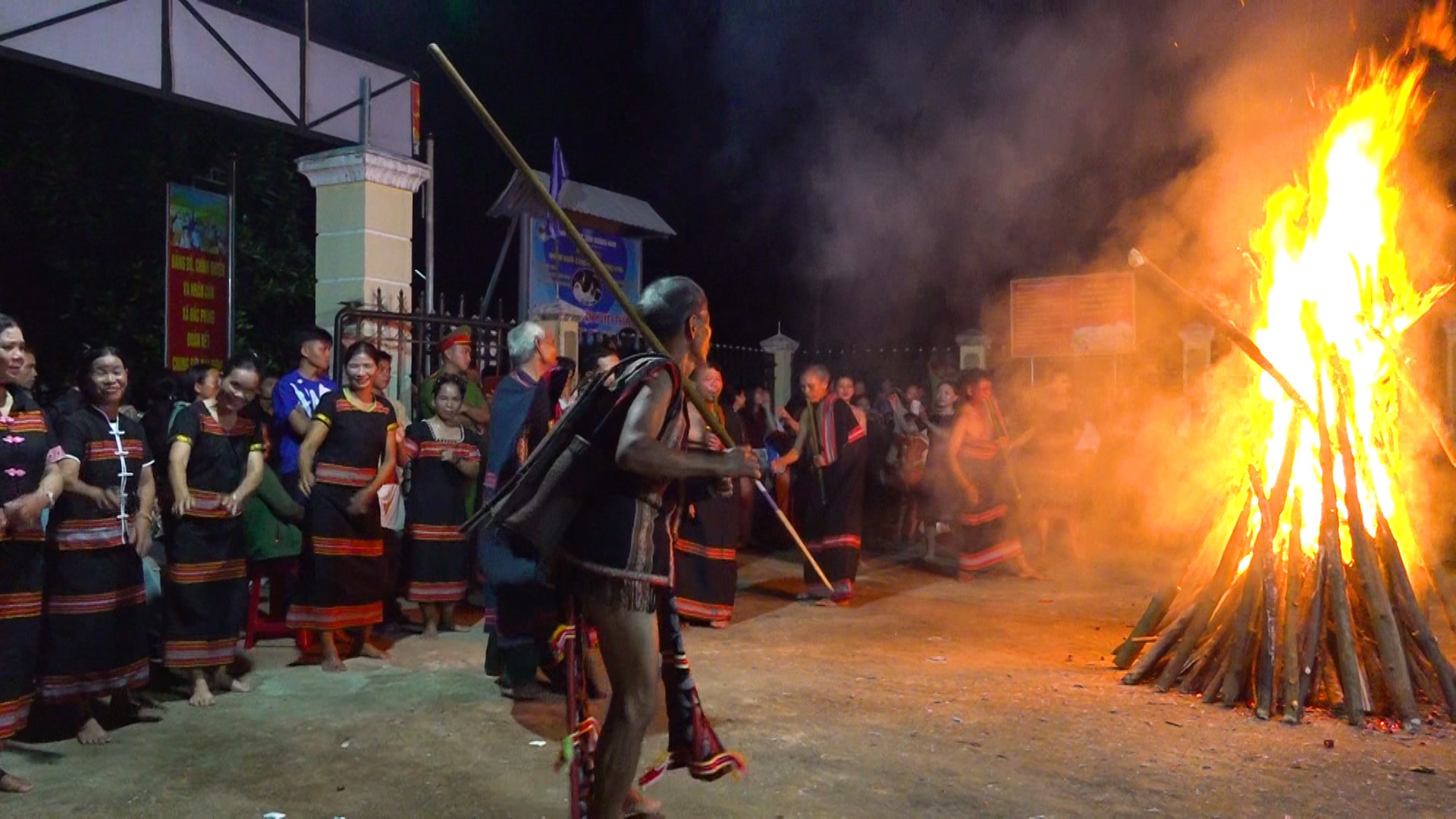
Preserving and passing on fine cultural values.
Along with preserving family traditions, the Ve people place great emphasis on preserving their unique cultural identity in brocade weaving, passing down the art of playing the ding tut flute, and performing the Pe Pel dance. To preserve these beautiful traditions, people in the villages have voluntarily established cultural preservation groups, with the core members being village elders, artisans, and senior citizens.
When farming work temporarily ceases, the members of the group gather their sons and daughters together to practice and teach the younger generation how to play the ding tut flute and perform the Pe Pel dance. It is through these simple gatherings that the traditional culture of the Ve people is passed down naturally and sustainably.
The Gie Trieng people's "dinh tut" consists of six tubes of varying lengths and sizes, with a fairly simple structure: one end is hollow for blowing and the other end has a closed notch. The blowing end is beveled on both sides to form a semicircle so that when played, the player's lower lip fits snugly against one side of the tube's mouth.
While playing the flute, the musician must sway and mimic the movements of people planting rice, weeding, or harvesting rice... At the same time, when the ding tut tune begins, the girls will move and dance the Pe Pel dance according to the rhythm.
“The ding tut and the pe pel, when combined, form an epic poem about the life of the Ve people in the mountains and forests. Therefore, they are only performed on joyous occasions such as celebrating the new rice harvest, land worship ceremonies, housewarming parties, weddings, etc., and not on sad days or when someone in the village has passed away. The pe pel dance tells the story of a mother going to work in the fields, leaving her child at home. When hungry, the child cries out for its mother to return. Through this, it conveys a message about the diligence and rich emotions of the Ve people, and the dance creates joy and excitement for labor and production.”
Mr. Kring Nhứ - Head of Hamlet 49B (Đắc Pring Commune)
[VIDEO] - People in village 49B play the ding tut and dance the Pe Pel dance:
According to the People's Committee of Dak Pring commune, the locality has fully implemented national target programs such as building new rural areas, developing socio -economic conditions in ethnic minority and mountainous areas, and sustainable poverty reduction. As a result, people have had the opportunity to improve their lives and preserve their traditional culture.
“The People's Committee of Dak Pring commune places great emphasis on the movement 'All people unite to build a cultured life' by regularly disseminating information on population and health issues and organizing regular activities in residential areas through associations and organizations. Therefore, in the commune, 303 out of 320 households have achieved the status of 'cultured family,' accounting for nearly 94.7%, with 8 cultured clans and 4 out of 4 villages recognized as cultured villages,” said Mr. Brao Nguu, Chairman of the People's Committee of Dak Pring commune.
Source: https://baoquangnam.vn/nguoi-ve-gin-giu-ban-sac-van-hoa-3156272.html
![[Photo] Prime Minister Pham Minh Chinh receives the Chinese Ambassador to Vietnam](https://vphoto.vietnam.vn/thumb/1200x675/vietnam/resource/IMAGE/2026/04/05/1775397481797_ndo_br_dsc-5512-jpg.webp)















































Comment (0)