

The imposition of a 25% tariff on imported steel and aluminum by US President Donald Trump, "without exception or exemption," places the world on the brink of a full-blown trade war.
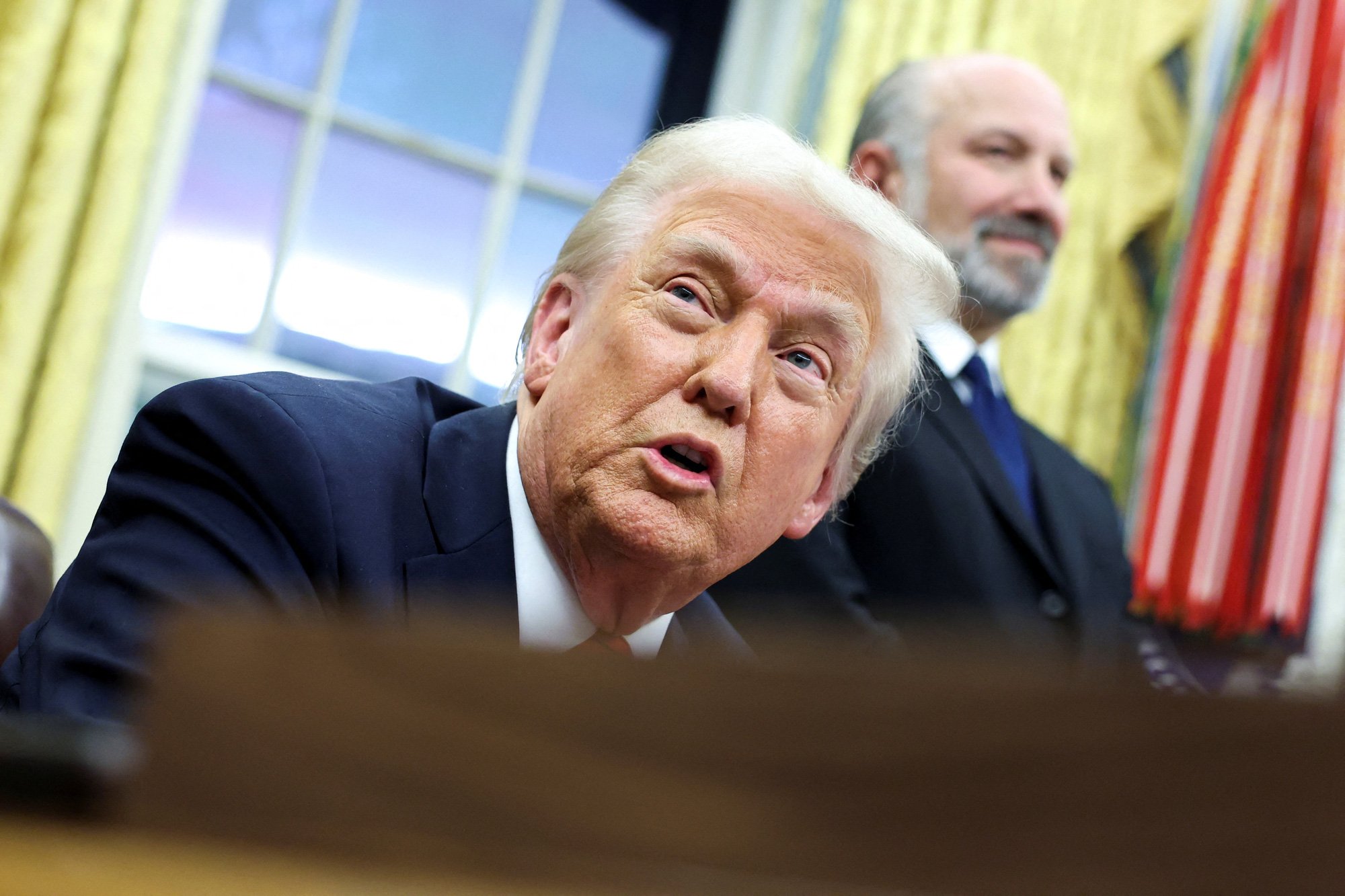
US President Donald Trump in the Oval Office at the White House signing executive orders on February 10 - Photo: REUTERS
"This is an unmistakable escalation of the trade conflict, but whether it will develop into a full-blown trade war depends on the response of the affected countries," Professor Julien Chaisse (University of Hong Kong, China) told Tuoi Tre newspaper .
Global impact
In trade law, a "trade war" typically refers to a series of escalating tariff and countermeasures. "With the European Union, Canada, and Mexico all having issued potential responses, we are seeing the first signs of such escalation," Chaisse continued.
When signing the executive order imposing a 25% tariff at the White House on the evening of February 10th, President Trump announced that he would take retaliatory measures against all countries that impose tariffs on American goods within the next two days.
This can be seen as a warning, and also a move to "shift the ball to the other side of the field," implying that how countries react will determine whether the world enters a full-blown trade war.
While international media attention has focused on the largest steel suppliers to the US, such as Canada, Brazil, Mexico, and South Korea, the new US tariff measures have a much broader impact.
During his first term, in 2018, through tariffs, the Trump administration reached agreements on quotas with several aluminum and steel-producing countries and exempted some countries from the 10% tariff.
However, in the newly signed executive order published by the White House, all quota agreements and hundreds of tariffs related to aluminum and steel products will be abolished.
According to the same decree, imported steel and aluminum must be "melted and formed" in the United States – a requirement reportedly aimed at limiting the influx of products originating from China and Russia into the US via third countries.
Furthermore, the tariffs will be extended to downstream products using steel and aluminum manufactured abroad, including structural steel and extruded aluminum.
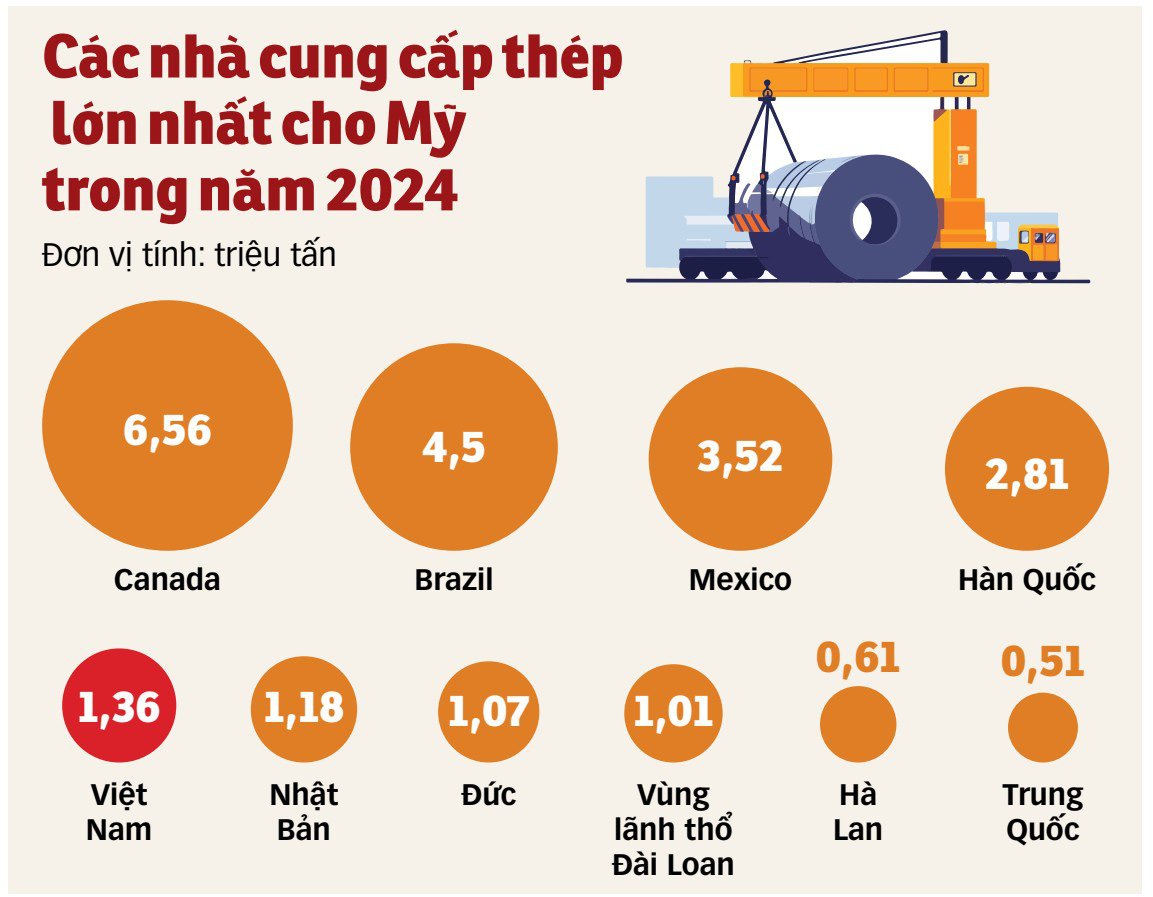
Source: American Iron and Steel Institute - Data: DUY LINH - Graphics: T. ĐẠT
Is the target China?
Trump's supporters believe that the new tariffs will help bring factories and jobs back to America. This view has some merit when looking at what happened during his first term.
According to statistics from the American Iron and Steel Institute, steel imports decreased by 10.2 million tons between 2017 – before the 10% tariff was implemented – and 2019. During the same period, US domestic steel production increased by 6.8 million tons, or 7.5%.
However, according to observers, Trump's target this time is not Canada, Mexico, or South Korea – countries that the US could easily "subdue" – but China.
Although China ranks only 10th among steel suppliers to the U.S., these tariffs act as an indirect restriction on the country, exploiting loopholes in shipping and proof of origin documentation.
According to Reuters, a US official also implicitly acknowledged that the ultimate target is China.
"Chinese steel is exported to third countries, processed or rebranded, and then exported to the U.S. under a different country of origin label. The new U.S. move is designed to close this backdoor," Professor Chaisse stated.
This will result in countries importing semi-finished steel and aluminum, such as China, facing closer scrutiny from the United States.
"If these countries' exports to the U.S. remain high, they could become targets of new trade investigations. China could divert more steel to Southeast Asia, Africa, and Europe, leading to oversupply and lower prices in those markets," Chaisse predicted.
Reactions from other countries
China has yet to comment – something many believe is unlikely, as it would be tantamount to confirming it has circumvented U.S. tariffs by shipping semi-finished steel and aluminum to other countries. Attention is now focused on countries like Canada, South Korea, and Mexico.
Acting South Korean President Choi Sang Mok announced that his government would seek to negotiate with the U.S. administration on the new tariffs to protect the interests of companies.
According to Choi, leaders of about 20 major corporations in the country have planned to visit the United States in the near future, while the government will discuss measures to respond to Japan and the European Union.
Meanwhile, Canada's Industry Minister described the new US tariffs as "completely baseless," emphasizing that Canadian steel and aluminum support key US industries ranging from defense, shipbuilding, and energy to automotive manufacturing.
Source: https://tuoitre.vn/nguy-co-chien-tranh-thuong-mai-toan-dien-20250212065530108.htm
![[Photo] Capturing the moment the tide recedes at Yen Binh Son rapids - a million-year-old scenic spot in Quang Ngai.](https://vphoto.vietnam.vn/thumb/1200x675/vietnam/resource/IMAGE/2026/05/19/1779175463885_yen9-1199-jpg.webp)
![[Photo] General Secretary and President To Lam presides over a meeting on the implementation of Directive No. 34-CT/TW of the Party Central Committee.](https://vphoto.vietnam.vn/thumb/1200x675/vietnam/resource/IMAGE/2026/05/19/1779187768672_a1-bnd-2350-631-jpg.webp)
![[Photo] National Assembly Chairman Tran Thanh Man attends the groundbreaking ceremony for the National Highway 1A spatial axis project.](https://vphoto.vietnam.vn/thumb/1200x675/vietnam/resource/IMAGE/2026/05/19/1779161360398_ndo_br_bnd-1412-jpg.webp)












































![[Photo] General Secretary and President To Lam receives Indian Defense Minister Rajnath Singh](https://vphoto.vietnam.vn/thumb/402x226/vietnam/resource/IMAGE/2026/05/19/1779184046302_anh-man-hinh-2026-05-19-luc-16-46-58.png)





















Comment (0)