

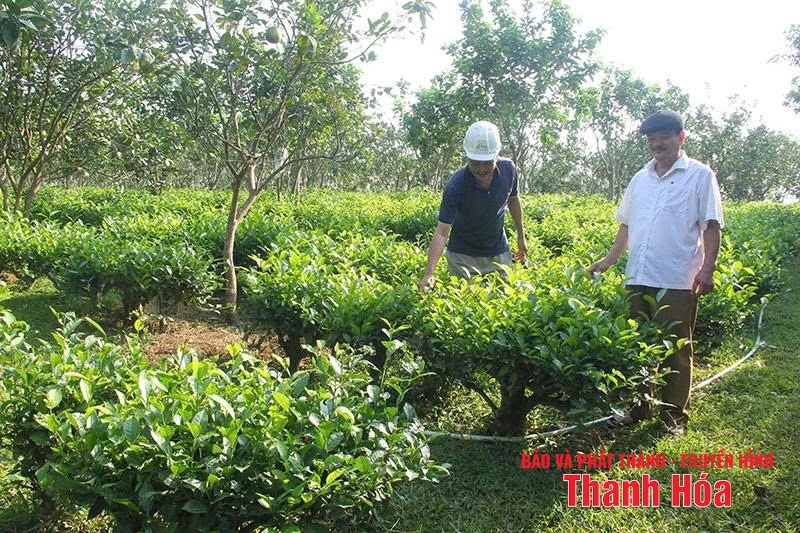
The tea garden is located on reclaimed hillside land belonging to Mr. Trinh Van Loi, Quang Trung ward.
Behind Mr. Trinh Van Loi's spacious single-story house lies a gently sloping hillside covered in lush green foliage. He has developed this 1.1-hectare hillside in Ward 8 of the former Bac Son commune into a comprehensive economic model, generating year-round income. Beneath the sparsely planted pomelo trees, which provide ample shade, rows of tea plants line the contour lines of the hillside. In areas further from the house, he has planted additional fruit trees such as longan and dragon fruit.
It is known that Mr. Loi is originally from Quang Truong commune, Quang Xuong district (formerly). After many years working in Bim Son, he got married and settled there, so Quang Trung ward became his second home. “The land used to be a barren hillside, and I only leased it in 1998 to reclaim it. It took many years of clearing overgrown bushes and thorns, a lot of hard work and sweat. Then, I had to gradually improve the land, reclaiming and cultivating fruit trees wherever possible. In the early years, I planted dragon fruit and longan, but found the results not very good, so I gradually switched to pomelo. The largest area was used for experimenting with tea cultivation, and after success, it was developed on a large scale,” Mr. Loi said.
According to Mr. Loi, he was probably the first person to cultivate tea on a large scale using intensive farming methods in the Quang Trung area. His tea plantation, which is over a decade old, is still thriving, confirming its suitability to the local climate and soil. Besides harvesting tea buds, he also receives daily orders from traders for fresh green tea leaves to supply markets in the former Bim Son town and Ninh Binh province.
On a plot of land nearly 1,000 square meters in front of his house, bordering the main road, he developed an ornamental garden. Many of the plants were pruned and shaped by his own hands, creating valuable works of art. The entire hillside has become a prosperous farming area. The two crops that generate the most income are dragon fruit, about 40 million VND, and tea, about 50 million VND each year. The total profit from the garden exceeds 100 million VND per year, providing stable employment for two family members and several hired workers who pick tea on a daily basis.
Within the same ward, rolling hills and mountain ranges form numerous valleys bordering Ninh Binh province. To this day, many areas remain barren, overgrown with weeds and wild plants. However, a model for commercial orange and pomelo cultivation using high technology has been established for many years. The owner of this model is Ms. Le Thi Sanh, 73 years old, a retired factory worker who bid for and reclaimed the barren hillside land. “In 2009, my family bid for this remote and isolated hillside land, which at that time had no roads or electricity. In the early years, we planted pineapples and sugarcane wherever we reclaimed the land. Using short-term gains to support long-term growth, the reclaimed area gradually increased, and from 2015 onwards, I gradually replaced it with fruit orchards.”
Currently, Mrs. Sanh's orange and pomelo orchard has expanded to nearly 10 hectares on sloping land, with 6 hectares dedicated to pineapple cultivation on the flat foothills. Since electricity became available, her family has applied scientific advancements to production. Despite the vast and steep hillsides, a high-capacity pumping system delivers water and dissolved nutrients to every tree root. A drip and sprinkler irrigation system, worth billions of dong, was completed many years ago. During harvest season, trucks from Ninh Binh province and traders from the North arrive at the farm every week to pick up oranges. The green-skinned and pink-fleshed pomelos grown on the fertile hillside, with ample organic fertilizer, are of comparable quality to those grown in the South, and the reduced transportation costs have attracted even more customers.
According to Ms. Sanh's calculations, in recent years, orange trees have brought in about 800 million VND, late-ripening longan about 100 million VND, various types of pomelo over 100 million VND, and about 500 million VND from the pineapple hill. In addition, the uncultivated hills further out are where the family raises large herds of goats and chickens in a semi-wild environment, providing a significant additional income. A continuous production area of over 15 hectares has been established, providing employment for dozens of local workers.
In Quang Trung ward, there are currently more than 30 farms and family farms in the Thung Con area that are developing production effectively. Most of these integrated economic models were created from reclaimed barren hills and production forests more than a decade ago. Many proactive owners of these hills and forests have introduced new plant and animal breeds, and applied scientific advancements to production processes, generating profits of hundreds, even billions of dong each year. These barren hills and remote areas are gradually becoming a green economic zone in the northeastern part of the province.
Text and photos: Linh Truong
Source: https://baothanhhoa.vn/nhung-dien-hinh-phuc-hoa-vung-doi-255876.htm


![[Photo] General Secretary and President To Lam presides over a working session with the Central Policy and Strategy Committee on the development of the materials industry.](https://vphoto.vietnam.vn/thumb/1200x675/vietnam/resource/IMAGE/2026/05/21/1779359935432_a3-bnd-3129-1412-jpg.webp)
![[Photo] National Assembly Chairman Tran Thanh Man working with the Standing Committee of the Law and Justice Committee](https://vphoto.vietnam.vn/thumb/1200x675/vietnam/resource/IMAGE/2026/05/21/1779378929214_ndo_br_1-4610-jpg.webp)










































































Comment (0)