

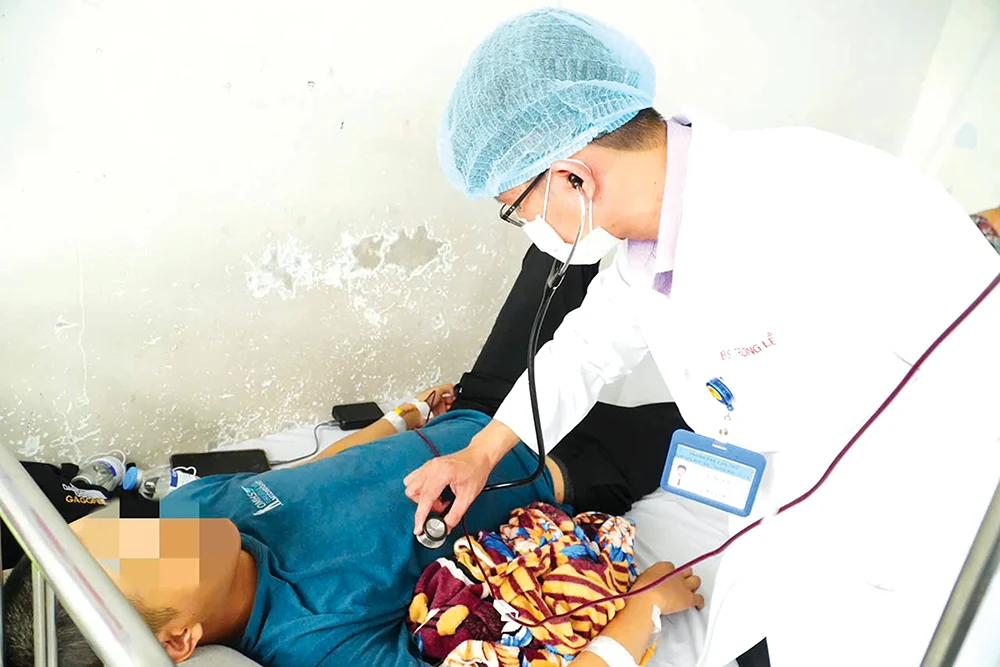
Dr. Truong Trong Le, Deputy Head of the Treatment Department, Can Tho City Hematology and Blood Transfusion Hospital, checks the patient's health.
According to Dr. Truong Trong Le, Deputy Head of the Treatment Department at the Hematology and Blood Transfusion Hospital in Can Tho City, because blood transports oxygen to all cells, when the body is anemic, most organ systems are directly affected with various clinical manifestations. In the central nervous system, oxygen deficiency causes dizziness, tinnitus, blurred vision, mood swings, irritability, poor concentration, and constant fatigue, leading to decreased work productivity. In the circulatory system, the heart has to increase its contraction frequency to compensate for the oxygen deficiency, leading to a rapid heart rate, causing palpitations and chest tightness. For those with pre-existing cardiovascular disease, anemia can trigger acute angina attacks. In the respiratory system, increased breathing frequency causes shortness of breath, rapid breathing, and gasping for breath. Anemia is also clearly manifested in outward appearance, such as pale and sallow skin.
Dr. Truong Trong Le warns that prolonged anemia can lead to serious consequences for patients. The heart's continuous excessive contraction can cause myocardial hypertrophy, dilation of the heart, and ultimately heart failure. In the brain, anemia increases the risk of stroke. In cases of acute anemia with large amounts of blood loss, patients may experience hypotension, hemorrhagic shock, and other life-threatening conditions.
Dr. Truong Trong Le noted the high-risk groups. First, children and adolescents, especially during puberty, have very high nutritional needs for physical development, so an inappropriate diet can easily lead to anemia. Next are women of reproductive age, especially those experiencing menstrual disorders, prolonged bleeding, or pregnant women. The elderly are also at risk due to chronic diseases that impair nutrient absorption for blood formation. Furthermore, the pressures of modern life cause stress, leading many people to eat carelessly, skip meals, and consume low-quality fast food, resulting in micronutrient deficiencies. Excessive dieting and unscientific weight loss among young women also lead to iron deficiency and anemia. Abusing tea and coffee daily inadvertently hinders the body's iron absorption process, negatively impacting blood-forming function in the long run.
When feeling tired and suspecting anemia, many people self-medicate with iron supplements. Regarding this issue, Dr. Truong Trong Le warns: “Self-administering iron without a doctor's prescription is very dangerous. Anemia stems from many causes, such as vitamin B12 deficiency, folic acid deficiency, genetic diseases, leukemia, etc., and is not simply due to iron deficiency. If a patient takes iron while the root cause is another disease, it will not address the underlying condition. Iron is a heavy metal; if the body is not deficient but still supplements it, it will cause iron accumulation, seriously damaging liver, heart, and endocrine function in the long term.”
To effectively prevent anemia, the most fundamental and sustainable solution is to establish a scientific diet. It's necessary to eat a balanced diet with all food groups; prioritizing dark green leafy vegetables, legumes rich in folic acid, and increasing the consumption of red meats such as beef, blood, and eggs, which are naturally rich in iron. Because anemia often progresses silently, people should maintain a habit of regular health checkups and proactive screening. When suspicious symptoms appear, even mild ones, patients should absolutely not self-treat at home but should immediately go to specialized medical facilities for proper diagnosis and strict adherence to the treatment plan.
Text and photos: THU SUONG
Source: https://baocantho.com.vn/nhung-doi-tuong-nguy-co-cao-bi-thieu-mau-a205864.html



![[Photo] Ba Lang An Lighthouse - the "eye of the sea" amidst the "rock museum" of Quang Ngai province.](https://vphoto.vietnam.vn/thumb/1200x675/vietnam/resource/IMAGE/2026/05/29/1780038698840_anh-man-hinh-2026-05-29-luc-14-10-42.png)

![[Image] Pleasant weather helps students enter the 10th grade entrance exam with confidence.](https://vphoto.vietnam.vn/thumb/1200x675/vietnam/resource/IMAGE/2026/05/29/1780034401612_ngay-1-thi-lop-10-minh-duy-8-5009-jpg.webp)















































































Comment (0)