Adjust to avoid missing out on development.
The Ben Tre Water Management Project (JICA3) is a key irrigation project in the Mekong Delta region, implemented in the former Ben Tre province (now part of Vinh Long province). The overarching goal of the project is to control saltwater intrusion, regulate water resources, and protect agricultural production and people's livelihoods from the increasingly evident impacts of climate change.
Following the Prime Minister's approval of the investment plan in 2016, the Ministry of Agriculture and Rural Development (now the Ministry of Agriculture and Environment ) implemented the project according to regulations, from signing loan agreements, bidding, surveying, designing to constructing some items such as the Tan Phu sluice gate and the Ben Ro sluice gate; and simultaneously coordinated with local authorities to carry out compensation and land clearance work.

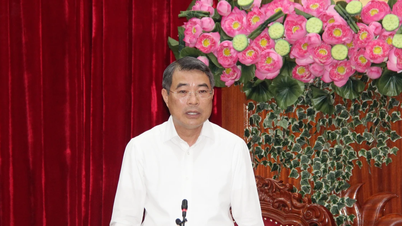
Leaders of Steering Committee 10 worked with the People's Committee of Vinh Long province to resolve land-related issues for the Vam Thom and Vam Nuoc Trong sluice gates during a meeting on September 16, 2025. Photo: Minh Dam.
However, the project implementation process was heavily impacted by several objective factors. The delay in allocating medium-term capital, lasting nearly two years compared to the approval date, directly affected the progress. The Covid-19 pandemic continued to disrupt construction, material supply, and manpower mobilization, especially the recruitment of international experts to Vietnam for design work. In addition, global economic and financial fluctuations led to a sharp increase in construction material prices, while the Japanese Yen depreciated significantly and persistently compared to the time the loan agreement was signed in 2017.
These factors increased the total investment cost of the project, while ODA loan funds were no longer sufficient (due to the depreciation of the Japanese Yen) to fully implement all items according to the original scale. Given this reality, adjusting the investment plan was considered a necessary solution to avoid prolonging the implementation time and limit the waste of resources.

Vam Thom estuary. Photo: Minh Dam.
Based on the provisions of the 2024 Law on Public Investment, the Ministry of Agriculture and Environment has decided to adjust the investment policy for the project, comprehensively reviewing the objectives, scale, total investment amount, and progress to suit the actual conditions and capital balance capacity. The project continues to be classified as a Group A project, with investment decisions made by the Ministry of Agriculture and Environment.
According to the revised plan, the project has a total investment of over 7,578 billion VND, of which Japanese ODA loans account for over 4,158 billion VND. The project is implemented in two components: the compensation and land clearance component, with the Vinh Long Provincial Agricultural Project Management Board as the investor; and the construction component, with the Irrigation Construction Investment Project Management Board 10 (Board 10) as the investor.
Accelerate from a well-established organizational foundation.
Along with the policy adjustments, the project entered a crucial transitional phase as management was transferred from the Investment and Construction Management Board of Irrigation Project No. 9 (Board 9) to Board 10. The merger of Board 9 into Board 10 was not only about streamlining the organizational structure, but also aimed at rectifying, restoring, and creating momentum for acceleration after a long period of project delays and obstacles in many areas.

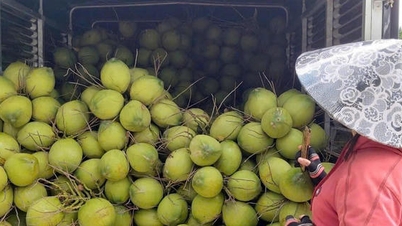
Lien Thanh coconut plantation, the site of the Vam Thom sluice gate construction. Photo: Minh Dam.
Immediately after taking over, Board 10 quickly reorganized its structure, issued operating regulations, and assigned tasks with clear responsibilities for each person and job; at the same time, it established a point of contact to work directly with JICA and the consulting consortium. Specialized teams on technical, bidding, and legal matters were established to comprehensively review the project's current status and focus on resolving long-standing issues.
One of the key tasks is to review the technical design documents and construction drawings of large sluices such as An Hoa, Ben Tre, Thu Cuu, Cai Quao, Vam Thom, and Vam Nuoc Trong. These are all large-scale projects with high technical requirements, demanding consistency between Vietnamese and JICA standards, especially in foundation and waterproofing aspects.
Simultaneously, Project Management Unit 10 proactively worked with JICA to adjust the bidding method for Package XL02 from an international tender with pre-qualification to a domestic open tender. JICA approved this proposal on the condition that the design and technical requirements remain unchanged. This is considered a crucial step in resolving issues, contributing to shortening the preparation time and facilitating faster implementation.
Working alongside local communities to strengthen people's trust.
Along with completing technical procedures, Project Management Board 10 closely coordinated with Vinh Long province in compensation and resettlement support. Difficulties related to land boundary disputes and complex inheritance cases were handled flexibly but in accordance with regulations, ensuring a balance between the interests of the people and the project's progress requirements.

The flooded land along the Vam Thom River still bears the imprint of silt on tree branches, blades of grass, and the road. Photo: Minh Dam.
Proactiveness and responsibility during the transition period contributed to restoring the trust of the people in the project area as well as international partners. JICA highly appreciated the cooperative spirit and transparency in providing documents and technical explanations from the investor. The local authorities acknowledged the support of Project Management Unit 10 in resolving land clearance issues.
In the Vam Thom sluice gate area, which is frequently affected by tidal surges and saltwater intrusion, residents have high hopes for the project's progress. Mr. Truong Van Mai, a resident of Nhuan Phu Tan commune, said that during the dry season, coconut and fruit trees often suffer from stunted growth, reducing productivity; during the rainy season, prolonged flooding makes travel and production difficult. "With the sluice gate in place, people can feel secure in their long-term livelihoods," Mr. Mai shared.
Surveys reveal that traces of tidal surges are still present on the roadsides and in orchards, forcing many households to build temporary embankments to prevent flooding. Therefore, completing the large sluices of the project is not only significant for irrigation purposes but also a fundamental solution to stabilize production, protect orchards, and ensure long-term livelihoods for the people.
With a strengthened organizational foundation and increasingly close coordination among all parties, 2026 is expected to be a year of accelerated construction for the JICA3 Project, gradually forming a synchronized salinity and freshwater control system, opening up space for sustainable development in the coastal areas of the Mekong Delta.
The sluice gate system of the JICA3 Project is designed on a large scale, suitable for the hydrological conditions of the estuary and coastal area. The An Hoa sluice gate has the largest width at 120 m (4 bays); the Thu Cuu, Cai Quao, and Vam Thom sluice gates are 90 m wide (3 bays); the Ben Tre sluice gate is 70 m wide (2 bays); and the smallest are the Tan Phu and Ben Ro sluice gates with one bay each, 20 m wide.
Source: https://nongnghiepmoitruong.vn/no-luc-tiep-noi-de-tang-toc-du-an-jica3-d791104.html



![[Photo] The courage of new recruits of Brigade 144 on the training ground.](https://vphoto.vietnam.vn/thumb/1200x675/vietnam/resource/IMAGE/2026/05/27/1779881651341_anh-man-hinh-2026-05-27-luc-18-32-52.png)
![[Photo] The heat at the fireworks display site on the opening night of the Da Nang International Fireworks Festival 2026](https://vphoto.vietnam.vn/thumb/1200x675/vietnam/resource/IMAGE/2026/05/27/1779889741485_ndo_br_z7872039145157-fecaba5112f39e8352544099d7ef4738-5140-jpg.webp)














































![[Photo] The courage of new recruits of Brigade 144 on the training ground.](https://vphoto.vietnam.vn/thumb/402x226/vietnam/resource/IMAGE/2026/05/27/1779881651341_anh-man-hinh-2026-05-27-luc-18-32-52.png)




















Comment (0)