


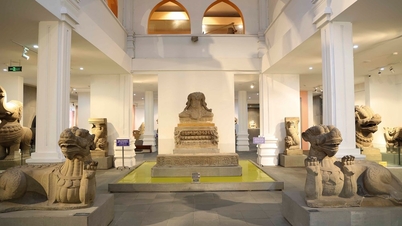
More than a century ago, research by the French School of Far Eastern Studies (École française d'Extrême-Orient; EFEO) opened the way for identifying, preserving, and gradually conserving Champa heritage using modern scientific methods. From this journey, the Da Nang Museum of Champa Sculpture was established as a "memory repository" of Champa art, and simultaneously became one of the most important heritage preservation institutions in Southeast Asia.
EFEO's mission in heritage preservation
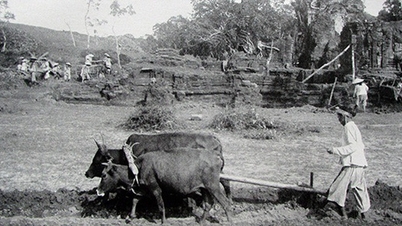
Ms. Le Thi Thu Trang, Director of the Da Nang Cham Sculpture Museum, believes that the achievements of the French School of Far Eastern Studies and French scholars in the early 20th century, through their pioneering work and laying the foundation for the preservation of Champa cultural heritage, have resulted in a cultural institution over 100 years old like the Cham Sculpture Museum. "That journey began with a sculpture garden initiated by Consul Charles Lemire at the end of the 19th century, followed by the persistent efforts of architect and archaeologist Henri Parmentier and many scholars of the Institute in creating a museum dedicated to this art form," Ms. Le Thi Thu Trang said.
According to Philippe Le Failler, Head of the EFEO Representative Office in Hanoi , since its establishment in 1900, the EFEO has identified the protection of heritage throughout Indochina as one of its core tasks. Buildings, temples, and artifacts are inventoried, proposed for classification, and then supervised for maintenance and restoration. Beyond archaeology, the EFEO has also built a system of libraries and museums, organized archaeological excavations, reproduced inscriptions, surveyed and mapped architectural structures, and published research on the history and culture of the region.
At the beginning of the 20th century, when awareness of heritage preservation in Indochina was still quite rudimentary, the activities of the EFEO laid the first foundation for modern archaeology and conservation in Vietnam. Without the EFEO's initial research, many Champa structures might have disappeared in the ravages of time and war. In that journey, Henri Parmentier was the figure who left the most profound mark.
Isabelle Poujol, head of the Photo Archive and Communications at EFEO Paris, stated that when Henri Parmentier arrived in Indochina in 1900, he was tasked with inventorying and protecting Cham relics. During the restoration of the Po Nagar tower complex in 1908, he wrote a lengthy report that served as a call for the establishment of a Cham art museum to rescue the scattered and deteriorating sculptures.
It took 17 years of campaigning and fundraising before the plan became a reality. In 1919, the museum officially opened. By 1935, following major archaeological discoveries at Tra Kieu and the Mam Tower, the museum was further expanded. A year later, it was renamed the Henri Parmentier Museum.
More than just a repository of artifacts, in Henri Parmentier's view, the museum was "a tool for understanding Champa civilization." This approach has transformed the Da Nang Cham Sculpture Museum into one of the world's most important centers for Cham art research to this day.

Cooperation for conservation
Bertrand Porte, a statue restoration expert at EFEO, said that since the early 2000s, during the expansion of the Da Nang Cham Sculpture Museum, a collaborative project between the museum, EFEO, the Guimet Museum, and the National Museum of Cambodia was implemented with funding from the French Embassy in Hanoi. The project's goal was not only to design new exhibition spaces but also to focus on the conservation and restoration of Cham sandstone sculpture collections.
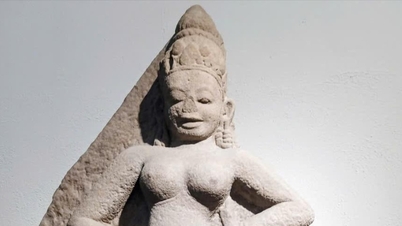
Consequently, many artifacts had gone unnoticed since the museum's early days. Initial interventions were quite simple before a professional restoration workshop was built in the museum's new expansion area. The period from 2001 to 2010 marked several major relocations and restorations of artifacts from My Son and Dong Duong. This was particularly challenging work because Cham sandstone is highly vulnerable to the humid tropical climate and weathering.
But through that process, the Da Nang Cham Sculpture Museum's capacity for on-site artifact preservation has gradually improved. Statues once covered in the dust of time have not only been "restored" but also placed back in a more modern exhibition space, helping the public access the heritage from a more vivid perspective.
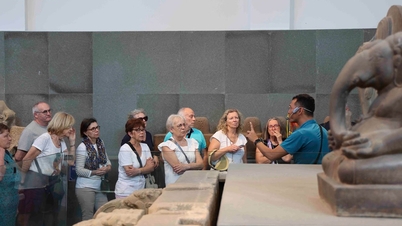
Ms. Le Thi Thu Trang stated that in recent years, along with the new approach to heritage management and museology, the responsibility of preserving and promoting the value of museum collections is facing many new demands. "From supplementing, digitizing, and connecting archival sources, to innovating exhibition interpretations, to strengthening professional cooperation and expanding public access. It is in this context that international cooperation continues to play a crucial role in sharing knowledge, experience, and professional practices between museums and professional partners both domestically and internationally."
Therefore, within the framework of the workshop, the Da Nang Cham Sculpture Museum and EFEO announced a cooperation agreement for the period 2026-2028 with directions for cooperation between the two units in the coming time, focusing on a series of events commemorating the 100th anniversary of archaeological excavations at Tra Kieu (1927-2027).
More than a century after Henri Parmentier conceived the dream of a Cham art museum in Tourane, the "heritage bridge" between EFEO and the Da Nang Cham Sculpture Museum continues to be built.
Source: https://baodanang.vn/noi-dai-hanh-trinh-bao-ton-di-san-champa-3337194.html

![[Video] Sunset at Lap An Lagoon – Where the sun sets over the fishing nets](https://vphoto.vietnam.vn/thumb/1200x675/vietnam/resource/IMAGE/2026/05/31/1780192137701_beach-landscape-sea-water-nature-grass-745871-pxhere-com.jpeg)









![[Video] Sunset at Lap An Lagoon – Where the sun sets over the fishing nets](https://vphoto.vietnam.vn/thumb/800x450/vietnam/resource/IMAGE/2026/05/31/1780192137701_beach-landscape-sea-water-nature-grass-745871-pxhere-com.jpeg)
































![[Video] Sunset at Lap An Lagoon – Where the sun sets over the fishing nets](https://vphoto.vietnam.vn/thumb/402x226/vietnam/resource/IMAGE/2026/05/31/1780192137701_beach-landscape-sea-water-nature-grass-745871-pxhere-com.jpeg)























Comment (0)