

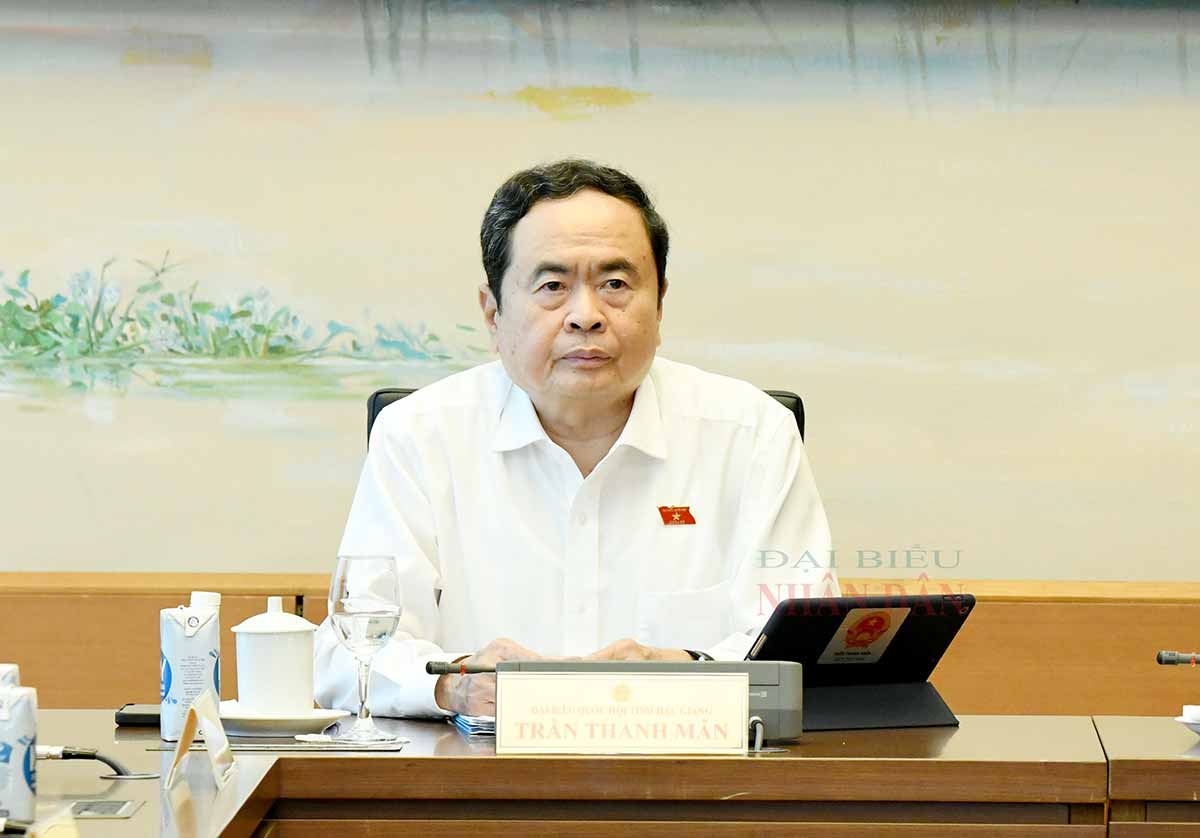
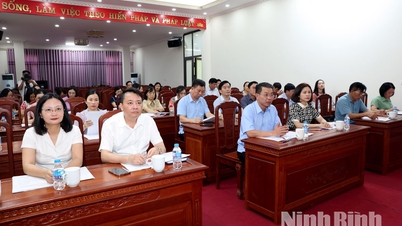
Politburo member and National Assembly Chairman Tran Thanh Man attended the discussion session at Group 13, which includes the National Assembly delegations from the provinces of Lang Son, Bac Ninh, Dak Lak, and Hau Giang.
Adding three more positions to the list of security personnel is appropriate.
Participating in the discussion at Group 13, the majority of National Assembly deputies agreed on the necessity of amending and supplementing several articles of the current Law on Security Guarding; they also stated that the promulgation of the Law amending and supplementing several articles of the Law on Security Guarding aims to institutionalize the Party's recent guidelines and viewpoints on building the People's Public Security force, especially the Party's 13th National Congress Resolution on the content of building the People's Public Security force; Resolution No. 12-NQ/TW, dated March 16, 2022, of the Politburo on promoting the building of a truly clean, strong, regular, elite, and modern People's Public Security force to meet the requirements and tasks in the new situation; and Conclusion No. 35-KL/TW, dated May 5, 2022, of the Politburo on the list of leadership positions and equivalents of the political system from the central to the grassroots level. Resolution No. 44-NQ/TW dated November 24, 2023, of the Central Committee on the Strategy for National Defense in the New Situation.
In particular, the amendment and supplementation of several articles of the Law on Security Guarding aims to further concretize the provisions of the Constitution on human rights and civil rights; overcome inadequacies, limitations, difficulties, and obstacles arising in the practical work of security guarding in the past, meeting the requirements of security guarding work in the new situation; contribute to supplementing and perfecting the legal system on protecting national security, ensuring social order and safety, proactively preventing, detecting, and promptly stopping all conspiracies, activities, and other acts and factors that harm the safety of the protected subjects.
Contributing opinions on the regulations regarding the subjects of protection (Clause 3, Article 1), National Assembly deputies Tran Thi Van (Bac Ninh), Nguyen Trung Thanh (Dak Lak)... agreed with the addition of the Standing Committee of the Party Central Committee, the Chief Justice of the Supreme People's Court, and the Director of the Supreme People's Procuracy as subjects of protection, as in the draft Law. This aims to promptly institutionalize the Party's regulations, especially Conclusion 35-KL/TW on the list of leadership positions and equivalents in the political system from the central to the grassroots level, and to ensure uniformity, fairness, and transparency regarding the titles, positions, and policies for high-ranking leaders of the Party, State, and Vietnam Fatherland Front.
The delegates also stated that the addition of the three aforementioned titles and positions is consistent with the nature and importance of these positions within the political system.
Review and ensure the consistency of the legal system.
Contributing his opinion to the draft Law on the Management and Use of Weapons, Explosives, and Supporting Tools (amended), National Assembly Deputy Pham Trong Nghia (Lang Son) agreed with the necessity of developing the Law to improve mechanisms, policies, administrative procedures, and overcome difficulties, obstacles, and inadequacies arising in the implementation of laws on the management and use of weapons, explosives, and supporting tools, ensuring consistency with related laws; and at the same time, creating a legal basis for state management and crime prevention and control, and violations of laws on weapons, explosives, and supporting tools.
In particular, according to delegate Pham Trong Nghia, the content of the draft Law closely adheres to the four policies approved by the Standing Committee of the National Assembly.
Specifically, Policy 1 is: To finalize regulations on the definition of weapons, support tools, weapon components, support tools, and new industrial explosives; and regulations on the management of the production, business, export, and import of knives with high lethality.
Policy 2 is: To reduce and simplify paperwork and regulations in administrative procedures concerning weapons, explosives, explosive precursors, and support tools; to regulate the issuance of licenses for the use of weapons and support tools, without specifying a license validity period; and to shift the issuance of registration certificates to the issuance of licenses for the use of support tools.
Policy 3 is: Allowing foreign organizations and businesses to donate, gift, or provide weapons and supporting tools to Vietnam for research, production, equipping, and use.
Policy 4 is: Amending and supplementing certain regulations on the research, production, business, and use of industrial explosives to remove difficulties and obstacles for organizations and businesses serving socio-economic development.
While generally agreeing with the provisions of the draft Law and the explanatory report of the verification agency, however, in order for the Law to be consistent with real-life situations after it comes into effect, National Assembly Deputy Le Thi Thanh Lam (Hau Giang) raised the issue: Clause 2, Article 3 stipulates military weapons, in which the Minister of National Defense and the Minister of Public Security will issue the List of types of weapons - this is understood to mean that the types of weapons included in these two lists will be considered military weapons.
However, point (d) of this clause stipulates that "Other weapons with similar features and functions to those specified in points a and b of this clause, not included in the list issued by the Minister of National Defense or the Minister of Public Security," are considered military weapons. Thus, any weapon with the described features – whether included in the list or not – is considered a military weapon; if this regulation is followed, issuing a list would be unnecessary. Noting this, Representative Le Thi Thanh Lam suggested reconsidering the requirement to issue a list of weapons as stipulated in Clause 2, Article 3.
Similarly, Clause 11 explains the term "support tools," but this regulation overlaps significantly with the regulations on military weapons in Clause 2, Article 3. Raising this issue, Representative Le Thi Thanh Lam cited an example showing that "guns" and gun components can both be classified as military weapons or support tools. The failure to clearly distinguish between these two concepts leads to difficulties in determining and applying management policies for weapons and support tools.
"I propose reviewing the regulations regarding these two concepts to clearly distinguish between military weapons and support tools," said delegate Le Thi Thanh Lam.
Regarding the definition of terms in Article 3, Representative Pham Trong Nghia raised the issue: Clause 4 stipulates that rudimentary weapons are weapons with simple structure and operating principles, including: swords, spears, lances, bayonets, knives, machetes, clubs, knuckle dusters, maces, bows, crossbows, and throwing darts, as listed in the catalog issued by the Minister of Public Security; knives with high lethality are sharp knives, pointed knives, and pointed knives with a blade length of 20cm or more , or with a blade length of less than 20cm but modified or assembled to have similar functionality and effect to knives with high lethality, as listed in the rudimentary weapons catalog issued by the Minister of Public Security. The use of knives with high lethality for labor, production, or daily life purposes is not within the scope of this Law .
Furthermore, Clause 13, Article 3 of the draft Law stipulates: " Business" is the buying and selling of weapons, explosives, explosive precursors, and supporting tools. Meanwhile, Clause 21, Article 4 of the Enterprise Law stipulates: Business is the continuous performance of one, several, or all stages of the process from investment and production to consumption of products or provision of services in the market for the purpose of seeking profit.
Pointing out these differences, delegate Pham Trong Nghia suggested that the regulations need to be reviewed to ensure the consistency of the legal system.
Article 5 stipulates prohibited acts in the management and use of weapons, explosives, explosive precursors, and supporting tools. Clause 12 states: "Illegally instructing, training, or organizing training on the methods of manufacturing, producing, repairing, assembling, or using weapons, explosives, explosive precursors, or supporting tools, or illegally advertising weapons, explosives, explosive precursors, or supporting tools in any form." However, Clause 7, Article 7 of the Advertising Law prohibits advertising of "hunting guns and ammunition, sporting weapons, and other products and goods that incite violence." Representative Le Thi Thanh Lam argued that the draft law does not need to include regulations on advertising, and proposed removing this provision.
Regarding state policy , the draft law does not yet have specific provisions on state policy concerning weapons, explosives, and supporting tools. Therefore, Representative Pham Trong Nghia proposed adding an article regulating this issue. This article would define the areas where the state has a monopoly, and the sectors where the state prioritizes investment or creates mechanisms to encourage other entities in society to invest, such as the production of weapons, explosives, and supporting tools for export.
In addition, according to Report No. 133/BC-BCA-C06 dated January 16, 2024, of the Ministry of Public Security... After five years of implementing the Law on the Management and Use of Weapons, Explosives, and Supporting Tools, it was noted that: "A segment of the population, especially ethnic minorities in remote areas, have not fully understood the meaning and importance of the management and use of weapons, explosives, and supporting tools, and therefore have not seriously complied with the legal regulations in this field." Therefore, Representative Pham Trong Nghia proposed supplementing the State's policy for ethnic minorities in remote areas.
During the discussion session, delegates also focused on discussing and contributing ideas regarding regulations on the responsibilities of organizations and businesses involved in the research, development, production, trading, transportation, and use of explosive precursors.
Source: https://daibieunhandan.vn/chinh-polit/phan-biet-ro-vu-khi-quan-dung-va-cong-cu-ho-tro-i372747/

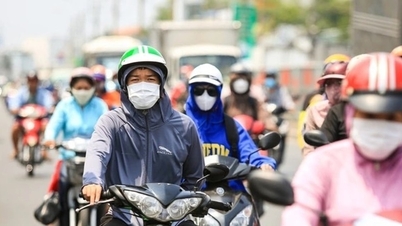
![[Image] Hanoi's urban life under the challenge of a "scorching hot" environment](https://vphoto.vietnam.vn/thumb/1200x675/vietnam/resource/IMAGE/2026/05/25/1779706979265_nang-nong-t5-2026-minh-duy-7-4636-jpg.webp)
![[Image] Close-up view of the interchange connecting the two expressways and Long Thanh Airport.](https://vphoto.vietnam.vn/thumb/1200x675/vietnam/resource/IMAGE/2026/05/25/1779703378210_ndo_br_z7863716673926-224453a31600126cce10622af6290afd-4549-jpg.webp)































































Comment (0)