

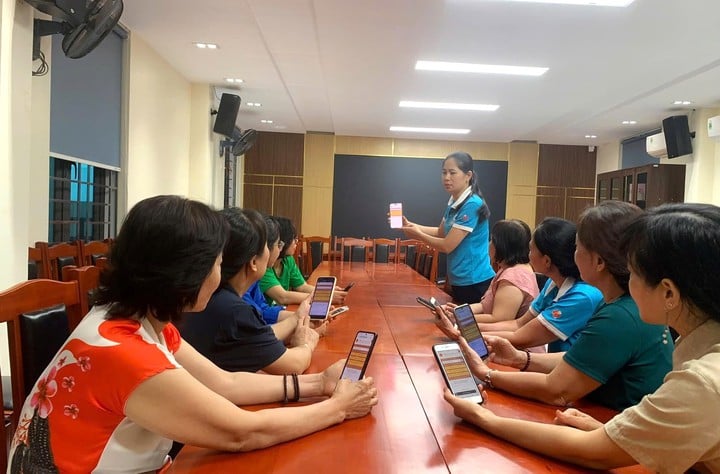
Ngo Quyen Ward Women's Union organizes a digital class called Technology Companion to implement the Digital Literacy Movement.
The "Digital Literacy" movement from classrooms close to the people
Instead of just organizing traditional activities, the Women's Union of Ngo Quyen Ward chose a new approach: opening a digital class called "Technology Companion", inviting members to bring their smartphones to practice together. There, many women learned for the first time how to install applications, submit online public service applications or look up information online.
At the end of July 2025, the Ward Women's Union launched the model "Ngo Quyen Women - Connecting online public services". Members were trained in online search and submission skills, using electronic identification accounts, and were also instructed to identify common scams on the internet. Vice President of the Union Nguyen Thi Nguyen said that the Union also posted QR codes for administrative procedures at public places, shared them on the Zalo group of the residential area for people to easily search, and strived for each member to proactively complete at least one public service application.
In An Bien ward, the model "An Bien women actively participate in digital transformation, applying information technology" was deployed from the beginning of August 2025. Right in the first Women's Congress of the ward, the organizing committee applied the form of "digital congress": Documents were scanned with QR codes, reports were presented in video format, helping to reduce printing costs, and were more intuitive and vivid. Fanpage and Zalo groups became the main propaganda channels, bringing information on policies and guidelines to members faster.
From those specific activities, the "Digital Education for All" movement launched by the City Women's Union quickly spread. The whole city currently maintains more than 1,200 "Connecting Women in the 4.0 Era" models with many methods such as "Digital Transformation in Loan Management" and "Women's Groups Applying Digital Technology in the Community".
In addition, the City Women's Union has also developed a comprehensive digital skills training program. Since the beginning of 2025, 58 classes on information technology application and digital transformation have been organized, attracting more than 12,000 officials and members to participate.
The training content is diverse, from simple skills such as using Canva, Capcut, to more complex tasks such as exploiting artificial intelligence (AI), designing electronic flipbooks, managing fanpages, editing news articles, creating infographics, using staff and member management software or Google spreadsheets in work management. After the training courses, about 95% of the Association's staff can apply digital tools in their daily work.
At the city level, membership management and loan management software has been put into use, making data lookup, statistics, and updates more convenient and transparent. Surveys, assessments, and reports are conducted via Google Forms, reducing paperwork, saving time, and limiting errors in data synthesis.
The "Digital Literacy for All" movement is designed with a clear goal: each Association base organizes or coordinates the organization of monthly training courses for members; each branch and organization strives to build at least one "Digital Family" model each year. By 2030, the goal is for 100% of officials, members and women aged 18 and over to have basic digital skills and own a level 2 electronic identification account. The Association also aims to support all members and about 80% of women in the area to use online public services and make electronic payments on digital platforms.
According to Vice President of the City Women's Union Pham Thi Thuy Hai, along with direct classes, the Union focuses on popularizing digital knowledge through the "Digital Women" website, online communication campaigns and digital documents. Technology is not only the content of propaganda, but also a tool for the Union to manage work with online meetings, manage electronic documents, digital signatures, and build model points such as "Digital Association", "Digital Association Base", "Digital Family", "Digital Business Women's Group".
Spreading the digital citizen model to each ward and commune
Many localities in Hai Phong have been proactively introducing solutions to support people in accessing online public services and digital management systems.
In Thanh Mien commune, the commune government considers administrative reform a key task, associated with improving digital skills for people. Training courses, seminars on digital transformation, emulation movements "The whole country competes in innovation and digital transformation" or "Digital education for the masses" are deployed so that people not only hear about digital transformation but also directly participate in its implementation.
In Yet Kieu commune, initiatives such as surveying people's satisfaction via QR codes on Zalo, increasing online conferences, and digitizing data on managing meritorious people and relatives in nursing care have helped the government reduce procedures and have more channels to listen to opinions from the grassroots.
In Le Chan ward, the Digital Transformation Festival at the end of October was an opportunity for people to practice the entire process of using online public services. They were guided to access and interact with the ward's electronic information portal, fanpage "Le Chan Ward - Hai Phong City", and the National Public Service Portal. Applications such as "Map of Le Chan Ward Residential Groups", "Smart Digital Map of Le Chan Ward" or the VR 360 virtual reality experience of the area, relics, and schools were widely introduced, showing a clearer picture of a government operating on a digital platform.
After each such program, the gap between the elderly and technology is shortened. Many people like Ms. Vu Thi Thuy, who were "afraid of making mistakes", have gradually become more secure when they see their data digitized, stored and reused for future transactions.
In Gia Phuc commune, every day at the Public Administration Service Center, Ms. Dang Thi Quyen - Vice President of the Commune Women's Union and another union official take turns on duty, directly guiding people to use online public services. For the elderly and people with disabilities, the women support each step; for young people and students, they only need to introduce the process, the rest the young people can do very quickly.
Youth union members in many communes and wards go to each house to support the installation of applications, create accounts, and train people to use digital platforms instead of relying entirely on paperwork. At the Public Administration Service Center of Thien Huong Ward, Ms. Bui Thi Huyen, a civil servant at the Thuy Nguyen Land Registration Office Branch, supports 5-10 people every day in entering land records. According to her, after one or two times of getting acquainted, most people find it more convenient when the data is kept intact on the system, without having to re-declare many times like before.
To create a stronger ripple effect, in October 2025, the City Department of Science and Technology organized a conference to launch the "National Digital Learning Festival" and launched the contest "Hai Phong Digital Citizen - Smart use, safe living". The goal is to popularize basic knowledge and skills in information technology, organize online courses on essential digital skills, guide the use of smart devices, social networks, online public services and interact with the government on digital platforms. People are encouraged to access the Internet in a civilized manner, know how to protect personal information, identify forms of fraud and malicious content.
The city aims that by the end of 2025, the majority of cadres, civil servants, public employees and workers in the public sector will have mastered digital skills, be able to use digital platforms, AI and digital services at work; all high school and university students will be equipped with digital knowledge and skills to serve their studies and creativity in a safe online environment; about 80% of adults will have basic knowledge of digital transformation, be proficient in digital skills, and use smart devices to exploit essential information and services.
From small classes at women's associations, training sessions at administrative centers, to city-level movements and competitions, Hai Phong is gradually forming a generation of digital citizens who know how to use technology intelligently and safely./.
Source: https://mst.gov.vn/phu-nu-hai-phong-nguoi-dan-duong-trong-the-gioi-so-197251129221123274.htm

















![[Photo] Dan Mountain Ginseng, a precious gift from nature to Kinh Bac land](/_next/image?url=https%3A%2F%2Fvphoto.vietnam.vn%2Fthumb%2F1200x675%2Fvietnam%2Fresource%2FIMAGE%2F2025%2F11%2F30%2F1764493588163_ndo_br_anh-longform-jpg.webp&w=3840&q=75)























































Comment (0)