

Meanwhile, the press in Quang Ninh continues to flow tirelessly, persistently, and quietly. Like the deep coal seams where darkness doesn't subdue people, journalism in the mining region is not a job for those who fear hardship. To write about miners, one needs not only a pen, but also a heart that empathizes with the lives of the miners, feet weathered by the coal seams, and eyes unafraid of the darkness of the deep mines…
Going back in time to the end of 1928, when the Coal Newspaper – the first newspaper of the mining working class – was born during the struggle against French colonialism, marking the early presence of revolutionary journalism in Quang Ninh. More than just a voice, the Coal Newspaper was a beacon guiding strikes, a place where miners living deep in the mines could express their aspirations for survival.
Every issue of the Coal Newspaper featured a slogan at the top of its front page taken from the concluding sentence of Marx and Engels' Communist Manifesto: "Workers of the world unite!" The articles consisted of news and reports about the miserable lives and the brutal and unjust treatment by the mine owners in Cam Pha and Cua Ong. The newspaper also called for and guided the struggle, with slogans like: "The factory to the workers!", "The land to the farmers!", "Establish a youth government!". Workers passed the newspaper around, those who could read reading aloud to those who couldn't.
The Coal Mining Newspaper had a profound influence on the coal miners of Cam Pha and Cua Ong. Party members monitored the masses' reactions, refining their writing style and gaining a deeper understanding of the people to recruit new members. In mid-1929, the Party cell prepared a special issue of the Coal Mining Newspaper to commemorate the Russian October Revolution, along with preparations for hanging flags, displaying slogans, distributing leaflets, planting mines to derail railway lines, and destroying electrical substations. Fortunately, Comrade Nguyen Van Cu (then using the pseudonym Phung), representing the Northern Regional Party Committee, issued a directive that corrected the situation in time. He analyzed the reckless mistake in the planned mine explosions but encouraged the publication of the Coal Mining Newspaper. He offered suggestions on both the content and format of the special issue of the Coal Mining Newspaper.
After the liberation of the mining area, the press entered a new era – the era of reconstruction and development. Quang Ninh Newspaper, Quang Ninh Radio and Television Station… became witnesses, recording every step of the coal industry's transformation – from simple collective housing, long night shifts, to the grimy but radiant smiles of miners exceeding production targets during the 90-day campaign. Newspaper pages and television reports were not only stories of work, but also living documents about the lives and culture of miners – a group that forged the distinctive worker identity of Quang Ninh.
“Although the facilities were very poor in the early days, the newspaper produced famous journalistic works that shook the whole country, such as journalist Vu Dieu's article about the coal industry and the rotational leave of miners. The newspaper recognized that the cause was the limited management skills of the coal industry, so it focused on writing about the coal industry and the lives of workers, starting with the layoffs. The printed newspaper was passed around among workers. Many who didn't have a copy would photocopy it to read. The articles were ahead of the management mechanisms, accurately predicted and analyzed the situation, and most importantly, they reflected the aspirations and desires of the workers. Later, Quang Ninh Newspaper compiled those articles into a book,” recalled journalist Le Toan, former Editor-in-Chief of Quang Ninh Newspaper.
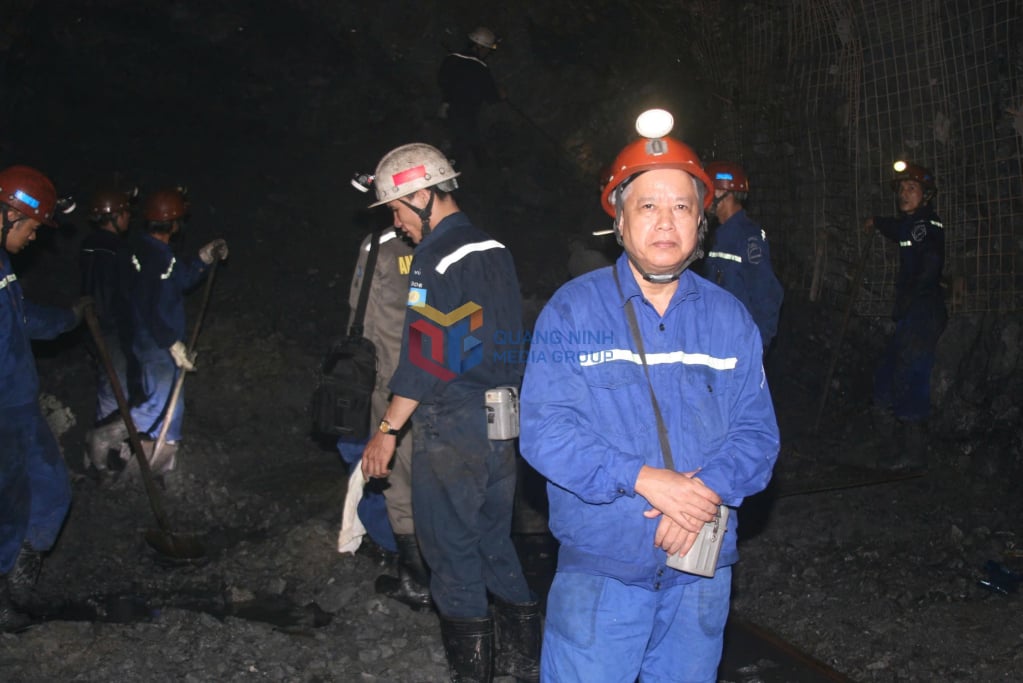
Journalist Tran Giang Nam working underground in the mine.
The writings about the coal industry by journalist Tran Giang Nam – a former reporter for Quang Ninh Newspaper and Vietnam Coal and Mineral Magazine – have naturally and simply become part of the lives of people in the mining region. His writing style is not bombastic or embellished, but rather like the coal seams flowing underground, deep, profound, and warm. Throughout his journalistic career, he has recounted countless stories about the lives of miners, the bright lights of the mines during the night shift, and even rescue operations for miners in distress… All are presented with empathy and respect for each character and detail.
Having made so many trips, he couldn't remember the exact number of times he worked underground or on the windy coal seams. But what remained most vividly in his mind was the feeling of admiration for the extraordinary nature of the miners. In their work, they were extraordinary, setting records for output and tunnel length. When accidents occurred, they were courageous, disciplined, and as skilled as soldiers.
Journalist Tran Giang Nam shared his feelings: "As a journalist working in Vietnam's coal and mineral industry, with such serious accidents, honestly, I'm no longer just a journalist; journalism has been relegated to a secondary position. I went there as part of the rescue force, to participate in the rescue. I remember that during all those nights and days of rescue, the miners clearly demonstrated themselves as an exceptionally skilled army, with a high level of unity and strict discipline, no different from the military. Is that why President Ho Chi Minh likened coal miners to 'an army fighting the enemy'? Thousands of people arrived in turn according to the job requirements, day and night, carrying rescue equipment, lining up neatly, listening to orders, shouting 'determined!', and entering the mine one by one to replace the previous shifts that had temporarily taken a break. It was all done in perfect order, like a machine with a pre-programmed schedule."
Similarly, journalist Trong Trung – former Head of the Special Programs Department at Quang Ninh Radio and Television Station – was one of the first television journalists to bring images of miners to the airwaves. Each of his reports was not simply news reporting; it was a glimpse into the soul of the coal miners, where a hearty smile from a miner during a shift could be a moving moment. In his time, the image of a reporter reporting from the scene underground – where only a little light reflected off the protective helmets; or amidst the giant machines in the open-pit mine – seemed to bring a breath of fresh air to television viewers. Through television, miners saw themselves in each report, further strengthening their love for their profession and inspiring them to work even harder.
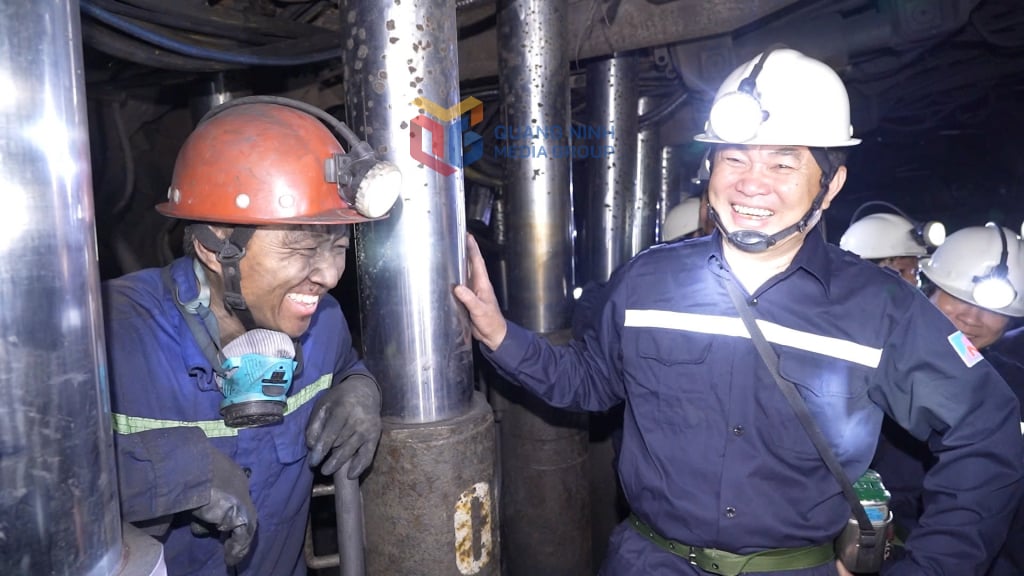
Reporters from the Quang Ninh Provincial Media Center captured the moment Mr. Ngo Hoang Ngan, Chairman of the Board of Directors of the Vietnam Coal and Mineral Industry Group , chatted with workers at the Nui Beo mine.
Today, as journalism enters the technological era, stories of miners are no longer confined to print newspapers or radio broadcasts, but are spreading powerfully across digital platforms. Radio reporters like Truong Giang (Vietnam Voice Radio) – who spent days "undercover" in mines to gather the most authentic articles and audio about the lives of miners; and television reporters Hoang Yen, Quoc Thang, and Hong Thang – who regularly work hundreds of meters underground, always carrying modern cameras and capturing emotionally charged images...
From the perspective of modern journalists, the coal industry presents a fresh and powerful image. Stories about automation, artificial intelligence, and "smart mine" models are far from dry, as they still capture the eyes of miners through the camera lens, the resounding laughter in the mine shafts, and the silent sweat dripping from the hands of truck drivers.
Today's press not only reports news but also builds images, contributing to promoting corporate culture and spreading the values of the region. In national journalistic competitions, works about the coal industry are always present, carrying the unique characteristics of Quang Ninh - where the press and the coal industry are writing a new chapter in history.
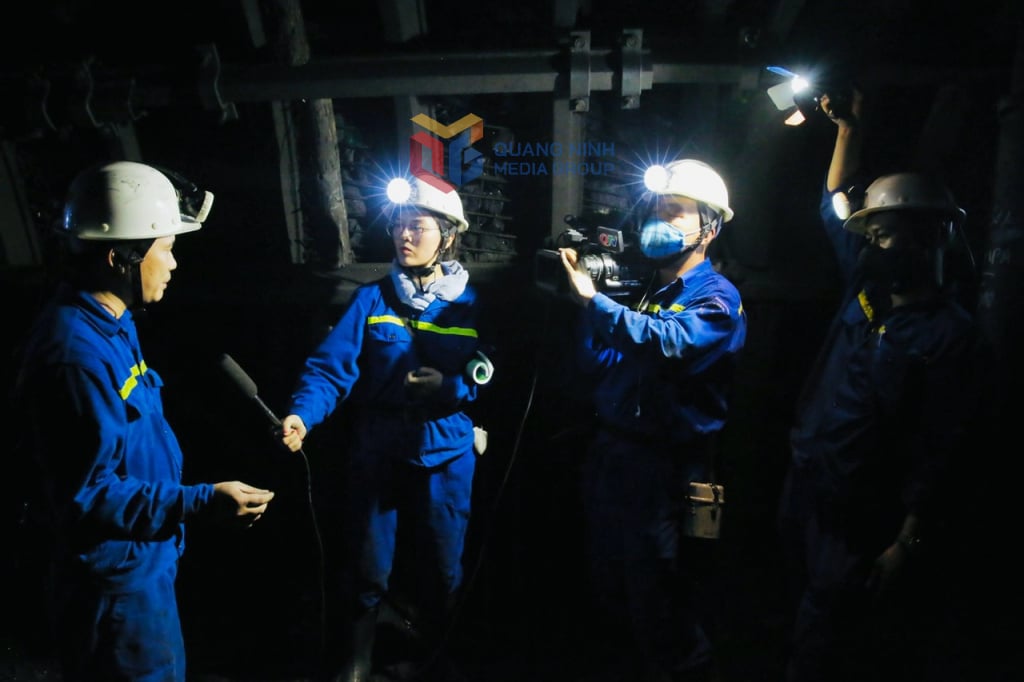
A team of television reporters from the Provincial Media Center is working at the underground mine of Vang Danh Coal Joint Stock Company - Vinacomin.
Few industries have such a close, symbiotic relationship with the press as the coal industry. And few places are like Quang Ninh – where individual miners are willing to share their stories, take journalists deep underground to witness the hardships firsthand without any concealment. This is a precious asset, a unique "living material" found nowhere else.
Conversely, the coal industry also considers the press a strategic partner; providing information and images, and working together to create a rich and distinctive "media ecosystem." In times of difficulty or success, the press and the coal industry have always been closely intertwined and inseparable.
Quang Ninh – the land of black coal, of hands calloused from sweat and coal dust, of eyes always looking forward, where every meter of land bears the footprints of miners. And it was there that I began my journalistic journey, entering the profession with all the respect I have for a land that has written vivid chapters of history, and where journalism has been a witness, companion, and igniter for so long.
Once, during a reporting trip to the underground mine at a depth of 400 meters below ground in Mong Duong, I interviewed a miner: "Have you ever been afraid of the darkness in the mine?" He laughed: "Yes, but I'm used to it. If I stay on the surface for too long, I miss the sound of the hammers, the smell of coal, the smoke from the blasting, the smell of earth and rocks."
That answer, for me, served as a reminder. How can journalists sit in air-conditioned rooms and write about the heat? How can they understand light if they have never walked in the darkness?
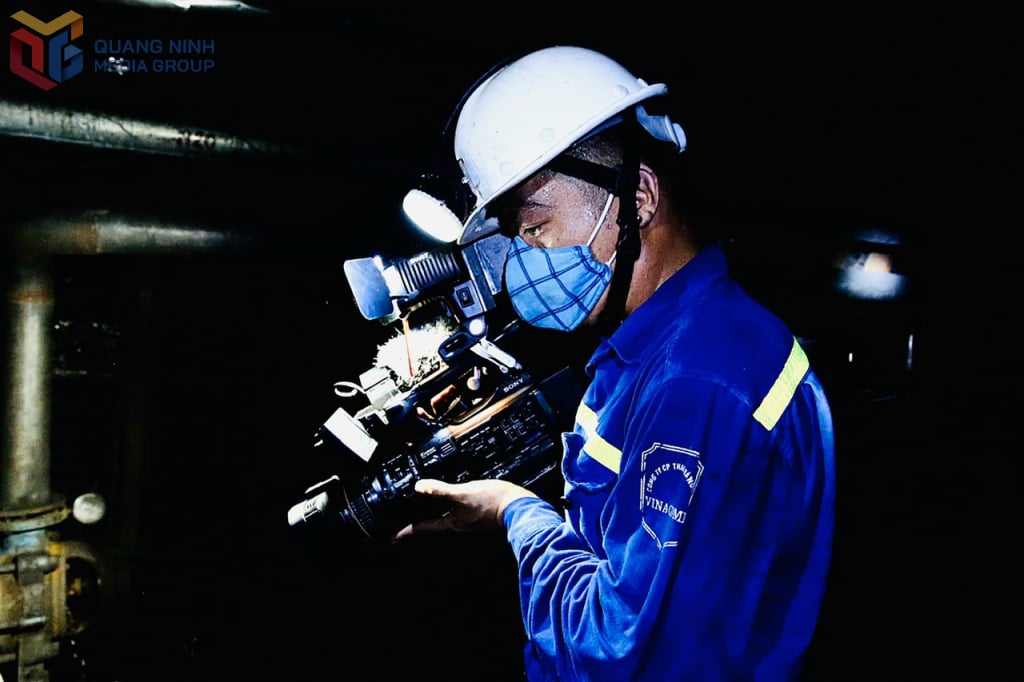
Reporter Thanh Hai, from the Special Programs Department of the Quang Ninh Media Center, reporting from the underground Vang Danh mine.
Our generation of journalists today may find it difficult to fully grasp the pulse of the coal mining region during the time when journalist Tran Giang Nam carried his camera to every mine, and we certainly lack the experience of journalist Trong Trung in his moving reports. But we can continue the path they opened with responsible writing, with images brimming with emotion, and with the belief that: Writing about miners is writing about unsung heroes.
Amidst the black coal seams, light shines brightly from every word, every image, every film clip, every radio wave… All combine to form a ceaseless stream of journalistic life. It's not just a symbiosis – it's a lasting love between Quang Ninh journalism and the coal industry, between writers and workers. And we – modern-day journalists – will continue the tradition and immortal spirit of revolutionary journalism, of the "coal journalists," to continue writing timeless stories about the miners, those who are dedicating their strength and intellect every day to keeping the coal flow ever-present…
Hoang Yen
Source: https://baoquangninh.vn/song-hanh-cung-tho-mo-3360251.html

![[Photo] Standing Committee member of the Party Central Committee Tran Cam Tu presents the Decision appointing the Secretary of the Party Committee of the Ho Chi Minh National Academy of Politics.](/_next/image?url=https%3A%2F%2Fvphoto.vietnam.vn%2Fthumb%2F1200x675%2Fvietnam%2Fresource%2FIMAGE%2F2026%2F02%2F02%2F1770039902160_le-cong-bo-bt-hvctqg-11-7880-jpg.webp&w=3840&q=75)


![OCOP during Tet season: [Part 3] Ultra-thin rice paper takes off.](/_next/image?url=https%3A%2F%2Fvphoto.vietnam.vn%2Fthumb%2F402x226%2Fvietnam%2Fresource%2FIMAGE%2F2026%2F01%2F28%2F1769562783429_004-194121_651-081010.jpeg&w=3840&q=75)


Comment (0)