

With its vibrant drum rhythms, powerful movements, and profound spiritual significance, Chhay-Dăm is not just a dance but also a bridge connecting the history, culture, and spirit of unity of the Khmer community.
The Chhay-Dăm drum dance art is considered a cultural "magnet," not only preserving the Khmer national identity but also contributing to enriching Vietnam's cultural heritage.
Since 2014, the Chhay-dăm drum dance (Truong Tay commune, Hoa Thanh town, Tay Ninh province) has been recognized as a National Intangible Cultural Heritage. Recently, the Chhay-Dăm drum performance art of the Khmer people in Tri Ton district and Tinh Bien town, An Giang province, was also inscribed on this list by the Minister of Culture, Sports and Tourism.
The essence of the Chhay-Dăm drum dance
Chhay-dăm drum dance is an art form that was taught to the Khmer people in Vietnam in 1972 by Master Thai Chia Thanh (a Cambodian).
The Chhay-Dăm drum dance is often performed during traditional festivals such as Chôl Chnăm Thmây New Year, Dolta Festival, Ok Om Bok Festival, or other community events. The dance carries historical significance, recreating the image of heroic Khmer warriors, honoring deities, and praying for a bountiful harvest. The vibrant drum sounds, combined with acrobatic movements, stances, and sparring in the style of traditional martial arts, create a unique appeal that captivates viewers.
The Chhay-Dăm drum is the soul of the dance, crafted from a hollowed-out old palm tree trunk, covered with buffalo or python skin on one side, with a smaller tail attached to a metal base. Each performance usually uses 4-6 drums, combined with gongs (Cuôl), cymbals (Chul), and rattles (Krap). The drum rhythm changes flexibly, from fast to slow, created by striking with hands, elbows, heels, or even hitting other people's drums, producing a rustic yet vibrant sound.
The dancers wear drums around their waists, performing decisive, graceful movements, combining acrobatics and martial arts techniques. A unique feature is that the performers must tightly grip the drums to prevent them from touching the floor, ensuring a resounding, uninterrupted sound. The dance can be performed solo, in pairs, or in groups, requiring physical strength, flexibility, and the ability to coordinate rhythm and body movements seamlessly.
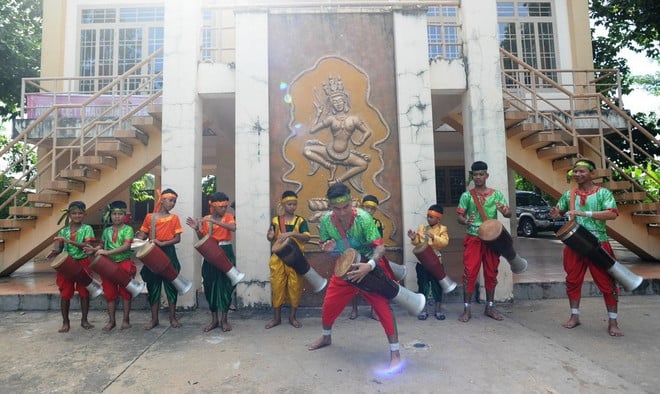
Khmer youth are the inheritors of the Chhay-dăm drum dance. (Photo: Minh Phú/VNA)
The costumes for Chhay-Dam dance are typically sa-banh, a traditional wrap-around fabric used for both men and women. Women combine this with Chang Pong, a wrap-around fabric that covers the chest but exposes the abdomen, allowing for comfort during performances. The costumes are skillfully and securely wrapped, with eye-catching colors, showcasing the distinctive Khmer culture without the need for elaborate facial makeup as in some regions of the Southwest.
A symbol of unity
Chhay-Dăm is not just an art form, but also a symbol of unity and joy. The dance dispels sadness, brings a festive atmosphere, and expresses the optimism and strength of the Khmer community. Stories of warriors, deities, and hopes for a bountiful harvest are told through each drum beat and movement, creating a vibrant cultural tapestry.
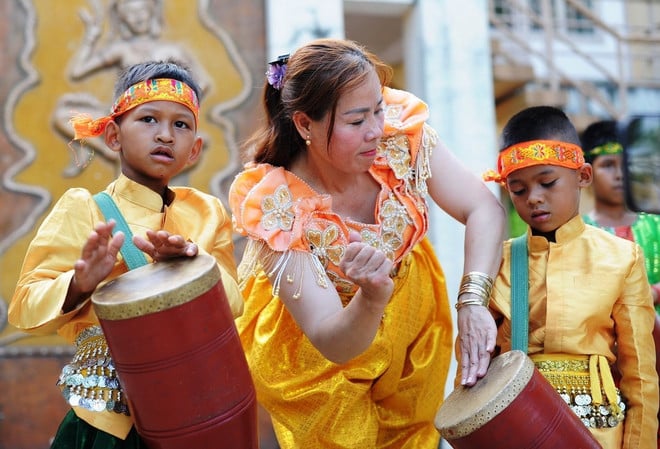
Teaching the Chhay-dăm drum dance to young people. (Photo: Minh Phú/VNA)
In Tay Ninh province , Truong Tay commune is the cradle of Chhay-Dam drum dance, where artisans pass on their skills to the younger generation. Dance troupes, from adults to children, regularly perform at the Khmer ethnic cultural center, preserving the flame of this heritage.
In An Giang , classes are held at Ta Ngao Pagoda (Tinh Bien) and O Lam commune (Tri Ton), attracting a large number of young people.
In addition, Chhay-Dam has been promoted through several major events, helping to bring this heritage closer to the public and boost cultural tourism.
To prevent the risk of the Chhay-Dăm drum performance art form disappearing, the Department of Culture, Sports and Tourism of An Giang province, in coordination with respected religious leaders of the Khmer ethnic community and the authorities of Tri Ton district and Tinh Bien town, has recently organized two classes to teach Chhay-Dăm drum dancing to nearly 50 young people of the Khmer ethnic community.
Speaking at the ceremony announcing the Decision of the Minister of Culture, Sports and Tourism to inscribe the "Chhay-Dăm drum performance art of the Khmer people" in Tri Ton district and Tinh Bien town, An Giang province, into the National Intangible Cultural Heritage list on the evening of June 27th, Mr. Truong Ba Trang, Deputy Director of the Department of Culture, Sports and Tourism of An Giang province, said that to preserve and promote the value of this heritage, the Department requested the People's Committees of Tinh Bien town and Tri Ton district, along with the wards and communes where this type of heritage exists, to have programs and plans for managing, preserving, and promoting the value of the heritage.
At the same time, localities are strengthening cultural performances and exchanges to create opportunities for artisans to participate in practice and performances, improve their skills, and promote creativity; training a team of successor artisans to form professional drum teams to serve temples on festive occasions, enhancing the cultural and spiritual life of the community and villages.
(Vietnam+)
Source: https://www.vietnamplus.vn/suc-hut-tu-di-san-nghe-thuat-dien-tau-trong-chhay-dam-cua-nguoi-khmer-post1046914.vnp


















![[Photo] Prime Minister Pham Minh Chinh holds a phone call with the CEO of Russia's Rosatom Corporation.](/_next/image?url=https%3A%2F%2Fvphoto.vietnam.vn%2Fthumb%2F1200x675%2Fvietnam%2Fresource%2FIMAGE%2F2025%2F12%2F11%2F1765464552365_dsc-5295-jpg.webp&w=3840&q=75)







































Comment (0)