

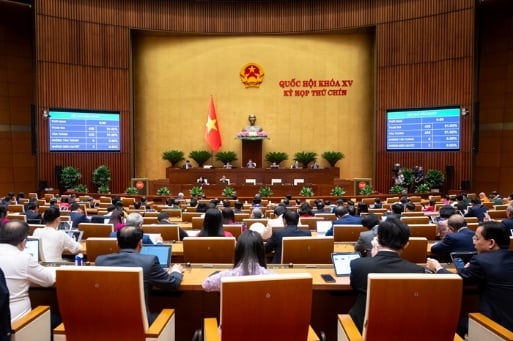
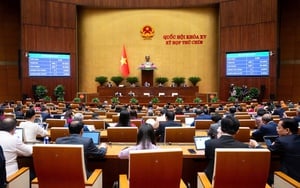
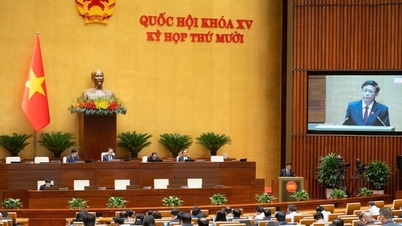
View of voting to pass the Law on Science, Technology and Innovation.
Institutionalize the Party's guidelines and policies and ensure the unity and uniformity of the legal system.
The Law on Science, Technology and Innovation has institutionalized Resolution No. 57-NQ/TW and Resolution No. 68-NQ/TW; inherited the core contents of Resolution No. 193/2025/QH15, and at the same time has more open, strong and innovative regulations.
Accept risks in science, technology and innovation activities and controlled testing of new technologies, processes, products, services and business models
The Law has established the principle of accepting risks in science, technology and innovation activities, associated with appropriate risk management measures and assigned the Government to prescribe criteria for determining acceptable risks, procedures for assessing compliance with procedures and regulations; at the same time, establishing a legal framework for a controlled testing mechanism, ensuring both encouragement of innovation and protection of community interests.
Special mechanism in decoding technology, purchasing technology secrets
To institutionalize this content in Resolution No. 57-NQ/TW, the Law stipulates that the organization in charge of the S&T task is allowed to apply a special mechanism in appointing and paying experts, directly purchasing technology and products at agreed prices to decode technology in developing strategic technology, and purchasing technological know-how.
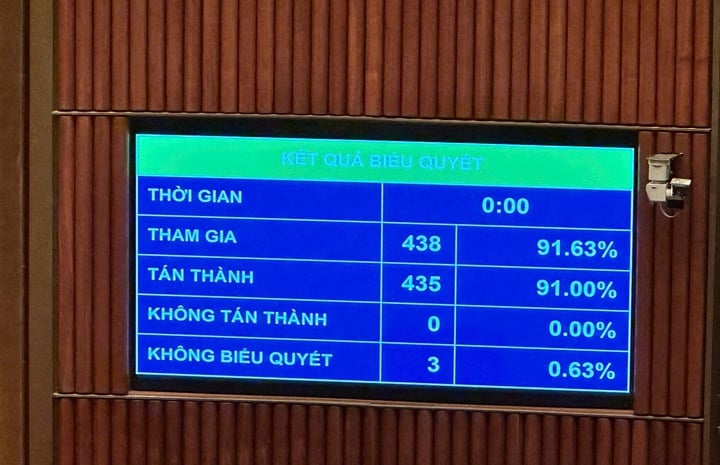
Voting results to pass the Law on Science, Technology and Innovation.
Support businesses to invest in developing strategic technology
Regarding this content, Article 36 of the Law on Science, Technology and Innovation stipulates as follows: (i) Investing in building infrastructure and specialized support services in industrial parks and high-tech parks to attract businesses to invest in building shared experimental and research facilities; (ii) Investing in building facilities and equipment for shared experimental and research facilities to attract businesses to participate in exploitation and operation.
Chief Engineer of Science, Technology and Innovation
Article 53 of the Law stipulates that "Chief Engineer" is an individual with outstanding prestige and capacity, empowered to comprehensively coordinate large-scale strategic science, technology and innovation programs and tasks; has a special mechanism for remuneration and the right to proactively use resources to create conditions to maximize the role of professional leadership in programs and tasks.
Financial mechanism, asset management and research results in science, technology and innovation activities
One of the core contents of the Law is to emphasize the shift from "expenditure management" to "results-based management". Accordingly: (i) Allocate expenditures based on final results, increasing flexibility and autonomy; (ii) Transfer ownership of assets and research results to the host organization immediately upon formation, without refunding the budget, without recording an increase in state capital; (iii) Flexible commercialization of research results, profits are reinvested or used to encourage innovation; (iv) Allocation based on output efficiency; (v) Establish a synchronous financial fund system, accept controlled risks, and flexibly support innovation activities.
- See more
Law on Science, Technology and Innovation: Open testing mechanism, accept risks to break through innovation
Law on Science, Technology and Innovation: Creating a knowledge ecosystem, leading national innovation
Law on Science, Technology and Innovation: Putting businesses at the center, promoting academic freedom and new management thinking
Source: https://mst.gov.vn/luat-khoa-hoc-cong-nghe-va-doi-moi-sang-tao-mo-rong-canh-cua-the-che-cho-doanh-nghiep-va-nha-khoa-hoc-197250628221537557.htm

![[Photo] National Assembly Chairman Tran Thanh Man attends the VinFuture 2025 Award Ceremony](/_next/image?url=https%3A%2F%2Fvphoto.vietnam.vn%2Fthumb%2F1200x675%2Fvietnam%2Fresource%2FIMAGE%2F2025%2F12%2F05%2F1764951162416_2628509768338816493-6995-jpg.webp&w=3840&q=75)


![[Photo] 60th Anniversary of the Founding of the Vietnam Association of Photographic Artists](/_next/image?url=https%3A%2F%2Fvphoto.vietnam.vn%2Fthumb%2F1200x675%2Fvietnam%2Fresource%2FIMAGE%2F2025%2F12%2F05%2F1764935864512_a1-bnd-0841-9740-jpg.webp&w=3840&q=75)


































































Comment (0)