

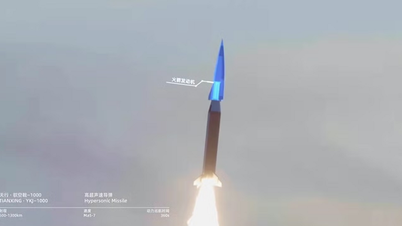
According to Sputnik, Russia's Kh-47M2 Kinzhal hypersonic missile is described by Western media as a dangerous offensive weapon with a flight speed of up to Mach 10 (11,925 km/h) and a range of 3,000 km. However, according to Sputnik, the Kinzhal is not the most powerful offensive missile in the Russian military.
Russia's fastest ballistic missile.
This position belongs to the RS-28 Sarmat intercontinental ballistic missile (ICBM) and the RSM-56 Bulava submarine-launched intercontinental ballistic missile (SLBM), with cruising speeds of Mach 20 (25,500 km/h) and Mach 24 (28,600 km/h) respectively.
Neither Sarmat nor Bulava are hypersonic missiles; they are ballistic missiles that undertake a flight path into space and then deploy their warheads to attack targets from orbit. Nevertheless, Russian ICBMs can still perform maneuvers similar to hypersonic missiles, and theoretically, they are uninterceptable.
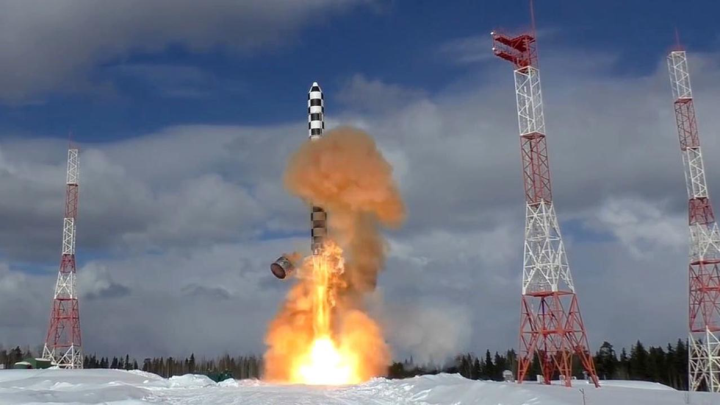
Russia's Sarmat missile surpasses American ICBMs in both range and destructive power.
Of course, realizing Sarmat and Bulava strikes is highly improbable, and they would only be used in real combat situations. The use of an ICBM would almost certainly trigger a nuclear war.
Sputnik's military experts analyze that while speed is good, a missile's speed isn't everything; a slower-flying anti-aircraft missile can still intercept a hypersonic missile if it can predict the target's trajectory.
To overcome this drawback, the Kinzhal hypersonic missile was enhanced with the ability to change its flight path during its supersonic flight. This makes predicting its trajectory and direction more difficult.
The world's fastest attack missile.
Determining the maximum speed of a missile depends on many factors. If we consider the fastest ballistic missiles in the world, this position belongs to the LGM-30 Minuteman ICBM and the UGM-133 Trident II SLBM of the US military, with maximum speeds of Mach 23 (28,200 km/h) and Mach 25 (30,600 km/h) respectively.
Meanwhile, the title of the world's fastest attack missile belongs to Russia's Avangard hypersonic glide vehicle, with a maximum speed of up to Mach 27 (32,200 km/h) when flying near orbit. Avangard's speed gradually decreases to Mach 15-20 upon re-entry into the atmosphere and approaching its target.
The role of hypersonic missiles in the Russian military.
Based on these assessments, Russia is almost at the top or near the top of most rankings for cruise, ballistic, and hypersonic missiles? The simple answer is that the Russian missile manufacturing industry has inherited technological achievements developed by the former Soviet Union.
As early as the 1960s, Soviet scientists began experimenting with hypersonic missile technology. After the collapse of the Soviet Union, Russia's secret hypersonic missile programs continued to receive investment and development to this day.
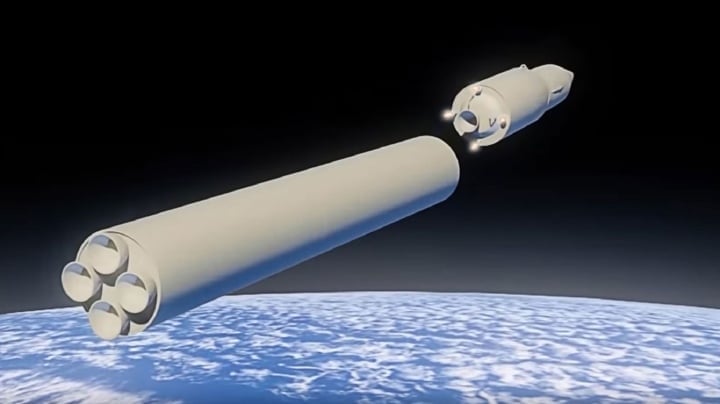
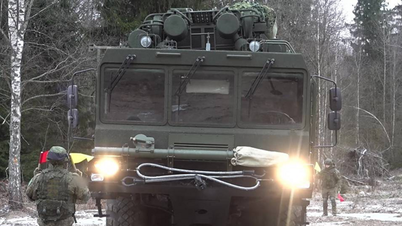
The Avangard hypersonic glide vehicle during testing. (Photo: TASS)
In 2002, after the United States unexpectedly withdrew from the Anti-Ballistic Missile Treaty, Russian President Vladimir Putin ordered an acceleration of existing hypersonic missile projects and the launch of new ones. This move was seen as necessary given the US's continuous expansion of its missile defense system worldwide, which could weaken the deterrent capability of Russia's nuclear forces.
These efforts bore fruit, and in 2020, President Putin announced that Russia possessed an uninterceptable hypersonic weapon system – Avangard. He also asserted that Avangard was not only fast but also accurate and highly destructive.
These upgrades to Russia's missile forces were deemed to be as timely as possible, because at the same time Washington abrogated the ABM Treaty, the Pentagon began implementing its "Global Rapid Strike" strategy – meaning attacking targets anywhere in the world with conventional weapons within an hour.
These missile attacks would target the enemy's political and military leadership, as well as prevent them from retaliating.
Essentially, possessing ultra-high-speed missiles capable of maneuvering, evading missile defense systems, and concealing their ultimate target provides Russia with a kind of missile "shield," allowing Moscow's leadership to sleep soundly at night knowing that the enemy will be caught by surprise.
The prospect of facing an uninterceptable hypersonic missile attack is also one of the reasons why the US has had to change its "Rapid Global Strike" strategy.
Tra Khanh (Source: Sputnik)
Beneficial
Emotion
Creative
Unique
Source

![[Image] National Assembly discusses the implementation of the socio-economic development plan.](https://vphoto.vietnam.vn/thumb/1200x675/vietnam/resource/IMAGE/2026/04/20/1776696707422_ndo_br_img-20260420-185419-jpg.webp)
![[Photo] General Secretary and President To Lam meets with National Assembly delegates from ethnic minorities.](https://vphoto.vietnam.vn/thumb/1200x675/vietnam/resource/IMAGE/2026/04/20/1776696701056_a1-bnd-8331-3342-jpg.webp)































































































Comment (0)