

The Kamov Ka-52 combat helicopter, equipped with the Vitebsk-25 electronic warfare upgrade, is becoming a "nightmare" for man-portable air defense systems (MANPADS) on the Ukrainian battlefield.
Western sources say that Russian Ka-52 Alligator attack helicopter squadrons suffered heavy losses in the early stages of the war, but Moscow appears to have found an "antidote" to counter the FIM-92 Stinger MANPAD missiles that Washington is supplying in large quantities to Kyiv.
According to EurAsian Times , a Russian military helicopter nicknamed "Alligator" set a record by neutralizing 18 MANPADS missiles by jamming their radio frequencies and returning to base unharmed.

The secret to the Ka-52's power lies in its domestically developed electronic air defense system called Vitebsk-25, also known by its export name, the President-S electronic warfare system.
“The Russians will have to find a way to eliminate shoulder-fired surface-to-air missiles if they don’t want to send their entire combat helicopter squadrons underground. The presence of suicide drones and other threats in asymmetric warfare makes combat helicopters increasingly vulnerable,” said an Indian Air Force helicopter pilot who requested anonymity.
Russia deployed the Vitebsk-25 on medium-range fighter jets and landing helicopters during the conflict in Syria, showing impressive results. Defense officials asserted that none of the aircraft equipped with the system were hit by MANPADS missiles fired by terrorists.
The Egyptian Ministry of Defence also conducted rigorous tests with the Ka-52 helicopter equipped with the Vitebsk-25. They fired more than two dozen Igla MANPADS missiles, but none of them hit their targets.
"Nightmare" with shoulder-fired missiles
The Vitebsk-25 electronic warfare system has breathed new life into Russian combat helicopters. The system was first showcased at Eurosatory-2010 in Paris in 2010. However, at the time, experts remained skeptical about the manufacturer's claimed ability to deflect missiles.
One of the system's standout features is its fully automatic operation, allowing it to respond to threats without waiting for pilot decisions. Additionally, the device is highly modular, easily integrating with a wide variety of aircraft types and configurations.
The Vitebsk-25 self-defense system includes infrared missile tracking equipment and laser countermeasures. The laser is used to counter enemy surface-to-air and air-to-air missiles. Additionally, it is connected to a flare launcher.
According to reports, the device can detect and jam threats at an azimuth angle of 120 degrees and an altitude of 60 degrees. Along with infrared threats, the Vitebsk-25 detects and jams radar waves in the 4 gigahertz/GHz range up to 18GHz. The Vitebsk product line includes the L-370E8 system mounted on medium-sized multi-purpose helicopters and the L-370E26L system equipped on heavy propeller aircraft.
The attack helicopters are equipped with L-370P2, L-370V52, and L-370E50 variants. The L-3703S variant features a fixed-wing platform similar to the Su-25 fighter jet.
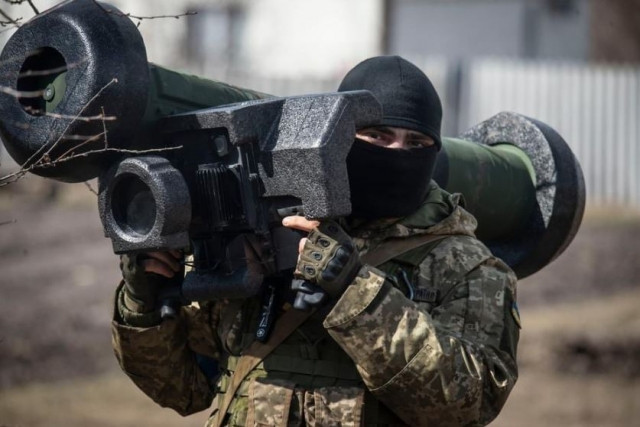
NATO is heavily equipping the Ukrainian armed forces with mobile air defense systems, including at least 2,557 FIM-92 Stinger systems and an unspecified number of Piorun, Sungur, Strela-2, Igla, and RBS-70 missile systems.
The Vitebsk-25 operates on the principle of scanning the entire area using a radar warning receiver, detecting launches by scanning the area with radar and laser warning receivers, as well as IR & UV sensors, and then alerting the crew about them.
In passive defense mode, it activates smoke and flare dispersal to confuse and neutralize missiles. Meanwhile, in active defense mode, the Vitebsk-25 directly interferes with the enemy missile's heat-seeking guidance system and redirects the threat to a decoy target.
Military experts assess that this Russian electronic warfare system has considerable power in countering warheads using radar-guided technology.
(According to EurAsian Times)
Source

![[Photo] Prime Minister Pham Minh Chinh holds a phone call with the CEO of Russia's Rosatom Corporation.](/_next/image?url=https%3A%2F%2Fvphoto.vietnam.vn%2Fthumb%2F1200x675%2Fvietnam%2Fresource%2FIMAGE%2F2025%2F12%2F11%2F1765464552365_dsc-5295-jpg.webp&w=3840&q=75)


![[Photo] Closing Ceremony of the 10th Session of the 15th National Assembly](/_next/image?url=https%3A%2F%2Fvphoto.vietnam.vn%2Fthumb%2F1200x675%2Fvietnam%2Fresource%2FIMAGE%2F2025%2F12%2F11%2F1765448959967_image-1437-jpg.webp&w=3840&q=75)
















































![[OFFICIAL] MISA GROUP ANNOUNCES ITS PIONEERING BRAND POSITIONING IN BUILDING AGENTIC AI FOR BUSINESSES, HOUSEHOLDS, AND THE GOVERNMENT](https://vphoto.vietnam.vn/thumb/402x226/vietnam/resource/IMAGE/2025/12/11/1765444754256_agentic-ai_postfb-scaled.png)












































Comment (0)